
Last Friday, the Sheffield Nablus Twinning Association organised a meeting to report back from the recent trip to Nablus in the West Bank. Julie Pearn, secretary of the Sheffield Nablus Twinning Association and Cllr Angela Argenzio, leader of the Green Group on Sheffield Council, shared their thoughts and experiences. Here is my video of the evening.
Here are some of the most important comments.
Julie On twinning with Nablus.
I think that there is something very special to be gained from the opportunities to develop deep and lasting relationships, which can be quite personal, but certainly are about people sharing common interests. So they can be organisation-to-organisation links. They can be about cultural links or also the question of having civic and official links between two cities. I feel personally that it’s quite clear that many of our politicians in Sheffield need a great deal of educating. They need educating about the actual experiences of Palestinians. They need educating about the value of having connections, so many of us feel deeply connected with. So, also, it’s very important, I think, in order for some of us to be able to develop our work, the sort of work that we’d like to do in schools, for example — that we do persuade our leaders to endorse and officially take some kind of leadership position that will encourage our citizens in the city to engage in really constructive or comradely work based on equality and respect, and in a view that we really want to work for justice, for the Palestinians and also, I think, globally… wherever we went, let’s just say that we experienced the most incredible welcome. The fact that we went was something that was absolutely no question; it was hugely important. I think we were the first visitors that there had been in Nablus for quite a long time.
On trauma and hope
Julie said, “Palestinians live with constant pain. They live with the realities of personal losses of family. They live with trauma of fear, the fear of arrest, of incarceration, of death. The awareness that brothers and sisters in Gaza are being slaughtered. These things are a constant sense of trauma, and that also is something that we took very much wherever we went. We feel the personal pain of Palestinians. But despite the increasing cruelty, the increasing relentlessness of the occupation. What I felt because I’ve been before — this was actually my fifth visit, and what I really was very taken by was a very, very strong sense of resolve: the harder and the more cruel the occupation becomes, the more Palestinians find ways of surviving, challenging, creating, and we saw when one of the things that we certainly saw was a lot of strategic leadership. We saw it amongst a lot of women who have always been doing the work. They’ve always been there, really being, in many ways, the mainstay of society, but we saw many women in strong leadership positions, strategising, organising, seeing ways through which I was really, really impressed, and we talked a lot. Our friends and the people we met talked a lot about hope, and that hope is actually based on a sense of greater unity. We might come back to some of these things, but actually a sense that people have got a vision of their future and they’re very, very determined that they are going to achieve it.”
The Democratic choice for Palestinians
Angela said, “When he realised that I was the leader of the Greens in Sheffield, he was praising the Green Party for Zionism is Racism. He said we live it every single day… He said “the democratic choice for Palestinians is between genocide and apartheid.”
Impact of the checkpoints
Angela said, “We were lucky because we weren’t stopped at the checkpoints at all on the way to Nablus. We were told by several sources that the week before, the 10 days previous, it would have been impossible to go into Nablus because it basically was locked down. And in fact, the gates were a theme wherever we went. I have some quotes about the gates. The gates were a problem because they have a huge effect on the economy. Because if people living in the villages around Nablus Nablus is a city, but people obviously come to work or, you know, to do their business in the city, university students travel to go in, to go to university. Teachers travel to go to schools that are outside of Nablus to teach. And the gates came up all the time because people were saying we never know how long it’s going to take us to get close. We never know whether we are going to get there. And that has an effect on employability. So we met quite a few nurses and midwives because we had a few meetings with relevant organisations. And quite a few of them were unemployed because they didn’t live in Nablus itself. Nablus has seven hospitals, and it has the only teaching hospital in Palestine. And yet the level of education is incredibly high… But lots of people with really high qualifications stay unemployed because they cannot keep a job because they can’t turn up to work. So I have just a few things about the gates here. One quote is “the gates are part of our daily life, but we will never normalise them”. “It is a big prison. You cannot plan for the next day. You cannot plan for the next hour.”
Arrests
Julie said, “Our hotel had actually been surrounded by the IDF in the early hours of the morning around about five in the morning; in fact, there had been arrests and people had been taken away.”
IDF Behaviour
“There’s a lot of horrible, constant military bullying. Some of it is actually destroying lives. Some of it is just about wearing people down and humiliating people.”
Nablus is a multi-faith city
Julie commented on a new book. “I think this is the first academic study of this ancient community, the Samaritan community… It’s called the Keepers of the Commandments, and it’s actually a group that follows the Torah, and they say they are the true Israelites, and they are Palestinians, and staunchly so. And therefore there has been a huge effort by the Israelis to kind of incorporate the Samaritans and draw them away and divide them against the other Palestinians on the whole story. But efforts that have been made by the people of Nablus to make sure that the Samaritans are supported, feel included and that they are respected. I think this is the first time that the story has been told in an academic way, reflecting their own narrative, their own experience, and in a way that the Samaritan leader who was there was very, very strong in terms of expressing their Palestinian identity and sense of belonging. Nablus also has a small Christian community. It’s a multi-faith city, and again that is part of the true Palestinian identity.
A message to Sheffield from a refugee camp
Saida Affoueh welcomed the delegation to the refugee camp. She said, “We warmly welcome you as friends from a city whose history was built by the hands of its workers and who struggles for rights and social justice have created a human legacy with which we are proud to connect. Sheffield, a city whose name is bound to industry, labour and the trade union movement, now extends its bridges of friendship to Nablus. In doing so, it affirms that the greatness of cities is measured not only by what their factories produce, but also by the values their communities uphold and their willingness to reach out to others. “
This is one of the things that we found all the time. Palestinians are so outward-looking. They’re so conscious. We have so much to gain from our links of friendship, and it’s hard to express really. I mean, this is also resistance, this refusal to be bowed down, this insistence on at least being free, free in the mind and free in a vision of the future.
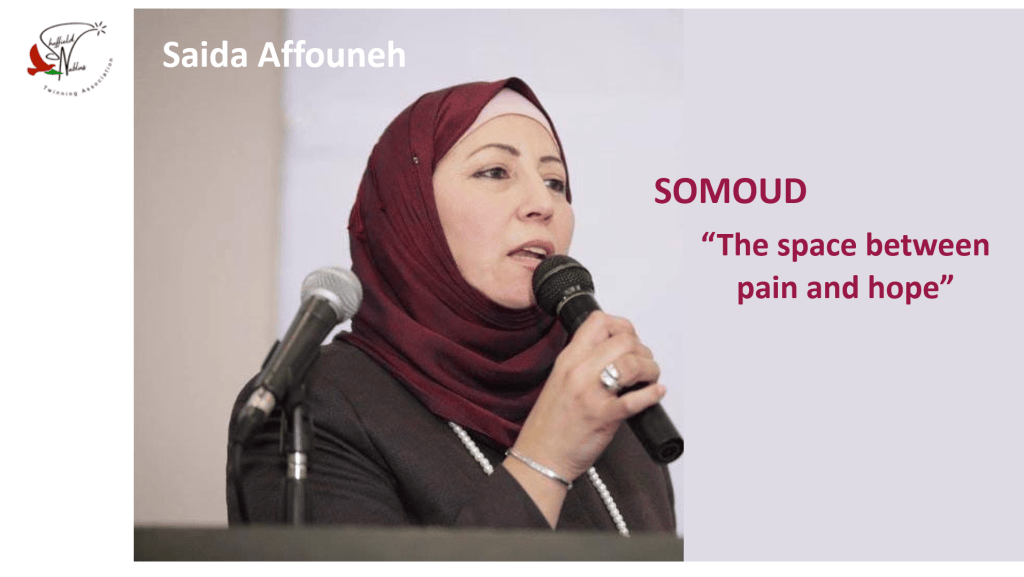
Somoud. The space between pain and hope
“I know that people talk poetry when they are actually expressing very profound levels of pain, but I think she conveyed the extraordinary sense of belief that she has. This is her definition of Somoud, which we saw constantly. She described it as the space between pain and hope.”
We don’t say Good Morning
Angela quoted a resident who said, “We don’t say good morning to each other. We say has anything happened? Are the roads free?”
End the occupation
Martin said, “We had quite an intense Zoom conversation with our comrades in Nablus some months ago, and I specifically asked them about their views on a one-state solution or a two-state solution. And the answer we got was very interesting, which was that no, we want to end the military occupation. And it’s only then that we’ll have the political freedom to discuss our future. And I think that was a very powerful message to me to understand where people are in Palestine at the moment. It’s very difficult to have any freedom to discuss a real, lasting future until the military occupation has to end. It has to end. It’s illegal, it’s brutal, and it’s against international law. It’s got to end in order for politics for Palestinians to have the freedom to discuss their future.
Could you go to Nablus?
Julie said, “I want to say that I want to encourage people to think about going. I will certainly be working from now to organise a visit from Sheffield specifically, and I would encourage people to think about going. We’ve demonstrated that it’s possible. We can certainly talk a lot in advance about how we can increase our chances of successfully getting in. I think it’s very important to go under the radar as much as possible because the objective is to get in. So that’s one thing, just knowing how much our visit meant to the people of Nablus. They couldn’t have made it clearer. It’s really important so we can do it. We have that privilege, and if any of you do want and are in a position to go, I would say you know that’s really strengthened my commitment and my determination to build those connections.”
Twinning
Angela said, ” I will be an advocate for twinning as much as I can, but also we need to find ways of involving particularly anchor organisations in Sheffield to get involved because it cannot just be the twinning association or the council that do the work. I think we need to ensure that other organisations get involved in specific sectors. So for example, if we can talk to the universities to see if we can do some kind of collaboration with the universities there.
Follow Sheffield Nablus Twinning Association on Instagram.
Sheffield Nablus Twinning Association is a member of the Sheffield Palestine Coalition Against Israeli Apartheid, as are Sheffield Green Party and Tell the Truth Sheffield.
