
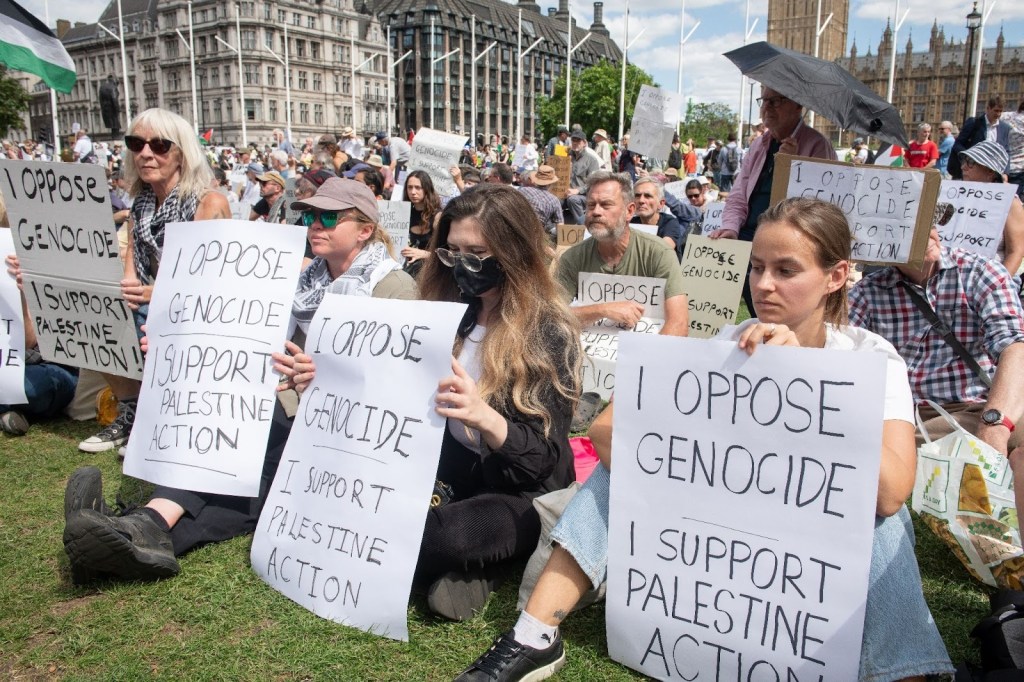
Defend Our Juries has announced the details of its “significant escalation”, with actions in 18 towns and cities across every nation in the UK, in “most widespread mass civil disobedience across the UK in modern British history”
Prisoners for Palestine has also announced a rolling hunger strike which will commence on 2 November after the Home Secretary ignored the demands of people imprisoned without trial
A Judicial Review is “twice as likely to succeed” after government’s failure to block the legal challenge and number of grounds for the case doubled.
A new UN report documents UK government’s complicity in Israel’s genocide in Gaza.
Defend Our Juries and Prisoners For Palestine have jointly announced actions designed to restore fundamental rights in relation to protest and freedom of expression in the UK, in what they say will be “most widespread mass civil disobedience across the UK in modern British history”.
Defend Our Juries announced actions in 18 towns and cities across every nation in the UK, challenging the ‘terror’ ban on Palestine Action ahead of and during the judicial review (25–27 November). Lift The Ban protests will take place in Edinburgh, Cardiff, Oxford, Leeds, Aberystwyth, Nottingham, Northampton, Gloucester and Truro (Tuesday 18 November), London (Thursday 20, Saturday 22, Monday 24, Wednesday 26), Belfast (Saturday 22), Edinburgh, Cardiff, Manchester, Birmingham, Cambridge, Bristol, Sheffield, Exeter and Lancaster (Saturday 29 November).
So far over 2,000 people have been arrested under terrorism legislation including at least 21 from Sheffield, for taking part in these actions in which people sit silently holding handwritten cardboard signs saying “I oppose genocide. I support Palestine Action.” Around 170 of these have so far been charged with section 13 offences under the Terrorism Act 2000, offences which carry a maximum six month prison sentence.
At the Court Of Appeal ruling on 15 October, Palestine Action co-founder Huda Ammori won two more grounds for her Judicial Review at the same time as the government lost their attempt to block the legal challenge of the ban. Defend Our Juries said this made the Judicial Review “twice as likely to succeed” as she now has four grounds on which to appeal rather than two.
Last week the UN issued its draft report Gaza Genocide: A Collective Crime detailing the complicity of states including the UK in the destruction of Gaza. Amongst other things, the UK continued to supply arms including components for F-35 stealth bombers, undertook daily surveillance flights over Gaza for Israel, maintained normal trade relations, and allowed Israel to undertake international crimes with impunity.
Watch the Press Conference
A spokesperson for Defend Our Juries said:
“Today, we’re announcing a significant escalation. This is set to be the most widespread mass civil disobedience across the UK in modern British history, stretching from city centres to small towns across the country, in open defiance of this authoritarian and unjust ban.
“These historic mobilisations will honour those already imprisoned for risking everything to disrupt the flow of arms to Israel and stands in unwavering solidarity with them.
“As the latest UN report makes devastatingly clear, both Conservative and Labour governments have been shamefully complicit in the horrors unfolding in Gaza. The use of counter-terror legislation to silence and criminalise people acting to save lives and expose the UK Government’s violations of international law must end now. The Filton 24 and Brize Norton 5 must be granted immediate bail and full access to the evidence they need to defend themselves.
“Our movement to defy this draconian ban is growing by the thousands and we will not stop until it is overturned.”
Different nations, different responses
The action in Belfast Saturday on 22nd November will be the first Lift The Ban action in the city. There have been regular independently-organised sign-holding actions in Derry but no arrests or charges have been brought to date in the north of Ireland. Legal experts say that Police Service Northern Ireland (PSNI) need the proscription “like a hole in the head” and suspect that PSNI were not consulted on the proscription by the Home Secretary.
Police Scotland have similarly made no arrests at Lift The Ban actions in Edinburgh, although they have subsequently arrested and charged a seemingly random ten people from the 85 who took action in September. The Scottish Counter-Terrorism Board CONTEST has concluded that Palestine Action “has not been close to meeting the statutory definition of terrorism.” Earlier this month former diplomat Craig Murray filed a legal challenge against the ban in Scotland meaning there is the potential for a constitutional crisis if Scottish and English courts reach different decisions.
In Cardiff, Welsh police took an alarmingly extreme approach back in July arresting sign-holding sitters originally under section 12 of the Terrorism Act 2000 (maximum penalty of 14 years in prison) and holding them in custody while raiding their houses. The same sitters were subsequently charged with lesser section 13 offences (maximum penalty of six months in prison).
PRISONERS PREPARE TO HUNGER-STRIKE ON 2ND NOVEMBER AFTER APPEAL TO BRITISH GOVERNMENT IS IGNORED
Prisoners for Palestine are today announcing that prisoners held in British jails without trial will go ahead with a rolling hunger strike on 2nd November after the Home Secretary failed to respond to their demands including immediate bail, access to documents necessary for the right to a fair trial and the de-proscription of Palestine Action.
The prisoners are part of the Filton 24 and Brize Norton 5 who are alleged to have taken part in actions in the name of Palestine Action designed to save lives by degrading weapons and machinery facilitating Israel’s genocide in Gaza.
The Crown Prosecution Service claims there is a “terrorism connection” to the alleged offences even though no charges have been brought under the Terrorism Act and the actions took place before Palestine Action was proscribed by the government.
Francesca Nadin, spokesperson for Prisoners for Palestine said:
“It’s no great surprise that the government has ignored the prisoners’ demands, this is simply a continuation of the corruption and violence enacted by the British state – not only upon the prisoners, but most importantly on the Palestinian people. It seems that they believe that they can act against the wishes of the people, but we are here to tell them otherwise. The prisoners lead the way with their resolve and moral clarity and we must heed their call. We are here today with Defend Our Juries to show the British state that we will not be intimidated into silence, on the contrary, we are fighting for the same cause and will continue to escalate. For justice, for freedom, to stop the genocide in Palestine.”
T Hoxa, one of the Filton 24 who ended a 28-day hunger strike on 7 September after winning most her demands, said:
“For me, the hunger strike is about autonomy. Your body is one way you can fight against the system, because in every other way they’ve taken everything from you. They lock you up when they want, give you red warnings just because they’ve got that power. So, for me, hunger strike is a very important and necessary tool, and the notion that this is one area they can’t control gives me strength.”
Dr Asim Qureshi, Research Director at CAGE International, who are negotiating partners for the hunger strikers alongside Prisoners for Palestine, said
“This hunger strike will be the first of its kind in at least two decades. It brings into sharp focus the violence of the carceral system in the UK, a violence we often associate with places afar. From Guantánamo to Gaza, the infrastructure of authoritarian terror laws built to imprison, silence, and suppress action for Palestine and voices challenging wars and genocide must be dismantled. Prisoners are the beating heart of our movement for justice. We must honour their sacrifices and stand up to challenge the injustices they face.”
BACKGROUND TO THE HUNGER STRIKE
The hunger-strikers are members of Prisoners for Palestine, which include the Filton 24 and Brize Norton 5. With some of these prisoners now having spent over a year in custody without trial and with their treatment having deteriorated following the proscription of Palestine Action, they feel they have no option but to go on hunger-strike to fight for fairer treatment.
The prisoners will start their hunger strike on 2nd November, Balfour Day, the anniversary of the Balfour Declaration, and just two weeks before the start of the first of the three Filton 24 trials. The hunger-strike aims to highlight the conditions of the prisoners’ incarceration, and set out a series of demands to the British government. These demands include the right to a fair trial, release on bail, and the dropping of all terror-related charges.
The Filton 24 are alleged to have been involved in an action on the Research, Development, and Manufacturing Hub of Israel’s biggest weapons maker Elbit Systems, located at Filton, Bristol. In the action, which took place in August 2024, a group of activists drove a modified prison van through the facility’s perimeter fence, and on through the shuttered entrance. Six activists then entered the building, and began dismantling production machinery, as well as Elbit-produced quadcopter drones, which have been used throughout the Gaza Genocide.
The six activists were arrested at the site, but later, while in police custody, they were re-arrested under counter-terrorism legislation, which allowed the authorities to extend their detention period. They were later charged with non-terror offences, and remanded in custody.
Over the following months, in a series of dawn raids, a further 18 activists were arrested, often along with family members, who were later released. The police again used counter-terror laws, and while they have never been charged with terrorist offences, the prosecution have alleged a ‘terrorism connection’. All have been denied bail, and been subject to various abuses by the prison authorities. The treatment of the Filton 24 has been widely condemned, not least by the United Nations.
In June of this year, activists entered RAF Brize Norton, and sprayed blood-red paint on 2 Voyager aircraft leased by the RAF. Brize Norton has served as a transport and re-fuelling hub for flights to RAF Akrotiri in Cyprus, from where daily flights have been dispatched to spy over Gaza. The Brize Norton action was cited by former Home Secretary, Yvette Cooper, in proscribing Palestine Action as a supposed terrorist group, though in fact evidence shows proscription had been planned for some time previously. Five people have been remanded in custody in relation to Brize Norton, with the police following a similar modus operandi to the Filton case.
There are currently 33 prisoners being held on remand in British prisons for Palestine-related actions.
Notes
The 1917 Balfour Declaration was the first time the British Cabinet promised support for a Jewish homeland in Palestine. Although the letter said “nothing shall be done which may prejudice the civil and religious rights of existing non-Jewish communities in Palestine”, the settler-colonial project led to the expulsion of 750,000 Palestinian people by militias in the Nakba of 1948, the genocide and ongoing ethnic cleansing in Gaza from October 2023 and the illegal settlements in the West Bank.
Discover more from Tell the Truth Sheffield
Subscribe to get the latest posts sent to your email.
