
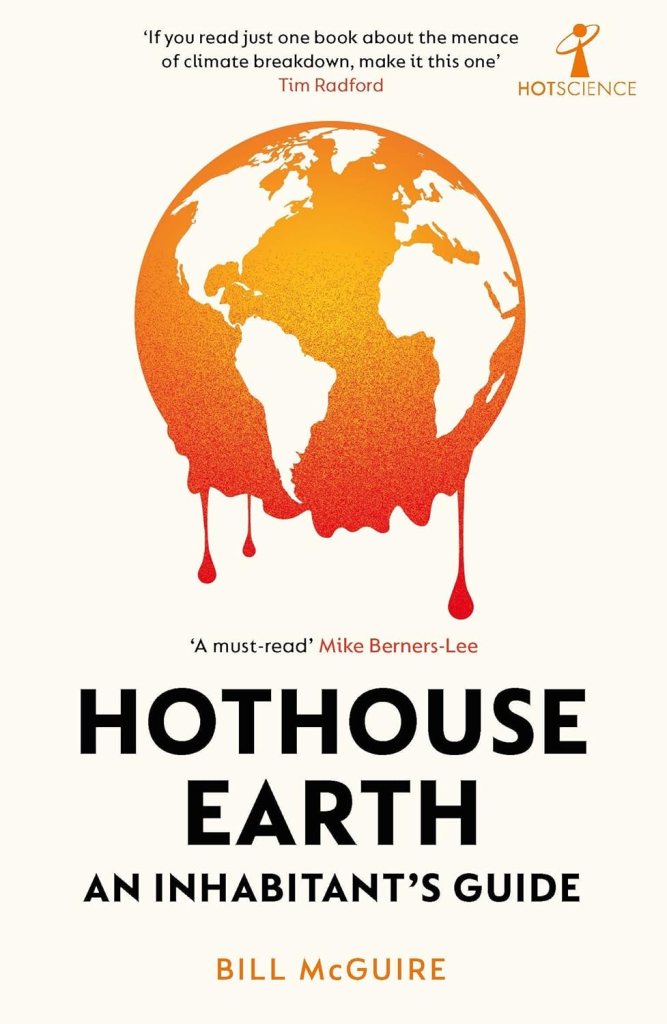
On Monday 7th October climate scientist, vulcanologist and author Bill Mcguire came to speak to a packed meeting hosted by Sheffield Green Party. Bill is an Emeritus Professor of Geophysical & Climate Hazards at University College London and has been in the news recently presenting evidence to courts in trials of Just Stop Oil protesters. He gave a frightening summary of the current science as found in his book Hothouse Earth. Illustrated with many graphs and charts, this was a wake-up call to the immediate action needed to delay the time when our planet could become completely uninhabitable.
Here is the 40-minute talk.
Bill began by explaining that the global average temperature rise of 1.5C means dangerous, all-pervasive climate breakdown and avoiding this is now practically impossible. We must adapt to new conditions at the same time as slashing emissions to stop “dangerous” from becoming “cataclysmic”.
In 2023, the global temperature was 1.54c above the long-term average compared to pre-industrial times. 2023 was the hottest year on record and probably the hottest for the last 125,000 years. In the last 12 months average rise was 1.67C and it reached 2C on a few days last November.
CO2 in the atmosphere has risen from 280 parts per million (ppm) to 420 ppm and despite scientists warning us that this must be reduced we are still emitting over 40 billion tonnes to the atmosphere each year.
Bill explained what he called the scariest graph ever, which shows the Earth’s Energy imbalance. For the last 150,000 years, this has varied between +0.3 and -0.2 watts per square metre. By 1971 this shot up to 0.5 and in the last three years, the graph has gone off the scale up to +1.4 watts per square metre.
Prof McGuire explained that we had had 30 years of COP’s but they had failed to stop CO2 emissions ratcheting up every year. If we continue with current policies we can expect heating of 2.8C by the end of this century, but this does not account for all the tipping points which will be reached during this time so that the actual heating will be much greater. To have any hope of staying at 1.5C we need an almost immediate end to all use of fossil fuels so avoiding a large over-shoot is practically impossible.
Tipping points are elements of the climate system that change rapidly, and once they start to change there is no return. So if the Greenland ice sheet starts to melt in earnest, even if you bring greenhouse gas emissions way down you won’t be able to stop it. We are very close to several tipping points such as the abrupt thawing of permafrost at high latitudes, the collapse of the Greenland ice sheet, the collapse of the Labrador Sea sub-polar gyre (part of the Gulf Stream), and the collapse of the Atlantic Meridional Overturning Circulation. All these are likely to occur within 2C warming. Politicians talk about future plans to suck CO2 from the atmosphere but Prof Mcguire says “It won’t make any bloody difference by then. It’s fine if you don’t mind a 12-metre sea level rise, but when tipping points tip, that’s it, you can’t go back.”
Polar melting is well underway. The Poles are heating 4 to 5 times faster than the planet’s average and they are now melting 6 times faster than they were in the 1980s. 7.5 trillion tonnes of ice were lost between 1992 and 2022. Greenland is shedding 400 billion tonnes (bt) of ice a year. The melting of Antarctica increased 3-fold from 76 bt to 219 bt a year between 2012 and 2017. In an ice-free earth, the sea level would be approximately 60m higher.
Methane (or “Natural Gas”) is 86 times more effective at heating the planet than CO2 over a 20-year period. 1.4 trillion tonnes could be locked up beneath the Arctic permafrost. Sudden ‘burps’ of up to 50 Billion tonnes have been postulated. These would increase atmospheric methane content 12 times almost overnight and bring forward global heating by 30 years. This remains controversial but we have to take the threat seriously.
All of these problems produce a threat multiplier, adding to human misery. Extreme weather events, famine and food insecurity, war and civil unrest, and physical and mental health problems all increase as the situation worsens.
Already 800 million people go to bed hungry. In the 1980s there were around 15 food emergencies a year. This has now doubled. Agricultural productivity has been down 1/5 since 1960 compared to what it would have been without climate breakdown. By 2050 the world will need 50% more food but crop yields could be down 30%. This means that on average we will all have half as much food by then.
If we continue business as usual two-thirds of our glaciers will be gone by 2100; one-third will be gone even if we keep below 1.5C. The Indus, Ganges, Mekong, Yellow and Yangtze Rivers provide water to feed 2 billion people and are all fed by the glaciers. From the 2060s scientists expect rivers will start to fail leading to widespread harvest failures and power losses. Competition for remaining water and energy will inevitably lead to wars.
Accelerating climate breakdown will translate into massive and persistent social and economic shocks. Extreme weather is already significantly impacting crop yields and food supply. The Human Development Index is heading down in 90% of nations, with falling life expectancy and income.
Prof McGuire quoted Alfred Henry Lewis who said “There are only 9 meals between humankind and anarchy.” We can expect the breakdown of society-in fact the Limits to Growth update report of 2022 predicts this could come as soon as 2040.
William Wilberforce said of the slave trade “You may choose to look the other
way but you can never say again that you did not know”.
After some much-needed refreshments, we returned to the hall for a question-and-answer session.
One questioner thought Prof McGuire had been too pessimistic and quoted American politician John Kerry who said that “50% of the solutions to climate change would be found in technology yet to be invented”. He wanted to know what solutions would have the biggest impact. Prof McGuire’s answer was very simple. Keeping fossil fuels in the ground solves 90% of the problem. He poured scorn on John Kerry for relying on as yet uninvented solutions when we clearly know what we have to do, keep fossil fuels in the ground.
Another questioner asked what groups like the Green Party and Extinction Rebellion (who had many members present in the room) should be doing to help keep fossil fuels in the ground. Prof McGuire said that Governments have to start to listen to climate science and take the necessary action. He despaired at the £22m our Government is spending on Cardon Capture and Storage when this is not going to reduce emissions.
There was a question about renewable energy. Prof McGuire re-emphasised that renewables must replace fossil fuels. It is no good expanding renewables if they are not replacing fossil fuels.

A questioner who had travelled from York asked Prof McGuire what he thought about Deep Adaptation. Prof McGuire explained he is already improving his composting and water harvesting and collecting seeds. We need to work together in our local communities to protect each other.
Another questioner talked about the importance of “powering down”, living simpler lifestyles that don’t require so much energy. Prof McGuire said that we have a choice to power down now or be forcibly powered down later by climate chaos. But our current Government are obsessed by Growth and just don’t get this.
To lighten the mood someone asked, “What gets you up in the morning?” It was his kid that needs to get to school! But also “trying to get people to bloody well do something!”
Another questioner asked about how the climate crisis impacts mental health and what helps to reduce climate anxiety. Prof McGuire said the first thing to do is to get involved with a group of like-minded people such as Extinction Rebellion where people will understand and be working together to bring solutions.
Another questioner was encouraged that the Green Party had been doing so well in recent elections and referenced the Arab Spring as an example of where revolutionary change happened. As things get worse people rise up and say we are not having this anymore. She said if she was in the Green Party she would be more optimistic about bringing about change. Another member of the audience urged her to join! Prof McGuire responded that the problem was time. People may rise up, but it will be too late to stop the breakdown of the climate. We can stop it becoming cataclysmic if we start slashing emissions immediately, but who thinks that’s going to happen?
Another questioner asked if there were any negative feedback loops that could improve the situation. Prof McGuire said no.
I raised the question what does this mean for the Green Party? I believe the Green Party need to stop reassuring people that Green policies have all the answers. Greens have by far the best policies to reduce emissions, but we are already at a point where we are staring climate catastrophe in the face. Rupert Read and the Climate Majority Project are urging the Greens to admit that we have run out of time to avoid overshooting 1.5C. We have to prepare for extremely difficult times ahead, prioritise building communities that grow food, retrofit our housing stock and be as self-reliant as possible. Prof McGuire agreed and emphasised implementing rewilding, permeable surfaces in cities which will help reduce flooding and other policies that will help us get through it.
Discover more from Tell the Truth Sheffield
Subscribe to get the latest posts sent to your email.

4 thoughts on “Climate scientist predicts society could break down by 2040”