
This is the second article in a series. Part 1 here.
Time to read
Last week we started to think about climate anxiety. How does this impact schools and parents?
A survey of 10,000 young people in 10 different countries found climate anxiety to be a very serious problem. 59% were very or extremely worried about climate change. Over 50% felt sad, anxious, angry, powerless, helpless, and guilty. Over 45% said their feelings about climate change negatively affected their daily life and functioning, and many reported a high number of negative thoughts about climate change. Climate anxiety and distress were significantly related to inadequate government response and associated feelings of betrayal.
Schools Climate Education South Yorkshire (SCESY) say that “we can observe an increase in young people’s mental health problems in a society defined by the climate crisis…To feel hopeless and filled with dread over one’s prospective future in today’s society seems only a natural response.”
SCESY offers resources that help reframe this sense of dread and worry, also known as Eco-Anxiety, to Eco-Empathy. This is the idea that these negative feelings can be transformed positively into action and change. Encouraging young people’s empowerment is at the forefront of their approach to tackling Eco-Anxiety.
SCESY believe empowerment can be divided into three parts. First of all, empowerment through education is taught with a positive mindset and the knowledge that education is an important tool for action and a precursor to change. Secondly, demonstrating to students that there is hope and there are solutions; it is important to highlight key inspirational activists and the work they are achieving. Lastly, students must be shown that they have the option to act and participate in a community; they do not have to be alone as they silently watch the degradation of our planet.
Students that know their school/college is taking the climate and nature emergencies seriously and that are able to take part in activities to combat them will be in a much better place than those that don’t. Schools should consider declaring a Climate Emergency.
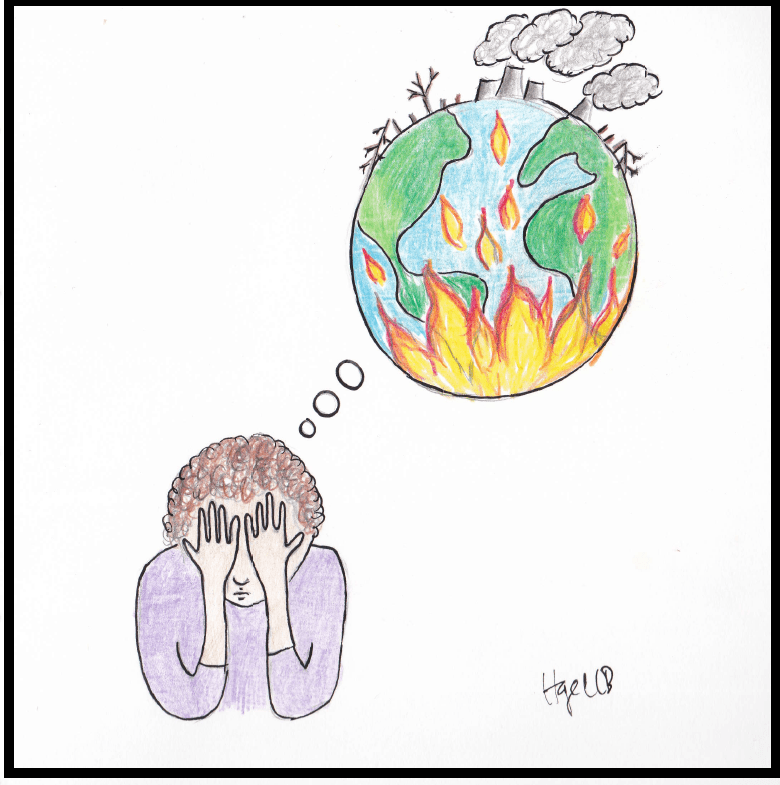
Illustration by Hazel Bober
Climate anxiety is particularly difficult for parents. Emma Pattee explains in Wired how our brains are biologically adapted to get very, very stressed when we sense that our children’s safety is threatened. Instantly after we sense a potential danger, our body draws resources away from functions that aren’t needed for survival (like our digestive system) and puts those resources toward survival functions. Our pupils dilate so we can see more clearly, our heart rate and blood flow increase so we can run faster, and the part of our brain that handles our survival—the amygdala—takes control while the part of our brain responsible for thinking and logic and reasoning—our neocortex —takes the back seat.
If you saw a car accelerating towards your child, all of this would be good. Your brain and body would be primed to pull your child to safety before you were consciously aware of the threat. After the threat, you would eventually return to a regulated state and be able to think clearly again. But if you’re staring at a screen reading a scary article about climate change, or lying in bed at night wondering about your child’s future, this natural stress response isn’t helpful. In her book, Elizabeth Bechard describes her first experiences with climate anxiety as “a flood of anxiety and grief that I couldn’t shake, and couldn’t look away from. Panicked, dread-filled visions of future apocalypse looped on repeat in my mind.” Our biological stress response is also meant to be instantaneous, to help us through a moment in time, not ongoing for days, months, or years. In fact, when we’re in a continuous state of stress arousal, we start to suffer physically and mentally.
If you are struggling with climate anxiety it is important to work out how you can best handle it. First, you need to regulate your nervous system. There are many techniques that can help the body recover after a stress response. Some people use deep abdominal breathing, meditation, visualisation or yoga. Once our bodies are calm we can face our painful emotions about climate change.
Locally Extinction Rebellion is hosting talking groups that may be helpful.
For some, spirituality is helpful. Christian Climate Action has some good resources. Sheffield Quakers have a monthly “Meeting for Worship for Climate”. Green Christian provides a course that helps people share and process feelings related to climate anxiety. It’s over 8 sessions, so time to build up trust and be real – rather than a one-off session. Christian faith is not a pre-requisite, though acceptance that some adhere to Christianity is. It’s called Deep Waters.
How do we talk to children about climate change without terrifying them and traumatising them? Caroline Hickman talks about a conversation with an 8-year-old who was asked this question in the video below. The girl said “Well you’ve got to tell children the truth. If you don’t tell me the truth you are lying to me and if you are lying to me then I can’t trust you and if I can’t trust you I can’t tell you how I feel. So tell me the truth. But don’t tell me all the bad stuff at once. Tell me some good stuff, then some bad stuff, then some good stuff. Anyway, I’m not a baby!” So we must keep it balanced.
It’s important to show children how to navigate their feelings and how to build emotional resilience to take on the world they are inheriting. Listen to them, even if you don’t understand their anxiety, even if you don’t share it, show them respect by listening to them and trying to understand from their perspective.
Monday 24th July: Listening and reflective space
Are you worried about our climate? Feeling overwhelmed as you look to the future? Needing to connect with others who feel the same? You are warmly invited to the first in a series of regular “XR Listening & Reflective Spaces”. This workshop will run in the main Monday meeting slot 6.45-8.00pm and be led by experienced facilitators Sophie McFadyen and Bob Banks using principles from “Active Hope” (Joanna Macey/ Chris Johnstone). All very welcome. Union Street, 18-20 Union Street, Sheffield City Centre, S1 2JP
How can parents and schools deal with Climate Anxiety?
Tweet
Discover more from Tell the Truth Sheffield
Subscribe to get the latest posts sent to your email.

One thought on “How can parents and schools deal with Climate Anxiety?”