
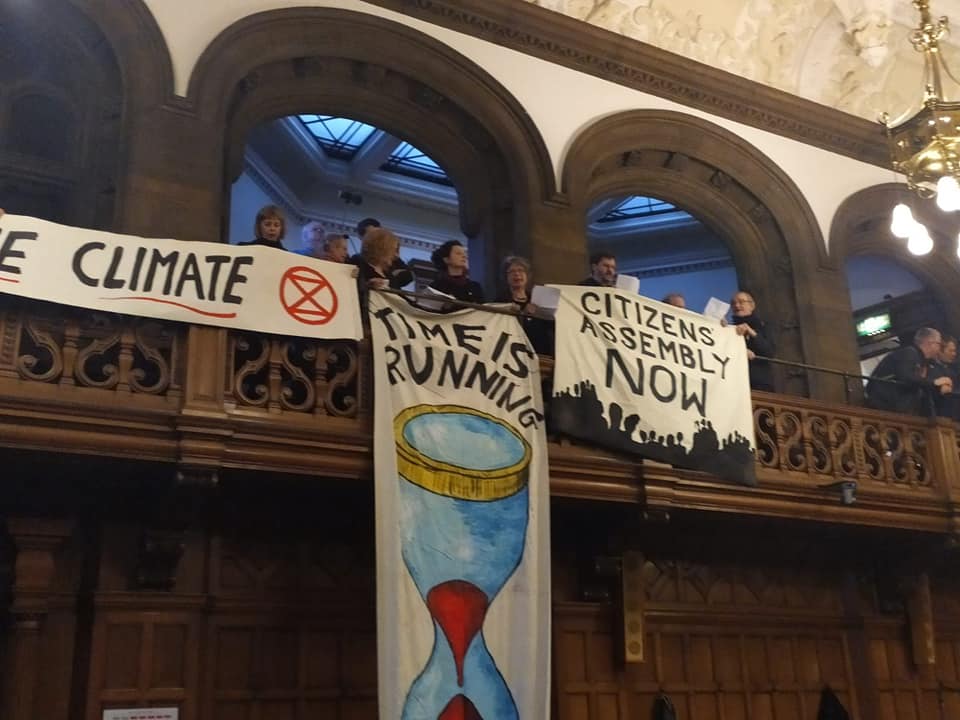
I have recently been working with a group of climate activists from various organisations to ask questions of Sheffield City Council to see how they are progressing in the aim to reach Net Zero emissions by 2030.
The group included
Graham Wroe Tell the Truth Sheffield
Ci Davis Jubilee Movement Sheffield
Sam Wakeling Walkley Living Streets
Dave Baillie Extinction Rebellion
Chris Broome
Zak Viney Green New Deal Rising
Izzy Price Extinction Rebellion
Bob Banks Extinction Rebellion
Heather Hunt Extinction Rebellion
We sent the following questions to all members of the Transport, Regeneration and Climate Committee which is chaired by Cllr Ben Miskell, on Tuesday 23rd January. The final answers were received on March 19th 2024.
Answers are in italics and are colour coded.
Green-positive answer. (but we will still need to make sure they keep their word)
Amber-question partially answered or some progress being made
Red-Negative answer or no real progress planned
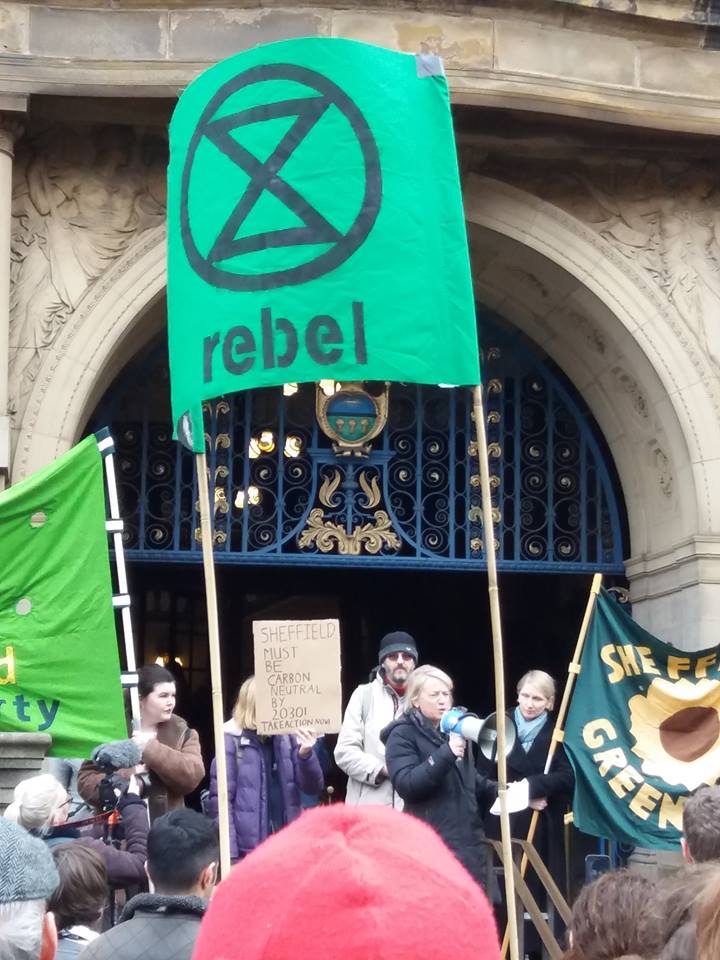
The full council meeting was on Wednesday February 7th at 2pm. Extinction Rebellion, South Yorkshire Climate Alliance and others rallied outside the Town Hall at 1pm.
Contents (click the link to go straight to that chapter)
- 1. Council Communications about the Climate and Nature Emergencies
- 2. Degrowth or Post-growth strategies
- 3.a.Transport
- 3.b. Governance and Finance
- 3.c. Biodiversity
- 3.d. Engagement
- 3.e. Building and Heating
- 3.f. Planning and Land Use
- 3.g. Waste Reduction and Food
- 4. Decarbonisation Routemaps
- 5.Resilience to extreme weather
Here are the questions and answers
1. Council Communications about the Climate and Nature Emergencies
1. In 2019 when the Council declared a Climate Emergency we asked you to prioritise Climate Information and Action in Council Communications. For instance, we wanted Climate Action to be clearly visible to any casual visitor of the Council Website and we wanted the Council Leader to use the annual Council Tax letter as an opportunity to educate the public about the dangers the planetary crises such as the climate and nature emergencies present us with and what the Council is doing to mitigate them. There is still no link from the front page of the website to information about climate change, and the Council Tax letter usually contains half a sentence referring to Climate Change. The page about Net Zero still links prominently to COP26 events so obviously hasn’t been updated for 2 years. This is not acting as if there is an emergency. When will the Council start to do this?
Council response
Our webpages are updated when capacity permits. The most recent update was February 2024 (and the updates before that January 2024 and December 2023), and further updates are imminent to include our bimonthly newsletter which is sent to over 5000 recipients. We encourage anyone who is interested to sign up to receive the newsletters and to encourage others to do so here by signing up to Environment News https://public.govdelivery.com/accounts/UKsheffield/subscriber/new. Climate change is usually included in the annual council tax letter, but there are no current plans to use this as an education tool.
This question was also asked at Full Council on 7th Feb 2024
I am very unhappy with this answer. These are two obvious things the Council should and could do.
2. Degrowth or Post-growth strategies
2i. Will the council prioritise emissions reduction over economic growth in 2024? Degrowth or post-growth strategies should be used to create well-being in Sheffield. The EU Degrowth Summit took place last year and Sheffield needs to learn lessons from this. Will the Council organise a local conference on Degrowth for Councillors, Business leaders, trade unionists, academics and members of the public?
A slightly different version of this question was asked at Full Council on the 7th Feb 2024. See video below.
ii. The Council appears to believe that increasing economic growth is compatible with reducing emissions to net zero. How is this scientifically justified?
Cllr Miskell appears to be talking on behalf of the Labour Party here, rather than the Committee. He says he is pro-growth and the Council wouldn’t consider hosting a conference that is “anti-growth”. (Anti-growth wasn’t mentioned in the question.) Cllr Miskell did not answer either of the first two parts of the question. They were asking for the strategic assumptions that would be pursued by SCC to achieve the necessary emissions reduction while pursuing growth. Someone please send Cllr Miskell a copy of Jason Hickel’s Less is More . Very ironic answer on the same day as Labour’s £28m Green Investment plans were scrapped. We did get a clear answer that the Council won’t organise such a conference. Hopefully this might be something SYCA can help with as I feel there is lots of interest in it.
The Council Climate Action Scorecards rank Sheffield 49th out of 180 so it is clear some good progress has been made. Sheffield Council scored an average of 42% compared to the national average of 36%. On some areas though Sheffield lags behind other Councils and it is very clear that all Councils need to treat global heating as an emergency.
3.a.Transport
3a. Sheffield City Council only scores 21% for Transport. (National average 22%) What will the Council do this year to improve this score?
i. What proportion of the Council fleet of vehicles are electric? How much will this improve this year?
We have 72 electric vehicles and 23 hybrid vehicles in our fleet, and 48 EV chargers within council depots. There are currently 6 electric vehicles on order to be delivered in 2024, with more being considered against service and operational requirements.
Notes-the question asked for the proportion of vehicles, not the number.
ii. Do the Council have plans to set up any of the following this year?
Community car clubs, Car clubs provided by private companies, Hiring of council vehicles when not in use, Bike share scheme, E-bike or cargo bike share scheme, E-scooter scheme, Mobility Devices Hire, Wheels 2 Work scheme
Council response
We have set out the actions that the council has committed to take between now and 2025 to encourage the uptake of decarbonisation vehicles in The Way We Travel Routemap (p46). Beyond these, we continue to identify further actions we can take, and take advantage of funding opportunities, to deliver further projects. Seeking further response from Transport service.
iii. How many year-round School Streets schemes now operate in Sheffield? How many new schemes do you plan to introduce this year?
Council response
There are currently 13 operational school street is Sheffield. 10 permanent and 3 ongoing trials (including the recently launched Astrea). We have one planned to launch in March. We plan to introduce between 3 & 6 new schemes this financial year (April 24 – March 25). All locations and circumstances are different, schemes in some areas take much longer to implement than others, hence the variation in figures.
iv. In what year will 20mph speed limits be introduced to all residential areas of Sheffield? How many new 20mph schemes will be introduced in 2024?
Council response
We have already applied 20mph speed limits in a number of areas within the city. We continue to consider where future 20mph schemes could go by looking at local accident reports and whether the work can happen at the same time as the Streets Ahead road development programme, as well as consulting with local residents to ensure that any such scheme is suitable for the specific community rather than taking a generic approach across the city. Seeking further response from Transport service.
v. What steps will be taken to educate local communities about poor air quality and the dangers of emissions from traffic in 2024?
Council response
Sheffield City Council currently educate the impact of Air Quality through a number of different approaches. We currently provide information and on a number of council webpages, providing material over a number of different sectors from wood burning to educational materials for children. Furthermore, we engage with school children through our School Streets / Mode Shift Stars engagement program, highlighting the benefits of transport selection.
vi. What steps will be taken this year to improve Active Travel? When choosing Low Traffic Neighbourhoods, these need community buy-in, so should come about through community assemblies.
Council response
We have set out the actions that the council has committed to take between now and 2025 to increase active travel in The Way We Travel Routemap (p39-40). Seeking further response from Transport service.
Note-Committment to improving road safety on Ecclesall Road in 2024 in the routemap.
vii. How many controlled parking zones will be introduced in 2024?
The Council will be introducing one area wide parking scheme (in Kelham and Neepsend), details of the scheme can be found here New parking zones | Sheffield City Council. This will be the only scheme to be implemented in 2024 that will be similar to the existing controlled parking zones around the edge of the City centre, including Highfield and Broomhall (replied March 19th)
viii. What percentage of Sheffield buses are currently low-emission? How much will this improve this year?
While the council is not the Transport Authority for Sheffield, we work with the South Yorkshire Mayoral Combined Authority (SYMCA) to deliver improvements to our public transport system, primarily journey time reliability and accessibility at bus stops. Bus operators are increasingly positive about bringing e-buses to Sheffield (topographical challenges). These are considerably more expensive than diesel buses currently but there is some government assistance with that through a fund called the ZEBRA which SYMCA can bid for. It had some success with a bid in ZEBRA1 and that will support a small number of e-buses to run the City Connect service, to start this year. SYMCA has also bid into ZEBRA2 – outcome to be announced later in the year. More information about the transition to ultra low carbon vehicles in public transport in Sheffield can be found on their website, or by contacting them directly. Beyond this, we have set out the actions that the council has committed to take to improve and increase the use of public transport between now and 2025 in The Way We Travel Routemap (p46)
ix. What steps will be taken this year to make bus travel more attractive to the public?
This question was asked at Full Council on 7th February
Trams are to be taken back into public control in March. Mayor planning franchising for buses. Bid submitted to government for 65 electric buses.
x. Will the Council introduce a Workplace Parking Levy in 2024? This has been very successful in Nottingham, raising money to improve public transport and active travel.
In the Transport Strategy 2019-2035 and The Way We Travel routemap, we have committed to investigate the suitability of various types of parking tariffs and what that could potentially look like in Sheffield specifically. No decision for or against such a scheme could be made until feasibility has been thoroughly investgated, alternative options considered, and extensive public consultion has been undertaken.
On 7th Feb 2024 the Council passed this motion that includes (o) ask the Transport, Regeneration and Climate Policy Committee to consider adding to its work programme, implementation of a workplace parking levy to leverage funding for active and public transport at comparable levels to Nottingham City Council, who raised around £680 million over 10 years;
xii. How will the Council support the expansion of electric vehicle chargers? How many chargers do we currently have, and how many will be added this year?
We set out the actions that the council has committed to take to improve and support the expansion of EV uptake between now and 2025 in The Way We Travel Routemap (p42). The Council’s approach to supporting the expansion of electric vehicle chargers was also included in a report prior to this which came to Committee in September 22 (Item 9, Electric Vehicle Public Charging Infrastructure Update and Short Term Action Plan): Agenda for Transport, Regeneration and Climate Policy Committee on Wednesday 21 September 2022, 2.00 pm | Sheffield City Council. SCC is currently supporting the development of the South Yorkshire Electric Vehicle Infrastructure Strategy, which is anticipated in early 2024, and an application for Local Electric Vehicle Infrastructure Fund funding, via South Yorkshire Mayoral Combined Authority, as well as continuing to roll out a programme of publicly available electric vehicle charging points, with the first residential charge points expected in the coming months. Official statistics published by the Department for Transport (Electric vehicle charging device statistics: January 2024 – GOV.UK (www.gov.uk)) show that there were 240 publicly available electric charging devices across Sheffield in January 2024. Sheffield City Council has to date installed 29 Rapid (50kW/22kW) chargers and 50 standard 7kW charging points. There are proposals for an additional 22 standard (7kW) chargepoints to be installed this year by Sheffield City Council.
xiii. Will the Council agree not to support any plans with a high-carbon cost in 2024, such as the expansion of the road network?
We undertake Climate Impact Assessments (CIAs) on all decisions valued over £500k or affecting more than one ward, at every stage of development to ensure that climate impacts of any such delivery and possible mitigation actions are considered and explored. Officers are also encouraged to consider climate impacts of lesser decisions. We do not take a generic approach that rules out all high-carbon activity, as there are a number of other factors and council priorities that must be considered on an scheme-by-scheme basis, and such impacts may become more balanced with suitable mitigation, adaptation and the realisation of other key benefits to the community.
xiv. NO2 pollution is a big problem. What percentage of Sheffield has Lower-layer Super Output Areas above the World Health Organisation (WHO) NO2 guidelines? How will this be improved in 2024?
According to national government data, Sheffield City Council is estimated to exceed WHO 2021 guidelines for NO2 (10µg/m3) in 71.3% (246 of 345) of the Lower-layer Super Output Areas. Sheffield’s local monitoring sites, which are used to discharge our Local Air Quality Management Duties, are estimated to exceed the WHO Guidelines at all but 2 of our sites (220 sites). Furthermore, in order to comply with legal thresholds, Sheffield City Council is in the process of reviewing / refreshing our policy documents to reflect future needs of the district. The current Action Plan is available on the council’s website and a new one is planned to be developed to reflect the changing landscape post pandemic and CAZ implementation.
xv. PM2.5 pollution is also significant. What percentage of Sheffield has Lower-layer Super Output Areas above the World Health Organisation (WHO) PM 2.5 guidelines? How will this be improved this year?
According to national government data, Sheffield City Council is estimated to exceed WHO 2021 guidelines for PM2.5 (5µg/m3) in 100% (345 of 345) of the Lower-layer Super Output Areas. Sheffield’s local monitoring sites, which are used to discharge our Local Air Quality Management Duties, are estimated to exceed the WHO Guidelines at all of our sites (9 sites). Furthermore, in order to comply with legal thresholds, Sheffield City Council is in the process of reviewing / refreshing our policy documents to reflect future needs of the district. The current Action Plan is available on the council’s website and a new one is planned to be developed to reflect the changing landscape post pandemic and CAZ implementation.
xvi, Given that the 2019 Transport Strategy said the change is: “not likely to be a question of just more ambition for cycling, cheap bus fares or tram extensions – rather, we anticipate the Climate Emergency is likely to fundamentally challenge, in short order, the degree to which we can facilitate travel as we have become accustomed to.” (P49) and the Arup report relied on a 66% reduction in car use share before 2030 (and since the 2023 transport climate route map does not include any such target), what scale of car use reduction is SCC now planning for?
While the ARUP report does advise a 66% reduction in car use may be required to meet our net zero target, this is not adopted as a formal target by the council.
It is important to say that the scale of reduction in car use that might be needed to achieve net zero is dependent on the mix of different measures that are used to decarbonise the whole transport system, through conversion to ultra-low emission vehicles and the provision of safe and accessible alternative travel options such as active travel and public transport. We are also busy improving EV charging infrastructure in the city and I was pleased to visit one of these schemes Woodhouse with Cllr Rooney last week.
A number of strategic activities around transport are currently in progress that relate to Transport targets and priorities. I am particularly looking forward to launching our new Sheffield Transport Vision in March, which will go into detail about many of the points that you have raised today.
Although there are some positive aims in the answer it is clear that SCC has no targets to reduce car travel.
3.b. Governance and Finance
3b. Sheffield City Council scores 24% for Governance and Finance. (National average 27%) What will the Council do this year to improve this score?
i. Will the Council’s medium-term financial plan include the council’s net zero target and make tackling the climate emergency one of its main priorities in 2024?
The new ‘Council Plan’ sets out the priorities for the Council, which are all underpinned by three drivers. These are People. Prosperity and Planet. Under the driver of Planet, the Plan sets out clear ambitions of working toward net zero in the medium term. This Plan will be used to drive the budget process in the coming years and will therefore also focus the resources needed to support this ambition. For example Outcome 5 (City on the Move) highlights this commitment.
ii. Will the Council publish a climate change risk register in 2024? Sheffielders need to know about the increased risk of flooding and other extreme weather events to their homes and workplaces.
Plans for responding to extreme weather events, like other emergency situations are lead by the Emergency Planning Shared Service, which is a joint service between Rotherham and Sheffield. There is an extreme weather plan which the EPSS team put together based on the national plans and guidance.
The Service works with the emergency services and other responders to make sure Sheffield is fully prepared for every eventuality as part of the South Yorkshire Local Resilience Forum. They write plans on how the Council would response to emergencies and incidents.
The webpage contains details on how communities can prepare for emergencies including winter conditions and signing up to receive flood warnings.
As noted in a previous response, Service areas also have operational plans on how to respond if there is a heatwave and all services will be required to develop a service based climate adaptation risk assessment and action plan during 2024. The Council will consider how this is communicated to residents and businesses as this work develops.
A climate change risk register is not the same as Emergency Planning. It is a risk management tool, which can be used to improve the resilience of an organisation by making a database of its climate related risks. These risks provide the basis upon which you can identify actions required to adapt operational capability, thereby making your organisation more resilient.
iii. Will the Council start reporting its Greenhouse Gas emissions in 2024 using the stated criteria from Climate Emergency UK?
“We will be a leader in the transition to a net zero city and economy, using all the levers available to us to reduce the climate impact of homes, businesses, energy sources and travel to transform our city and benefit from being a modern and sustainable city. We will lead by example, aiming to reduce the council’s net carbon greenhouse gas emissions by 95% by 2030 and working with partners to secure external investment to drive our transition and create new green economic opportunities”
(This does not answer the question asked. Presume the answer is no.)
iv. The Council recently announced it has reduced its emissions by 3% since 2019. To be on track for Net Zero in 2030, what reduction should have been made? How will this reduction be increased in 2024? (The Tyndall report recommendations are for the whole city rather than just the Council. Had these been followed by the Council we should have reduced emissions by between 40- 50% by now).
In answering the question Cllr Miskell failed to give any examples of how emissions will be reduced in 2024 and blamed the Government for the Council’s lack of finance. He certainly has a point about the Government but there are things the Council could be doing now to reduce emissions and they should be getting on with them.
v. Will the Council embed climate action and waste reduction into their procurement policies in 2024?
The actions we are taking to reduce the council emissions between 2023 and 2025 have been outlined in the Our Council decarbonisation routemap. In relation to procurement, you can find the actions on page 27. We also continue to progress and follow-on from the actions set out in the ’10 point plan for climate action’, many of which will need to continue delivery right up to 2030.
To save you looking it up here is the page referred to.

Although this all sounds good, I smell Greenwash. In 2022 Sheffield Council renewed its contract with Barclays, the Bank renowned for supporting the Oil and Gas Industries (and now of course complicit in its support for Israeli Apartheid). How can we trust their other “ethical” procurements?
vi. What percentage of the Council’s staff work on implementing the Climate Action Plan or other climate change projects? Will this be increased in 2024?
The Council doesn’t currently have a way of reporting on this, as climate activity is delivered across the organisation in different ways, for example through Climate Impact Assessments undertaken for a wide range of Committee reports or through Service Planning. This is expected to increase however as Services across the Council will be required to develop a service-based climate adaptation risk assessment and action plan during 2024.
vii. What proportion of senior management and Councillors who chair Commitees have received Climate Awareness training? How will this be improved in 2024?
11 of the 14 committee chairs (78%) and 154 officers (% data and seniority breakdown not readily available – all and exec directors in post in early 2022 received a full day’s training) have received formal training on the climate emergency and our response since 2020 through Sheffield City Council, with many more being involved in conversations and meetings which have covered the issues, as well as other external training sessions – these are not logged. We are currently in the process of developing an online learning package which all employees and councillors will be encouraged to complete.
viii. What proportion of Councillors have received Climate Awareness training? How does this breakdown for each political party? How will this be improved in 2024?
55 of current councillors (64%) have attended climate training sessions.This comprises of 1 Conservative councillor, 12 Green councillors, 23 Labour councillors, 19 Liberal Democrat councillors. Climate awareness training is included in new councillor induction, with all councillors invited to attend to provide refresher training if desired. Online resurces are also available for councillors to engage in self-learning – uptake of these are not monitored. All councillors receive the bimonthly climate newsletter. Councillors will be encouraged to complete the new online module.
This means that the % for each party is as follows. Green 12/14=86% Lab 23/39=59% (this includes Community Councillors) Lib Dem 19/29=66% Con 1/1 = 100% Ind 0/1=0%
ix. Does the Council have plans to raise income for climate action from property development in 2024?
No answer. Friends of the Earth say “Money to fund climate action and nature restoration projects can be brought in via legal and planning mechanisms, such as Section 106 agreements or the Community Infrastructure Levy (CIL). Section 106 agreements are when a local authority approves a development, such as new homes, based on the requirement that the developer also funds other related projects. The CIL is a charge that can be levied on new developments, which can help local authorities to deliver other infrastructure needed in their area. Councils should be using the CIL to fund carbon-cutting projects like active travel infrastructure and new green space, but it’s worth noting that a replacement Infrastructure Levy has been proposed”
x. Will the Council launch a Climate Bond, Community Municipal Investment or equivalent as a way to raise funds for climate action in 2024?
No answer. But they did feature in the Green Party Budget amendment
On Feb 7th 2024 the Council passed this motion which includes (v) ask the Strategy and Resources Policy Committee to consider adding to its work programme as a matter of urgency, investigation of the practicalities of issuing Green Bonds to raise extra funding to support climate action;
xi. Will the Council support the divestment of the council’s pension investments from fossil fuel companies in 2024?
No answer. But googling reveals that the aim is to divest by 2030. This is far too late.
3.c. Biodiversity
3c. Sheffield City Council scores 23% on Biodiversity. (National average 27%) What will the Council do this year to improve this score? Possibilities include
i. Only using peat-free compost or soil in landscaping and horticulture.
We don’t use peat as a planting medium. Unfortunately because we’ve never made this decision public, Climate Emergency UK don’t acknowledge it which is why we didn’t receive a score against this criteria
ii. Ban the use of pesticides on all Council-owned and managed land.
No answer. The Council has committed to gradually reduce its use of Glyphosate but is making slow progress.
iii. Ensure at least two-thirds of the wildlife sites in the city boundary are in positive conservation management.
No answer. Googling found “Through the actions of the Local Wildlife Sites Partnership the total number of Local Sites currently in positive management will be 144 or 45.1% (all LWS) in 2018. This is an increase of 4 (1.2%) on the position at year end of 2016/2017.
iv. Employ a planning ecologist to scruitinise planning reports
The Council already employs a team of ecologists and one of the roles of this team is to scrutinise planning applications and to propose mitigations.
3.d. Engagement
3d. Sheffield City Council scores 47% on Engagement, (National average 54%). With the new Committee system and It’s Our City continuing to press for better engagement it is disappointing this is not higher. How will it improve in 2024?
i. Will SCC produce a Climate Action Plan with SMART targets in 2024?
There are not current intentions to produce a further climate action plan for the council beyond the 7 routemaps and 10 point plan for climate action. However these plans are intended to be iterative, meaning that they will be updated as new evidence becomes available and as delivery progressed and actions developed beyond these will be held in specificstrategies, programme or service level plans. Schemes delivered within our capital programmes are all subject to monitoring and reporting against schedule, budget, delivery, and risks. We are currently reviewing how progress against our 2030 commitment is monitored to identify meaninful key performance indicators and targets, both quantative and qualitative.
The 10 point plan is full of wonderful aspirations but without SMART targets how can we see that the Council are making progress? One target is clear, Net Zero by 2030. It is already obvious that the Council hasn’t got any hope of meeting that target.
ii. Will the Council lobby the Government to enable more climate action in 2024?
No answer. Surely if the Council believes we are in a Climate and Nature Emergency and hasn’t got the resources that it requires to get to Net Zero, a lobby of the Government would be the first thing to do?
iii. Will SCC provide funding for community climate action in 2024?
We are exploring opportunities to support community climate action, including providing support to community energy organisations in the city.
iv. Will SCC ban high-carbon advertising and sponsorship in 2024?
This question was asked at Full Council on 7th Feb 2024
A new policy was passed by the Finance Committee on the 18th March 2024. See https://sheffieldgreenparty.org.uk/2024/03/18/greens-welcome-sheffields-new-forward-looking-advertising-policy/ This is a great achievement for Sheffield Council.
I
3e. Building and Heating
3e. SCC did well on Building and Heating with 67% (National average 49%). There are things to work on however.
i. Which of the significant Council buildings have already been retrofitted to minimise energy use? Which buildings do the Council aim to retrofit in 2024? Which significant buildings still need retrofitting?
We received £1.1m in phase 1 of the Public Sector Decarbonisation Scheme. This financed a range of measures including LED, solar PV, air source heat pumps, building energy management systems at Town Hall, Acres Hill Store and Moor Market. We’re currently at feasibility and design stage for LED and solar PV at 12 council buildings.
ii. What proportion of its electricity does SCC create through energy from waste? Will this be increased in 2024?
The council doesn’t create electricity from efw. The Veolia managed plant does produce electricity but that is exported to the grid rather than fed into any council buildings.
I am looking to find out how much electricity is exported compared to how much is used to see how near the Council is to self-sufficiency.
iii. Can the Council switch provider to either Good Energy, Ecotricity or Green Energy UK in 2024?
No. We procure energy via public procured frameworks compliant with procurement regulations to ensure value for money. Like many public sector bodies, we use Crown Commercial Services. Through the framework our energy is procured up to 3 years ahead of the delivery period and we would be required to give 3 years notice to leave the framework.
iv. What percentage of the council’s homes receive C or above in their Environmental Performance Certificate ratings? Will this be improved in 2024?
The latest 2015 BRE data for Energy Performance Certificate (EPC) ratings for private housing across the city, commissioned in 2022, showed that only 23.4% of private housing is within EPC band A-C, with 25.3% falling into the lowest energy performance band, E-G. In comparison to private tenure housing, 82% of our council homes are within EPC bands A-C, and 18% are within the D-G band. Notably, less than 1% of council stock falls into the E-G rating. We have set out the action we will be taking to improve the energy efficiency of the councils housing between 2023 and 2025 in the Our Council Routemap (p14-15). Beyond these, we continue to identify further actions we can take, and take advantage of funding opportunities, to deliver further projects. The 2024/25 housing delivery plan is due to go to the Housing Committee in March 2024.
This is absolutely vital work. Green Bonds could be used to help finance it. We need to continue to hold the Council to account to make sure this is progressed. The Housing Committee needs lobbying to ensure this is prioritised at the March meeting.
v. What percentage of all homes in the SCC area have an EPC rating C or above? What will the Council do to improve this in 2024?
The latest 2015 BRE data for Energy Performance Certificate (EPC) ratings for private housing across the city, commissioned in 2022, showed that only 23.4% of private housing is within EPC band A-C, with 25.3% falling into the lowest energy performance band, E-G. In comparison to private tenure housing, 82% of our council homes are within EPC bands A-C, and 18% are within the D-G band. Notably, less than 1% of council stock falls into the E-G rating. The 2024/25 housing delivery plan is due to go to the Housing Committee in March 2024. Beyond this, we continue to identify further actions we can take, and take advantage of funding opportunities, to deliver further projects.
vi. Is the council actively enforcing Minimum Energy Efficiency Standards of homes in the private rented sector? How many compliance or enforcement notices were carried out the last financial year 2022/23. Will this improve in 23/24?
Trading Standards have no current active enforcement activity in this area and nil compliance enforcement notices were issued during 2022/23. Our service is intelligence led so individual complaints falling within this remit would receive a response and investigation where applicable. There is a program of work scheduled for 23/24 relating to Tenants Fees Act legislation which may highlight some circumstances of non-compliant MEES in private rented properties. However, resource restrictions mean we are unable to commit to a proactive program of checking all EPCs relating to private rented properties. It is, therefore, unlikely that the current position will change/improve during 23/24.
vii. Will the council start a scheme to allow residents to purchase renewable energy cheaply, through collective buying, such as Solar Together, in 2024?
This is an action within the emerging Energy Generation and Storage Decarbonisation Routemap that will be going to Committee for consideration in March 2024.
viii. Can the Council support Sheffield Renewables to expand its work in 2024? Can the Council learn from the Street Power Station in Walthamstow as a model for fitting solar panels on houses in Sheffield?
We are working with Sheffield Renewables to support them in expanding their work. We will look at the Walthamstow case study, thank you.
ix. What measures will be taken to increase the provision to train people to retrofit houses in 2024?
There is an increasing focus on the use of AEB and other national and regional funding to enhance and support Sheffield’s businesses and people so that they gain advantages and opportunities on the journey to net zero. We accept that Sheffield and the region are at the beginning of this journey and are behind some other combined authorities and cities but specifically Sheffield is currently moving forward in the following areas:
Sheffield College is already using its AEB allocation and other funding streams to deliver courses around electric vehicles, air source heat pump and PV (solar) panel installation meeting PAS 2035 standards. • (A section has been removed here for commercial confidentiality)• The South Yorkshire 23-24 Boot Camp programme had a significant proportion of its delivery dedicated to green skills to help people get into work – specifically around Retrofit • Following the success of this programme, the 24-25 skills bootcamps have increased the allocation dedicated to green skills and the prospectus for 24-25 is currently out to procurement. • Construction Skills People also delivering a Retrofit Academy in the region which includes programmes that are AEB funded, Bootcamp funded and funded through FCFJ (Free Courses For Jobs). • Sheffield Employment and Skills Advisory Board has had a substantive agenda at the 1st February meeting and has agreed an action to co-ordinate and grow activity in this sector.
3f. Planning and Land Use
3f. SCC scored 67% on Planning and Land Use, which was much better than the national average of 35%. There are some things still to work on.
i. Will the council commit to building all future council-owned or managed housing to a high energy efficiency or operationally net-zero standard in 2024?
In the developing Local Plan, due to be adopted in 2024, developments that result in new dwellings or new non-residential buildings will be expected to reduce their regulated carbon emissions by at least 75% from 1 January 2025 and be net zero carbon (in terms of both operational carbon and embodied carbon) from 1 January 2030. In order to achieve this, developments should:
a) adopt a ‘fabric first’ approach, achieving minimised energy demand through the use of efficient services and low carbon heating before maximising potential for onsite renewables; and
b) generate renewable energy and/or provide low carbon heating in accordance with Policies ES2 or ES3; and
c) reuse existing buildings wherever possible; and
d) use sustainable and/or recycled materials wherever possible; and
e) create and restore habitats that absorb carbon, such as wetlands and woodlands wherever possible and in accordance with Policies GS5-GS7 ; and
f) improve soil management to enable better storage of carbon within soils wherever possible
2030 is far too late. We should be doing this now.
ii. A fabric-first approach to building design involves prioritising the building envelope (walls, roofs, floors, windows, and doors) to create a high-performance, energy-efficient building. Will the Council require developers to use a fabric-first approach in new developments in 2024?
We submitted our Draft Sheffield Plan to central government in September 2023 and are currently awaiting it’s independent examination by the Planning Inspectorate. Once approved and adopted, the following Policies relating to your queries will apply: ES1, ES2, ES3, ES4 & CO2. The Policies will require developments to adopt a fabric first approach, but do not set requirements of whole lifecycle carbon assessments, remove minimum parking requirements or set percentages for renewable energy generation. It is highly unlikely that the examination into the Draft Sheffield Plan will have completed by the end of 2024, so the currently adopted policies in the Core Strategy (CS63, CS64, CS65) will still apply.
My translation, yes when the Sheffield Plan is agreed by the Planning Inspectorate!
iii. Will the Council require developers to carry out a whole life cycle carbon assessment of new build developments in 2024?
We submitted our Draft Sheffield Plan to central government in September 2023 and are currently awaiting it’s independent examination by the Planning Inspectorate. Once approved and adopted, the following Policies relating to your queries will apply: ES1, ES2, ES3, ES4 & CO2. The Policies will require developments to adopt a fabric first approach, but do not set requirements of whole lifecycle carbon assessments, remove minimum parking requirements or set percentages for renewable energy generation. It is highly unlikely that the examination into the Draft Sheffield Plan will have completed by the end of 2024, so the currently adopted policies in the Core Strategy (CS63, CS64, CS65) will still apply.
My translation, no.
iv. Will the Council remove minimum parking requirements for new residential homes in 2024?
We submitted our Draft Sheffield Plan to central government in September 2023 and are currently awaiting it’s independent examination by the Planning Inspectorate. Once approved and adopted, the following Policies relating to your queries will apply: ES1, ES2, ES3, ES4 & CO2. The Policies will require developments to adopt a fabric first approach, but do not set requirements of whole lifecycle carbon assessments, remove minimum parking requirements or set percentages for renewable energy generation. It is highly unlikely that the examination into the Draft Sheffield Plan will have completed by the end of 2024, so the currently adopted policies in the Core Strategy (CS63, CS64, CS65) will still apply.
My translation, no.
v. Will the Council require 20%, or above, onsite renewable energy generation for new building development in 2024?
We submitted our Draft Sheffield Plan to central government in September 2023 and are currently awaiting it’s independent examination by the Planning Inspectorate. Once approved and adopted, the following Policies relating to your queries will apply: ES1, ES2, ES3, ES4 & CO2. The Policies will require developments to adopt a fabric first approach, but do not set requirements of whole lifecycle carbon assessments, remove minimum parking requirements or set percentages for renewable energy generation. It is highly unlikely that the examination into the Draft Sheffield Plan will have completed by the end of 2024, so the currently adopted policies in the Core Strategy (CS63, CS64, CS65) will still apply.
My translation, no.
vi. How will the Council work with partners to ensure there is a significant increase in renewable energy, such as solar and wind developments, battery storage, or renewable district heat networks in 2024?
The emerging Energy Generation and Storage routemap that will be considered by Committee in March sets out the partnership working in this area. We’re engaging with community groups and community owned energy, working with Veolia and Eon on heat network expansion plans as well as particiapting in DESNZ programmes on heat network zoning ready for legislation in 2025. We’ll also be commissioning a Local Area Energy Plan in 2024 that will provide the spatial and costed detail on this.
3g. Waste Reduction and Food
3g. SCC scored 44% on Waste Reduction and Food compared to the national average of 37%. There is still room for improvement.
i. How will the Council reduce use of single-use plastics in 2024? Will it
*install water drinking fountains on the council estate/public spaces
*ban plastic cups for water
*reduce plastic packaging
*reduce the use of plastic cutlery (forks, knives, spoons, chopsticks), plates, straws, beverage stirrers, balloon sticks or food and cup containers made of expanded polystyrene; including their covers and lids at their external events.
Council procurement practise must align with national leislation. With single use plastics ban from 1 October 2023, council vendors must no longer supply, sell or offer certain single-use plastic and polystyrene items in England, including single use plastic cutlery and plastic balloon sticks; expanded and extruded polystyrene food and drinks containers and cups; and single use plastic plates, bowls, and trays (subject to restrictions). At the time of the implementation, Business Sheffield sought to make Sheffield businesses aware of the changes with email bulletins being sent to its mailing lists and signposting businesses to government information, and by reposting social media posts from DEFRA about the ban.
ii. Will the council reduce single-use plastic at external events on council land, property or public spaces such as roads and parks in 2024?
Our 2024 trader terms and conditions for Parks and City Centre events states that
‘Exhibitors and Caterers must manage their business in a sustainable and environmentally friendly manner and must abide by the Single Use Plastics Ban introduced in October 2023’ –
For example –
Organisers of the 2 road races continually looking at their water suppliers with a view to reduce / remove plastic at their events. In the interim waste is collected, and split it in to two categories’, general waste and dry mix recycling (DMR) and ensure that all that can be recycled is channelled through DMR.
For Fringe, we have swapped to paper cups and also reduced the amount of cups we give out and encouraged people to bring their own reusable cups and vessels to decant into via marketing.
iii. Will the council take steps to support a circular economy locally in 2024? Will it provide funding or space for a repair cafe? Will it provide funding or space for exchange shops?
The council does not current have any budget for providing a reuse café nor do we have any space to make available. While we are not aware of any current funding stream available for this, we continue to monitor for future oppurtunities. We are currently considering feasibiloty of a Household Waste Recycling Centre supersite, which may include a reuse shop, however it is unlikely this would be delivered in the next few years due to uncertainty around land availability and funding.
A re-use shop is a great idea. Ideally all recycling sites should have one but I appreciate space is limited at current sites. The Council could do more to promote existing repair cafes such as Reyt Repair and Harland Works on its website and communications.
iv. How will SCC work with food groups in 2024 to increase our food production and make Sheffield more resilient to the problems global heating is bringing?
The ‘Fairer, Healthier, Greener’ Food Strategy for Sheffield focuses on the council’s key priorities around addressing the climate emergency, better health and reducing inequalities. Amongst others, we have committed to use our influence to create environments where healthier and more sustainable food choices are possible, easy, affordable, culturally appropriate and abundant; and to safeguard our food system by ensuring it produces nutritious food, restores nature, reduces greenhouse gas emissions and is resilient to effects of climate change and other global shocks. The strategy outlines a number of priority actions we intend to take in order to meet those commitments. In relation to carbon emissions, these can be found on pages 18 to 19. A public consultation will occur which will aim to gather and understand the publics views on the areas of priority for The Council in relation to Food (Access, Security, Sustainability, and Policy). One subject that will be explored in this consultation is reducing meat consumption and increasing the availability of plant-based food provision. I realise that this can be a contentious subject, which is why we must gather and understand public views, as well as inform.”
This all sounds good, but I want to know what the Council is actually going to do, rather than their good intentions.
v. Can the council support initiatives to redistribute surplus food in 2024? Can it support an organisation that redistributes surplus food within the area through funding, staff or other ways (such as being listed as a partner of the project).
The ‘Fairer, Healthier, Greener’ Food Strategy for Sheffield focuses on the council’s key priorities around addressing the climate emergency, better health and reducing inequalities. Amongst others, we have committed to use our influence to create environments where healthier and more sustainable food choices are possible, easy, affordable, culturally appropriate and abundant; and to safeguard our food system by ensuring it produces nutritious food, restores nature, reduces greenhouse gas emissions and is resilient to effects of climate change and other global shocks. The strategy outlines a number of priority actions we intend to take in order to meet those commitments. In relation to carbon emissions, these can be found on pages 18 to 19. A public consultation will occur which will aim to gather and understand the publics views on the areas of priority for The Council in relation to Food (Access, Security, Sustainability, and Policy). One subject that will be explored in this consultation is reducing meat consumption and increasing the availability of plant-based food provision. I realise that this can be a contentious subject, which is why we must gather and understand public views, as well as inform.”
It is very good to hear that reducing meat consupmption will be explored in the consultation but the question was about redistributing surplus food and hasn’t been answered. In the Food Strategy it does say the Council will “Consider how we can work strategically with community initiatives that seek to minimise the negative impact of the food system on the environment, for example by redistributing food surpluses or by growing food for local use in order to maximise the positive outcomes.” It was written in 2022 so the Council should have had time to “consider”.
vi. We appreciate that kerbside food recycling has been investigated but found to be too expensive due to the Veolia contract. How will the Council improve the promotion of home composting and wormeries in 2024?
No answer. But there is some news from Now Then here.
vii. Sheffield’s recycling rate in 22/23 was 28% plus a further 5% composting. How will SCC improve these figures in 2024?
No answer. But we should be working towards becoming a Zero Waste City.
viii. Sheffield needs to reduce the amount of waste it produces. What is the annual residual waste in kg per household in the area? What measures will SCC take to encourage waste reduction in 2024?
No answer. But I googled to find this. For 2022/3 it was 470.7. Sheffield does not do too badly compared with other cities and is slightly better than average.
4. Decarbonisation Routemaps
4i. The Council has promised to publish Decarbonisation Routemaps 2023-2025. “The Council” and “Travel” have been published but we await
Chapter Three: Our Businesses and Economy
Chapter Four: Our Homes
Chapter Five: Energy Generation and Storage
Chapter Six: The Way We Use Our Land
Chapter Seven: What We Eat, Buy and Throw Away
When will each of these be published?
Chapter Three: Our Businesses and Economy – 2025
Chapter Four: Our Homes – Summer 2024, development aligned to be incorporated into the Sheffield Housing strategy 2024-25, to be followed by more detailed delivery plans for both city-wide and council housing. Chapter Five: Energy Generation and Storage – Spring 2024 (likely March), to be followed by a Sheffield Local Area Energy Plan that will be delivered by an external consultant. Chapter Six: The Way We Use Our Land – Spring 2025, development aligned to follow on from Nature Emergency task and finish group Chapter Seven: What We Eat, Buy and Throw Away – 2025
ii. The route maps are supposed to outline the vision and objectives for achieving net zero by 2030, and the actions and activities which will be carried out between 2023 and 2025. We are already in 2024. Is the lack of these documents delaying action?
We are not waiting until all the routemaps are complete to take action – where we already know what we need to do and are in a position to do it, we are taking advantage of funding opportunities to deliver projects including retrofitting homes and council buildings, improving cycling and pedestrian infrastructure on roads and working with educational organisations to improve access to green skills training. The routemap that are yet to be published will not cover the same period as the 2023-25 ones already published. They cover a similary appropriate period of time. It is worth noting that the vision set out in the routemaos is not expected to significantly change in the coming years, whereas the actions included are intended to iterative, and will continue to be revised beyond their initial duration, unless superceded by another more detailed delivery plan.
5. Resilience to extreme weather.
5. Sheffield’s resilience to extreme weather needs to improve as global heating continues and extreme weather events become more frequent and more extreme.
i. What preparations have been made for the next extreme heatwave? Are the Council aware which council houses and care homes are particularly vulnerable to overheating in a heatwave? What provision will there be for people in such accommodation? Rotherham have a Heatwave Action Plan. Are Sheffield developing one?
ii. The Upper Don Flood Alleviation Scheme is now complete which is good news. But with sea levels rising and the likelihood of heavy storms increasing we need to continue to improve flood defences. Which parts of the city are now most vulnerable to flooding? What progress has been made in natural methods of flood alleviation, to stop water running off the moors so quickly? When will beavers be reintroduced to the city? What flood prevention measures will be progressed in 2024?
iii. The incidence of wildfires is also increasing. The Fire Brigade need more resources to cope with this, as well as floods and storms. Will the Council lobby the Government for an increase in the Revenue Support Grant to help the Fire Brigade keep us all safe?
This question was asked in full council on 7th Feb. Scroll to 3.50
i. Emergency Planning Service is joint service between Rotherham and Sheffield. There is an Extreme Weather Plan (but I don’t know where it is). No reply regarding which council houses and care homes are particularly vulnerable to overheating in a heatwave. No reply regarding what provision will there be for people in such accommodation.
ii. Promised written response but this has not yet been received. Positive news on Beavers here. They hope to introduce them in Blacka Moor and the Upper Don Catchment areas, but no time scale is available yet.
iii. Not answered, presume this means no.
Discover more from Tell the Truth Sheffield
Subscribe to get the latest posts sent to your email.

4 thoughts on “Five years since declaring a Climate Emergency, how are Sheffield City Council doing?”