
It is getting increasingly difficult to sort out fact from fiction when discussing local politics. Blatant lies are sometimes told on election leaflets, and misinformation is deliberately spread on social media. How do we get to the truth, and who should we vote for to prioritise environmental action?
Greenpeace has been on the streets encouraging people to register to vote and support politicians who prioritise tackling the climate and nature emergencies. One volunteer told me, “I talked to a group of workmen in hi-viz. They were very disillusioned with politics, 3 of the 4 said they were not going to vote because of the cost of living and suggested the Council wasn’t going to change things. Then one very unexpectedly said, “Look at this Council, if they wanted to do something about cars, they’d make public transport free!”
At present, Sheffield City Council has 84 Councillors. There are 36 Labour, 27 Liberal Democrats, and 14 Greens that share power in a cooperation agreement. The opposition is made up of 6 Independents and one Reform Councillor. So talk in election leaflets of one party funding this, or being responsible for that, is a bit disingenuous, as the funding comes mainly from us, the Council Tax payers and Government grants. To get anything done, there has to be agreement between at least two of the parties. One third of the Councillors are up for election this year, but due to resignations, two wards have two votes.
I don’t think there has ever been a broader choice of candidates in Sheffield elections. Most wards have the choice of Labour, Lib Dem, Green, Conservative, TUSC and Reform. There are also candidates from Restore UK in some wards. This is a party further to the right of Reform, but they are called “Independent” on the ballot papers. These should not be confused with Independent candidates in some wards, standing on a pro-Palestine ticket. With such a massive choice of candidates, if the vote is evenly split, one party could win with a very small proportion of the vote. Our first past the post voting system was designed for two-party contests. The Government must bring in fair proportional voting as soon as possible.
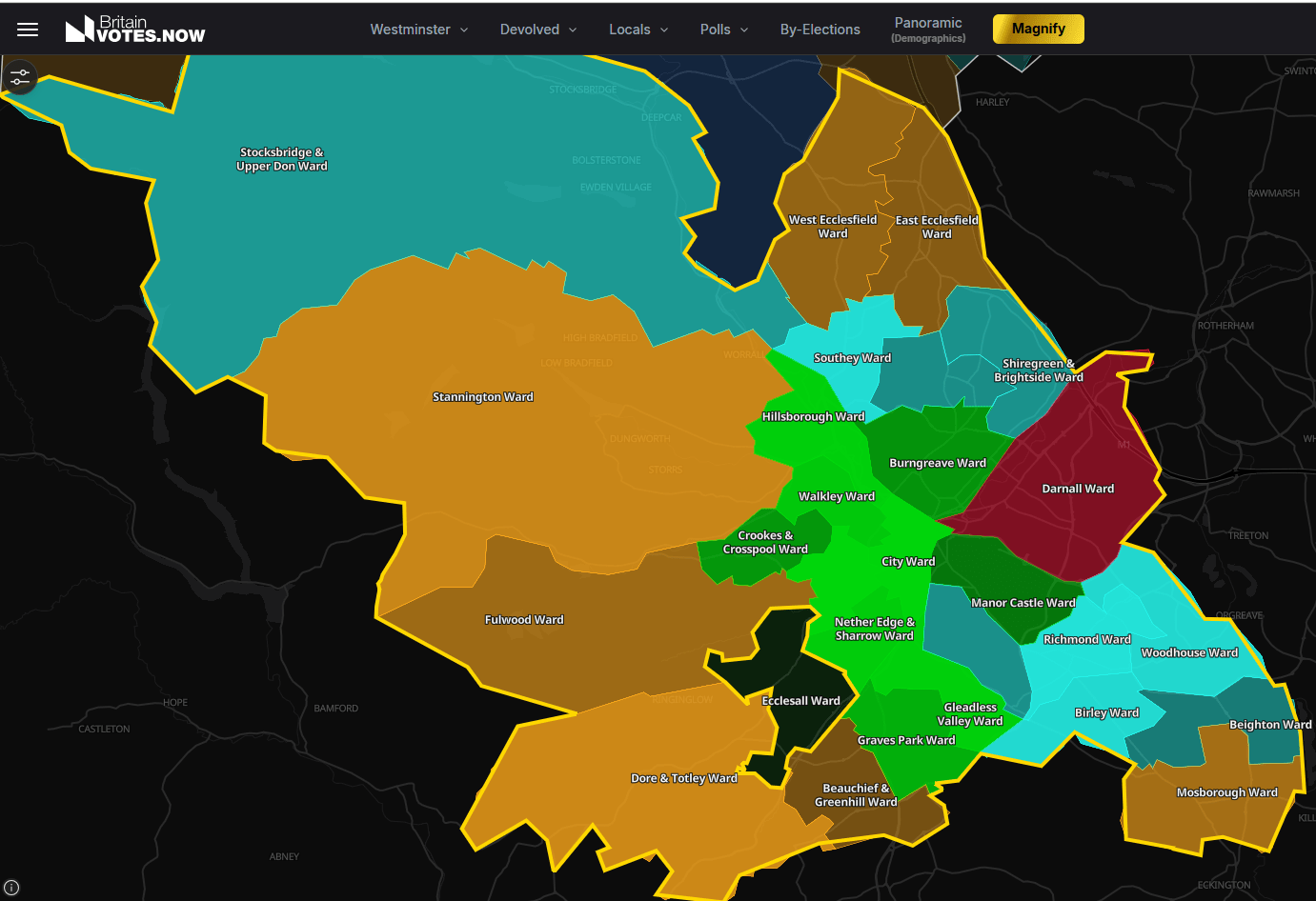
This opinion poll indicates that the Labour vote has collapsed, and they could lose all their seats in this election. The poll has them hanging on to Darnall by just 2%. Greens could gain Labour strongholds Manor Castle, Walkley, Burngreave, Nether Edge and Sharrow and Crookes and Crosspool and Ecclesall and Graves Park from the Lib Dems. while holding City, Hillsborough and Gleadless Valley. Reform could gain Birley, Woodhouse, Southey, Shiregreen and Brightside from Labour and Beighton from the Lib Dems. Lib Dems could gain East Ecclesfield from Labour, and hold Beauchief, Dore and Totley, Fulwood, Mosborough, Stannington and West Ecclesfield. So overall, massive gains for Greens and Reform and a massive collapse for Labour.
But this is only a poll: the only one that counts is on May 7th.
So, which parties should interest you if you are making environmental issues your priority? Three parties, Reform, the Conservatives and Restore, are now ideologically opposed to the concept of Net Zero carbon emissions. They oppose measures that improve life for pedestrians, cyclists and public transport users in pursuit of drivers’ votes. They oppose renewable energy schemes in favour of a Trump-like “drill baby drill” attitude, hoping to exploit more oil in the North Sea, which we can’t afford to burn if we are going to avoid climate tipping points. Their disbelief or scepticism in the science of climate change is deeply worrying, but not surprising when you examine where their funds come from. These parties have deep vested interests in oil and tech companies and the millionaires associated with them.
I could only find local manifestos for 3 parties, Labour, Lib Dems and Greens. If you are not sure who to vote for, do examine the policies carefully.
It’s hard to find mentions of environmental issues in most election leaflets. But it’s disappointing to see untruths being told. Some Labour leaflets and social media posts, for instance, are taking full credit for Green Bonds, an idea brought to the Council by the Green Party. The Bonds quickly raised £1 million pounds for solar panels on school roofs.
Another hot potato is the Greenbelt. Liberal Democrats and Reform are both criticising the Green Party for voting for the Local Plan, and campaigners have bombarded social media with memes, objecting to the Local Plan. The Lib Dem leaflet for Ecclesall says “The Lib Dems voted to protect our Greenbelt and nature from Labour’s building plans. The Green Party voted with Labour to pave over our greenbelt in yet another let down!” The Green Party say that a Local Plan is vital to stop developments throughout the Greenbelt and in other areas of special interest not protected by the Greenbelt. They voted to give as much protection to the Greenbelt as possible and will oppose planning applications on Greenbelt land in future. So they did not vote to “pave over the Greenbelt”, they voted to protect it.
Only the Green Party mentions the climate crisis in their manifesto, but one crucial detail is missing from all the election leaflets I’ve seen. How are we going to meet the Council’s commitment to reach Net Zero by 2030?
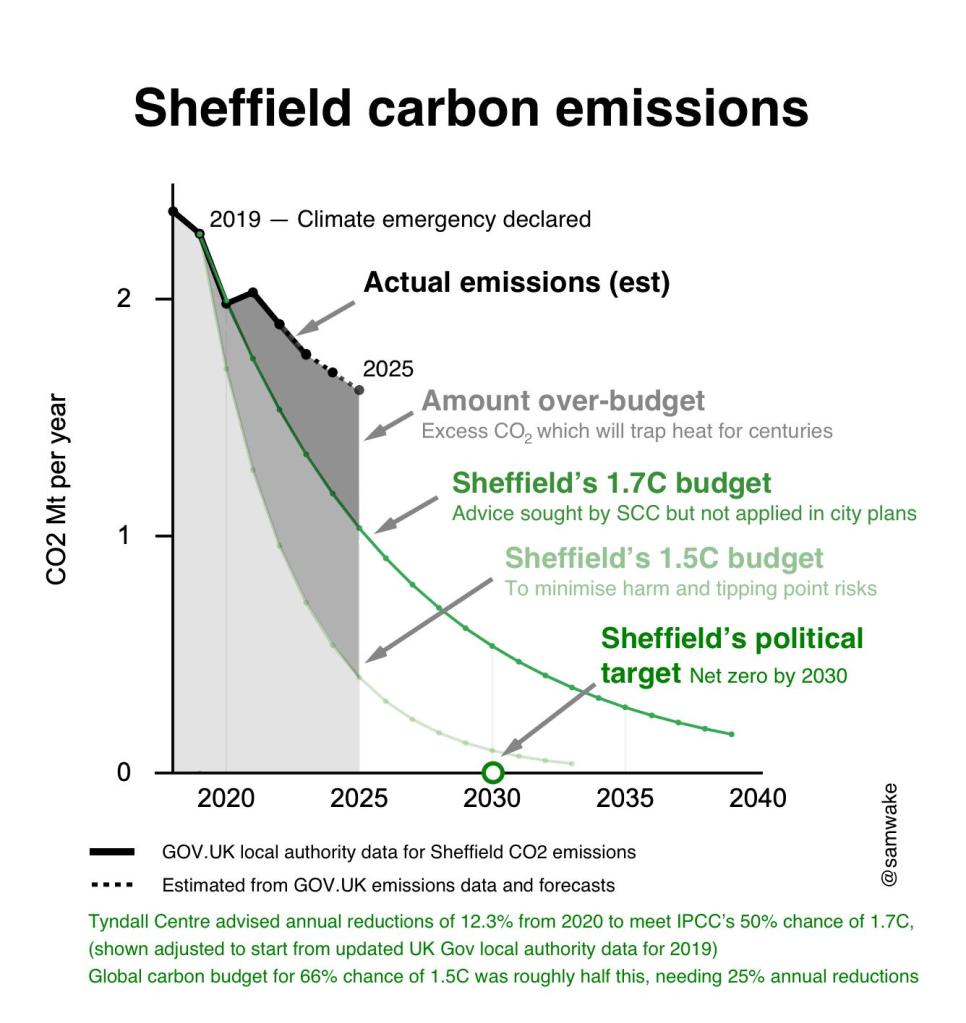
This graph, produced by Sam Wakeling, shows that we are way off track. The Council declared a Climate Emergency in 2019, but has never taken monitoring of CO2 seriously. Extinction Rebellion was saying at the time that we need to aim for Net Zero by 2025. They were right. Today, we may already be too late to save the Coral Reefs, which are home to a quarter of the planet’s marine species. We are dangerously close to other tipping points, like the collapse of the Atlantic Meridional Ocean Circulation, without which Britain would be 5 degrees C colder, with agricultural production falling dramatically worldwide. All politicians, at every level of Government, need to be prioritising climate action and working out how we can be more resilient as a country, ready for shocks like the closure of the Straits of Hormuz or the next extreme weather event.
I don’t blame political parties or the electorate for their silence on AMOC and other climate tipping points. Political parties need to attract votes and appeal to the demands of their supporters. But most people are completely in the dark regarding the threats climate tipping points now pose to us. And the electorate isn’t demanding climate action because the mainstream media don’t inform them. This week George Monbiot published an excellent article on AMOC, but there has been very little on the BBC or the popular press. Maybe this will change soon, because the BBC are being taken to a tribunal for suppressing the most important climate news. There will be more on this in future posts.
If we are to have any chance of meeting Sheffield’s emissions target, we urgently need more Green Councillors in the Town Hall who will make the climate and nature emergencies a priority. Wherever you live in Sheffield, Vote Green Party on May 7th.
Discover more from Tell the Truth Sheffield
Subscribe to get the latest posts sent to your email.
