
It’s now six years since Sheffield City Council declared a Climate Emergency. You may remember those heady days when Extinction Rebellion began and hopes were high of real action to seriously change our addiction to fossil fuels. This is what I wrote on the 1st anniversary. Unfortunately, all levels of Government have been slow to react and now both the climate and nature emergencies threaten our survival, along with other planetary boundaries that we have broken through.
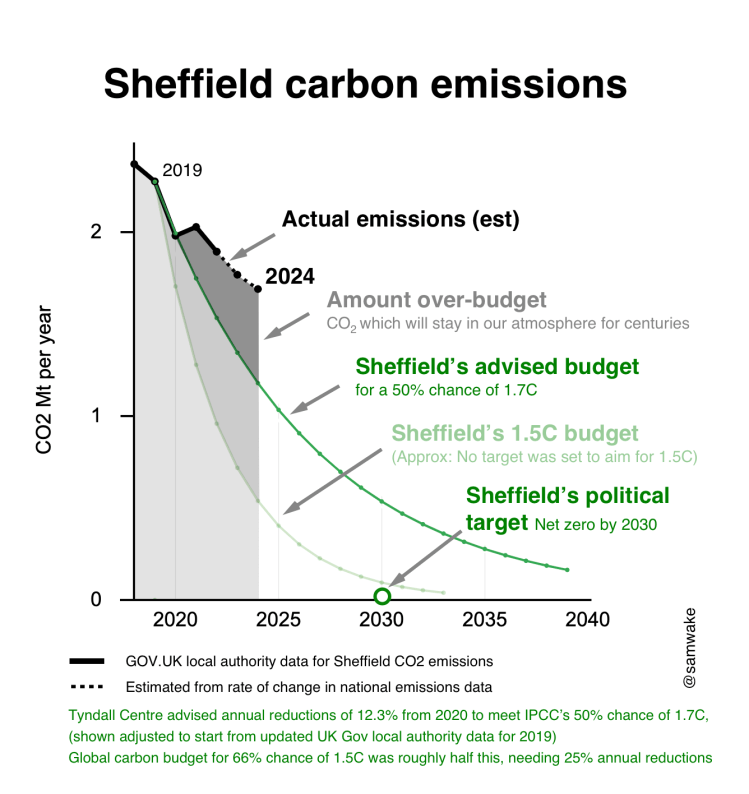
Sam Wakeling has produced this graph using national statistics to keep track of how the Council are doing in reducing emissions.
Note how the dark grey area showing how much our emissions exceed our budget, is now a similar size to the area under the curve if we are to meet our political target of net zero by 2030. In other words, it is already clear it is impossible to meet this target.
It is in this context that two questions have been asked of Sheffield City Council.
Jenny Patient from South Yorkshire Climate Alliance has asked
It is now six years since Sheffield City Council formally recognised the Climate Emergency facing the world.
In February 2019 the council declared a climate emergency, and subsequently stated its intention for Sheffield to become a zero-carbon city by 2030 – thereby playing our full part in the Paris Agreement. The timescale was ambitious but properly reflected the urgency of the situation.
Since then, six of the eleven years between setting the target and achieving the goal have passed without any steps being taken that will genuinely make a serious dent in our city’s carbon emissions. The positive actions that have been taken are commendable, but the reality is that they are on nothing like the scale and pace required.
UN Secretary-General Antonio Guterres tells us: “There’s still time to avoid the worst of climate catastrophe, but leaders must act – now. We have just endured the hottest decade on record – with 2024 topping the list. Blazing temperatures in 2024 require trail-blazing climate action in 2025.”
What percentage of Sheffield’s all-time carbon budget has been used up since 2019, and how does Sheffield City Council plan to take trail-blazing action in 2025, to do all it can to reach net zero by 2030?
Here is the Council’s written answer.
The carbon budget for Sheffield as set by the Tyndall Centre from 2018 to 2100 is 19.6MtCO2. In the first carbon budget period of 2018 – 2022, Sheffield emissions were 10.6MtCO2, compared to the recommended carbon budget for that period of 9.3 MtCO2. Since 2018, Sheffield has used 54% of its carbon budget to 2100.
Although there is significant activity across the city, with momentum continuing to grow, the rate of emissions reduction has slowed in certain sectors. Much of the necessary action to accelerate and scale up progress remains beyond the control of local government, and we will continue to focus our efforts on areas such as a funding and finance, as increasing access to finance will be key to facilitating delivering on the ground.
The Council and its partners have developed a strong policy framework to enable climate action to flourish. Both our City Goals and Council Plan set a clear direction on decarbonisation and climate resilience, and our recently adopted Growth Plan is structured around four missions which include a ‘Global, Green and Growing’ mission.
We adopted two more Decarbonisation routemaps during 2024, and we will be completing our thematic routemaps including business and industrial decarbonisation n the coming year, alongside the development of a Local Area Energy Plan (LAEP)
We will be working to scale up current decarbonisation programmes, included in the existing routemaps, such as rolling out further active travel, public transport and electric vehicle options, and continue to retrofit social housing and support home-owners to improve the energy efficiency of their own homes.
In recognising the need for finance and investment to support and deliver our plans, we will continue to work closely with the South Yorkshire Mayoral Combined Authority (SYMCA) to agree a favourable integrated settlement with a strong focus on decarbonisation, resilience and nature recovery from central government for 2026/7 and beyond.
However as noted above, the Council cannot do this alone or in isolation, and therefore we will continue to work with city partners and stakeholders to facilitate action in other sectors and institutions, as well as continue to work with our UK Core City partners to work with Government to secure the necessary investment and policy framework to support our vision.
Jenny was allowed to ask a supplementary question in response to this written answer, at Full Council. This was
“”In response to my question, the Council said that 54% of Sheffield’s carbon budget from 2018 to 2100 has already been used.
In seven years, we have used half – so we have only the same amount to last the next 75 years.
We have failed the young people who pushed for action on the climate emergency.
Although we are now moving out of the “safe operating space for humanity”, the Council still celebrates the presence of Boeing, Rolls Royce and McLaren, which are among the highest carbon polluting companies, making arms and machines that are incompatible with the world our children need to survive.
In the climate emergency, Sheffield’s economy needs to prioritise:
- homes that protect people from extreme weather, connected by non-polluting ways to get around
- healthy food that doesn’t get disrupted by war,
- good education, health and care
All of these things can provide good jobs.
The Covid pandemic showed that big change can happen when governments tell people the truth and ask for new behaviours.This must now happen for climate change – will the Council prioritise telling Sheffield people the truth, and involving them in the changes needed to make our city resilient in the coming storm? “
Here she is asking the question, with Cllr Ben Miskell’s reply. It has to be said the Cllr Miskell did not acknowledge the massive failure these figures represent or show any sense of urgency in tackling the Climate and Nature Emergencies now. He was proud that the city was investing in arms companies.
I am asking the Transport, Regeneration and Climate Committee, on Wednesday February 12th
In 2007 Sheffield Council set its first target to reduce greenhouse gas emissions. The aim was 30% in 6 years.1
Cabinet Member for Environment Mary Lea said “Labour has pointed to a number of schemes which will help the Council reach the target, including a new car club as well as wind turbines and water power.”
In fact the Council managed 18% reductions, falling from 3.9 to 3.2 mt, mainly due to using less coal.
By 2019 emissions had reduced to 2.3mt. An estimate for 2024 is 1.8mt. So since declaring a Climate Emergency emissions have reduced by nearly 22%. But the most difficult reductions are still to come and the aim is to get to net zero by 2030. Reductions should be well over 50% if the Council were on target. Last year global temperatures were 1.6C above pre-industrial levels, so we are already at the dangerous stage of global heating scientists warned us not to exceed. We risk tipping points such as the collapse of AMOC, which would plunge the UK into an everlasting Arctic winter. Billions of lives are at stake.
How will the Council get on track to net zero?
Graham Wroe
1.(Sheffield Star April 7th 2007).
2. National figures from
https://www.gov.uk/government/publications/energy-and-emissions-projections-2023-to-2050 (annex b)
Up to 2022 is in local authority figures
I will publish any answers received here.
Join Tell the Truth Sheffield’s What’s App Broadcast Channel here.
Discover more from Tell the Truth Sheffield
Subscribe to get the latest posts sent to your email.

3 thoughts on “6th Anniversary of Sheffield Council declaring a Climate Emergency.”