
As COP31 talks conclude in Turkey, it’s vital to remember that climate change is just one of the nine planetary boundaries that scientists are concerned we are breaching, or about to breach.
Clare Farrell and Dr Charlie Gardener addressed this in their recent podcast. Charlie explained, “Scientists have identified nine critical processes or systems in our planetary system that regulate the habitability of our planet for us and other species. They have calculated what they think of as safe threshold levels for each of these nine systems. And if we don’t exceed those thresholds, then we stay within what they call the safe operating space for humanity.”
Worryingly, the 2026 report tells us we have already transgressed seven of these boundaries. They are
- Climate change: Disruption of the Earth’s energy balance through greenhouse gas emissions.
- Biosphere integrity (biodiversity loss and extinction): The rate of species loss and ecosystem collapse.
- Land-system change: Conversion of forests, wetlands, and other natural lands for human use.
- Biogeochemical flows (nitrogen and phosphorus cycles): Overuse and runoff of key agricultural nutrients causing aquatic dead zones.
- Freshwater change (global freshwater use): Depletion and alteration of surface and groundwater supplies.
- Ocean acidification: Decreasing pH levels in the oceans due to carbon dioxide absorption, which threatens marine life.
- Novel entities: Introduction of synthetic chemicals, plastics, heavy metals, and genetically modified organisms into the environment.
The two that are not yet transgressed are
- Atmospheric aerosol loading: The concentration of microscopic particles in the air that affect climate and living organisms (currently within safe limits globally, with regional hot spots).
- Stratospheric ozone depletion: Thinning of the ozone layer that protects Earth from harmful ultraviolet radiation (currently recovering and within safe limits).
This all sounds very complicated, but the podcast explains it all in easy-to-understand language.
I’m just going to look at one of these boundaries: ocean acidification and I’ve used Charlie and Clare’s thoughts here.
When we release carbon dioxide into the atmosphere, that has massive impacts on the greenhouse effect, and it drives climate change. But not all of that carbon dioxide stays in the atmosphere. About a quarter of it is absorbed by terrestrial carbon sinks. So forests, wetlands, soils, etc. About a quarter of it is absorbed by the oceans, and half of it stays up in the atmosphere where it causes climate change. You might think if a quarter of it is being absorbed by the oceans, then that’s great because that’s limiting climate change? Except it’s not, because it changes the chemistry of the oceans and it makes them more acidic. It’s called ocean acidification. It doesn’t really make them acidic because they’re alkaline. It makes them less alkaline, basically. And that’s a real problem because loads of the life in the ocean is adapted to specific ocean chemistry. And in particular, lots of the animals that live in the ocean have exoskeletons or shells made of calcium carbonate like limestone.
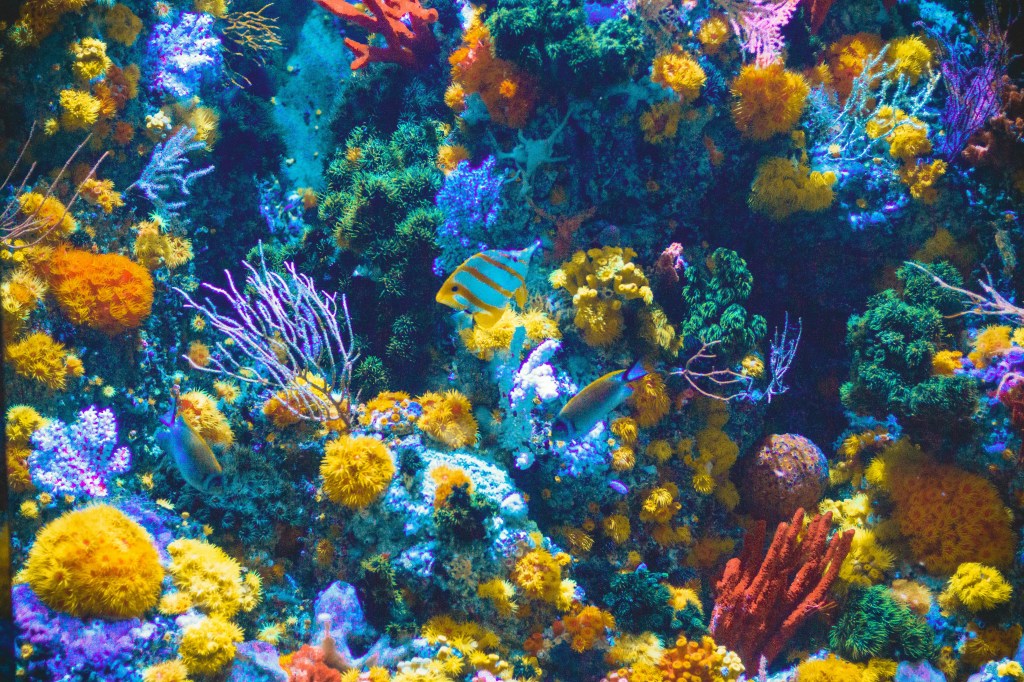
Things like corals, molluscs and gastropods have to make their shells. To make their shell, they need to get calcium carbonate out of the water. But when the water’s less alkaline, the chemistry just doesn’t work, and it’s much harder to get what they need to build their bodies. So, ocean acidification is a real problem. It’s been called climate change’s equally evil twin, and it risks basically just undermining the whole ocean food chain and all life in the ocean. It’s not just a problem for all these wonderful creatures; 500 million people get their primary dietary protein from the ocean. That will become less possible as ocean acidification worsens.
Also, ocean acidification undermines plant life in the ocean, which can also mean that
it’s got less capacity as a carbon sink. And so we’re destroying the ocean’s ability to take up carbon at the same time as we’re depending on it, and it’s running out of capacity. It’s a triple whammy. So when we talk about planetary feedback loops and planetary tipping points, the death of coral reefs is one of them. And coral reefs are getting hammered by this triple threat. One, climate change. The ocean is too warm for corals to be able to survive, so they bleach. Two, ocean acidification. They can’t build their physical structures. And then the third is anthropogenic impacts like reefs being destroyed by anchors and overfishing. So coral reefs are massively threatened in these different ways. And when we lose coral reefs, we lose a big oceanic carbon sink, and that will become a source of CO2, and it will contribute to runaway climate change.
This is just one reason why commissioning new oil and gas fields in the North Sea is absolute madness. Join the Stop Rosebank march on Saturday.
Find our more abour planetary boundaries here.
Discover more from Tell the Truth Sheffield
Subscribe to get the latest posts sent to your email.

Really good Graham
LikeLike