
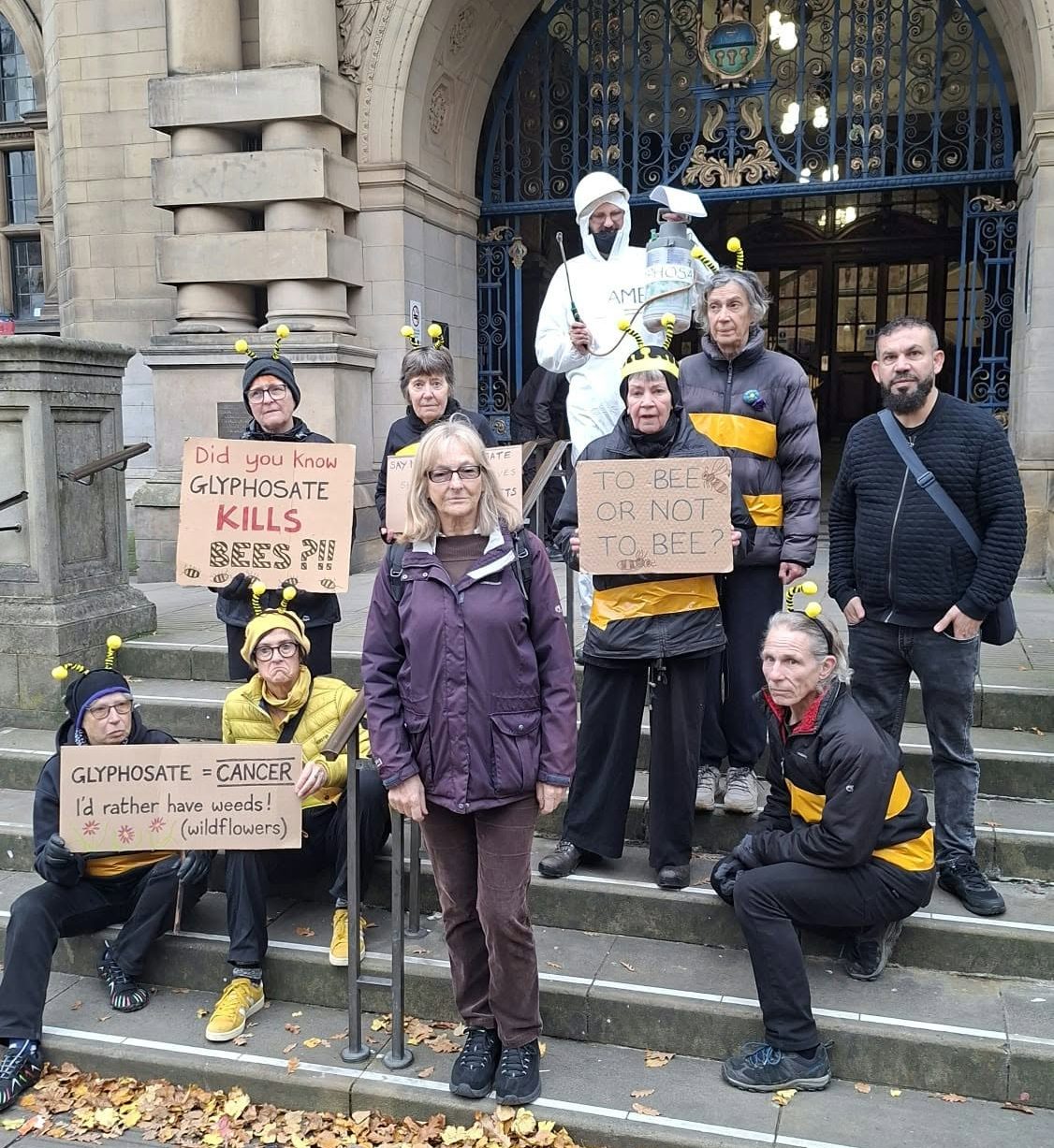
Last Friday, giant Bees were seen swarming around the Town Hall, to sting Councillors into taking action on the dangerous herbicide, Glyphosate. Queen Bee, Izzy Price, said, “This chemical not only destroys our sources of food, but it damages our navigational abilities and is a major reason bee populations and other insects are in massive decline.” According to Friends of the Earth, “Bees, especially wild solitary bees and bumblebees, are in serious decline in the UK and globally. In the UK, we have already lost around 13 species and another 35 are currently at risk.” This really is an emergency. Without pollinators, our food sources are threatened.
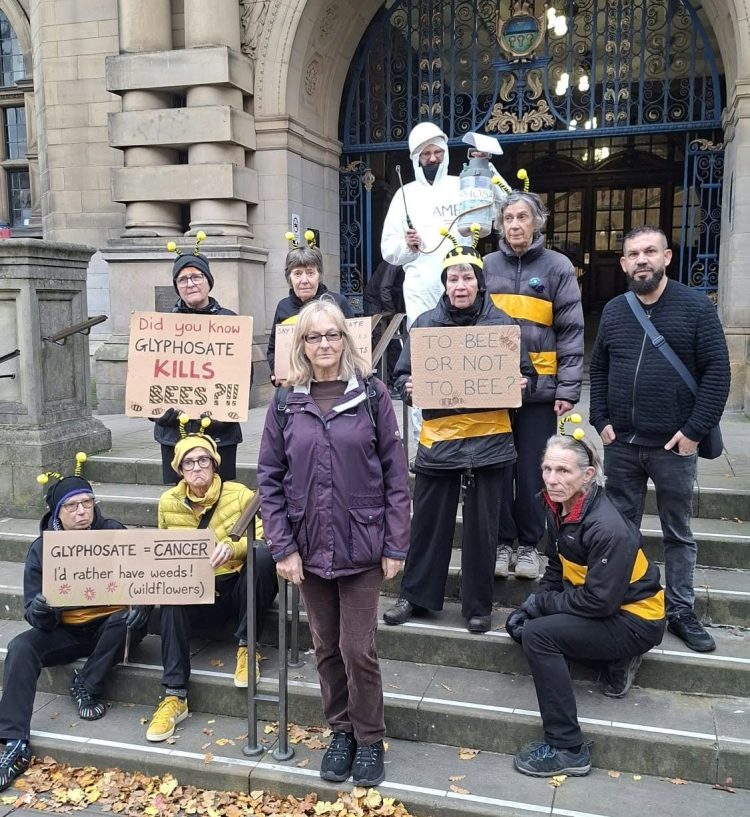
A man dressed as an Amey operative with a large container labelled “Glyphosate” was spraying the weeds outside the Town Hall, and this resulted in the untimely death of the hive. He informed passers-by that the solution was “only a little bit carcinogenic, so you are only likely to get a little bit of cancer.” Dogs and cats pick the pesticide up on their paws and lick it off, which can make them ill.
Inside the Town Hall, councillors debated what to do about Glyphosate. You can see a report on the Green Party website here. The broadcast of the meeting is here. And the Council press release is here.
Thankfully, the Glyphosate debate was moved to the beginning of the meeting because members of the public were there to observe. The agenda was an unwieldy 198 pages. Anyone who thinks Councillors don’t work hard for their meagre allowance needs to think again! (presuming of course that they had all diligently read this).
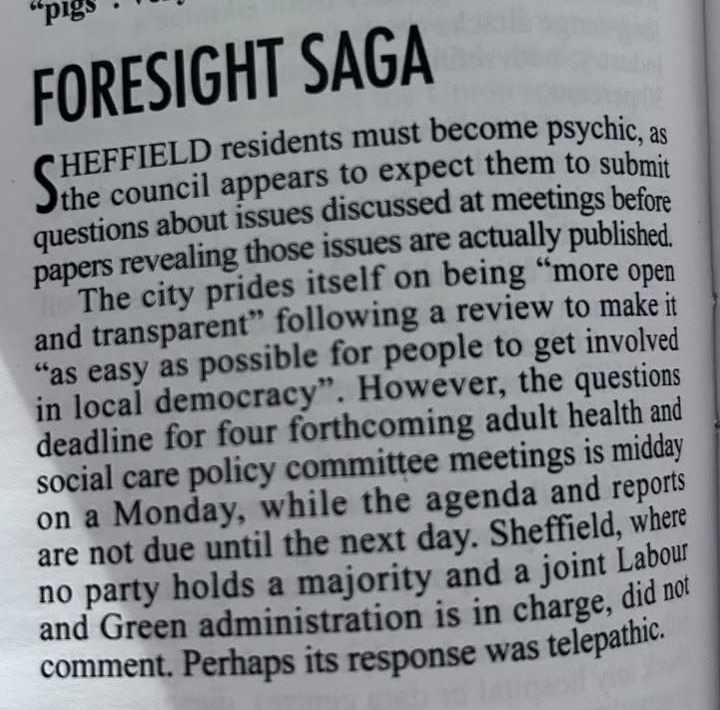
Bizarrely, the questions submitted by the No Glyphosate Campaign were not permitted to be asked because they were submitted after the deadline. But the papers for the meeting were not available before this time, so it was impossible to submit them on time. Thanks to an intervention by Cllr Mustafa Ahmed, Tim Birch was allowed to address the Councillors. You can hear his off-the-cuff speech 46 minutes into the broadcast.
The issue about questions was recently highlighted in Private Eye.
Tim Birch explained to the meeting that the aim of the campaign was to stop Glyphosate being sprayed in Sheffield, and there are already 32 streets around the city that want Glyphosate to be banned on their streets. Talks are in progress with more. Many cities and countries around Europe have already banned Glyphosate in public spaces, including France, Germany, Denmark, the Netherlands, and Italy. We believe that should now happen in the UK. He corrected one of the officers who had said earlier in the meeting that bees are not directly affected by spraying. Evidence shows that the navigational powers of bees are severely impacted by Glyphosate. Evidence also shows there is a direct link between Glyphosate and cancer. Nationally, the UK Parliament will be deciding whether to allow the continued use of Glyphosate in the UK in December. Sheffield Council declared a Climate Emergency in 2021, and allowing continued spraying of Glyphosate is not compatible with this.
Tim urged the Council to consider letting more than the proposed 20 streets take part in the trial, as there are already nearly 40 streets interested in this, and this is bound to increase as the Campaign grows.
Tim concluded by saying the concept of “weeds” is quite outdated. His video of an Amey operative spraying his street from a buggy caused lots of concern among residents.
He said he was horrified that there was no warning of the street being sprayed; there were cats and dogs on the street at the time, and there was no warning to pet owners. Beautiful wildflowers on the wall, such as Speedwell and forget-me-nots, were destroyed by the spray.
More nature will help us address the impacts of climate change in Sheffield, and it will help address mental health in the city. Stopping using Glyphosate brings all sorts of benefits to nature, wildlife and people. Why are we still discussing the use of Glyphosate when it has been banned in so many places?
There are real alternatives. If there weren’t real alternatives, why are many European cities, like Paris, banning Glyphosate?
The motion passed by the Committee is as follows.
The Environmental Services and Regulation Policy Committee is recommended to:
1. Agree to Option 3: Continue with the Integrated Pesticide Management approach utilised throughout 2026 to achieve significant reductions in Glyphosate usage through intensive street cleansing “deep cleaning” and removal of growing media from the highway.
2. Empower officers to run street-specific consultations and localised trials of alternative approaches in areas where public demand is high for “Chemical Free Streets”.
3. Continue as per the agreed 2026 methodology to carry out a single annual spray around obstacles in “soft” surfaces such as lamp columns or signs within highway verges by means of Glyphosate in tandem with complementary tank-mixed products applied in accordance with label recommendations. 4. Continue as per the agreed 2026 methodology to carry out spraying of Glyphosate on hard surfaces such as footways and other surfaces not intended to bear vegetation on a “spot treatment” basis with a focus on route optimisation and interdependency with Street Cleansing services to minimise chemical usage.
The full documentation can be found here. (pdf)
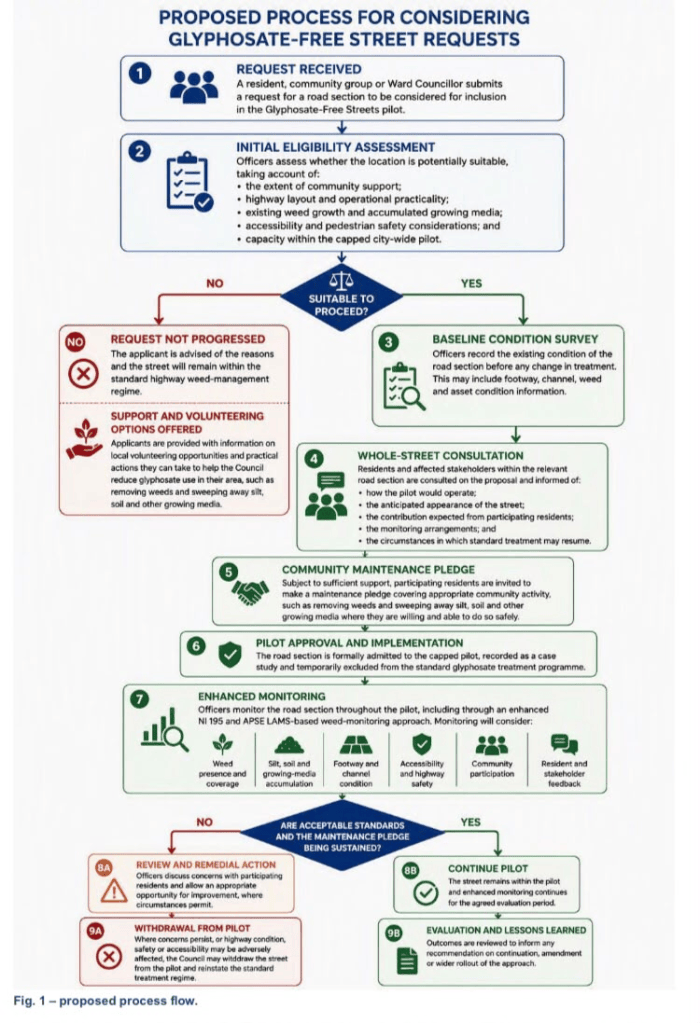
This is the Council flow chart for considering Glyphosate-free street requests.
The Council are not working quickly enough on this issue. Boasting about the big fall in Glyphosate use this summer is clearly not good enough, as we all know there was a long drought and plants were growing very slowly. I wish the No Glyphosate campaign every success as they continue in the quest for safer streets in Sheffield.
Get in touch with the campaign by emailing noglyphosatesheffield@gmail.com
or on Facebook https://www.facebook.com/profile.php?id=61593814361298
or on Instagram https://www.instagram.com/noglyphosatesheffield/
Discover more from Tell the Truth Sheffield
Subscribe to get the latest posts sent to your email.
