
by Ci Davis

We have become accustomed to seeing the human impacts of war, from starvation in Sudan to the almost 100,000 killed in Gaza, but most people will be less familiar with the environmental impacts. On February 28th, another Middle East war broke out when the US and Israel launched an attack on Iran. In the first few hours, the Supreme Leader was killed, followed by the bombing of a school, killing 150 Iranian schoolgirls, and soon after, columns of smoke began to rise from targeted hits on petrochemical infrastructures.
Over the past three weeks, oil refineries, gas fields, tankers, nuclear facilities, desalination plants, oil storage tanks, air bases, and industrial areas have all been attacked. The water, marine and toxic-air pollution are a consequence of the smoke from the multiple infernos, from the widely dispersed toxic fragments, and from the many chemicals and heavy metals that escape into the soil and water, caused by thousands of bomb and missile strikes
The human and environmental costs of another war prompted two protests in Sheffield. On 21st March, 150 people demonstrated outside the Town Hall to call for an end to the war on Iran and also made connections with other current conflicts, including Gaza, Lebanon, Sudan, Ukraine and Cuba.
Our media tends to represent the environmental impacts of war as collateral damage, an unfortunate side effect, but really, they are a deliberate and targeted means of disrupting the lives of people by making their connection to land fragile or even untenable. No clearer example exists than the use of Agent Orange to defoliate the forests of Vietnam that left millions of Vietnamese and hundreds of thousands of US veterans with multigenerational health disorders and birth defects. Environmental harm is one of the ways that war impacts lives that can last many decades.
The environmental impacts of war cannot be separated from the environmental costs of the military machine itself, which is responsible for 5.5% of global greenhouse gas (GHGs) emissions, which rose by a staggering 9.4% in 2024. The US military is the largest institutional emitter of GHGs that are responsible for climate change, burning 270000 barrels of oil daily. Countries are not required to produce figures for the wartime emissions, but recently it is estimated that the war in Ukraine has produced 237 million tonnes of CO2, the Gaza conflict 32 million tonnes and in the first 5 days of the Iran war 5 million tonnes. At a time when all countries should be doing everything to reduce climate and environmental damage, the resort to war is escalating the harm.
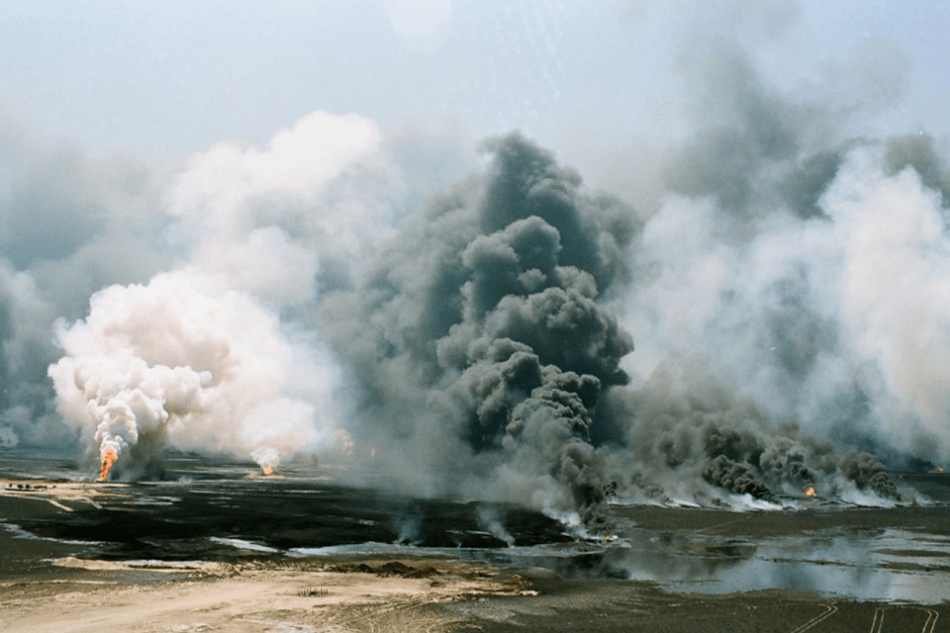
Apocalyptic images, showing clouds of black toxic smoke blocking out the sun over Tehran, following the bombings of local oil depots on 7th March, are haunting. The oily residues, soot and sulphur-laden smoke, combined with a rare rainstorm, produced acid rain, causing immediate respiratory impacts with a lasting health legacy. For people who had already experienced chemical weapons attacks during the Iran-Iraq war, this environmental warfare was experienced as chemical warfare again.
The Middle East is experiencing the climate crisis through water insecurity. The conflict in Syria, which displaced 1.5 million people between 2007 and 2010, was in part precipitated by drought. There are clear parallels to Iran today. After six years of drought, the water supply to Tehran was at just 11% capacity, and the shortage of water to drink or to supply agriculture contributed to protests in January 2026. War is exploiting this suffering, with all parties having targeted water and sewerage systems that, if continued, threaten to displace people throughout the region, as well as causing severe health impacts.
Most of us will be familiar with the skeletons of buildings and mountains of debris from TV images of Gaza. The 61 million tonnes of rubble are laden with asbestos, unexploded weapons, dead bodies, and untreated sewerage that has rendered the land unfit for agriculture. The clearance will take decades and burn through hundreds of thousands more tonnes of fossil fuel, and we are seeing the same thing being repeated across Iran and the Gulf.
Years after wars end, the land, air and sea will remain contaminated. Thankfully, the deliberate targeting of the environment is becoming recognised in International Law as a war crime or ecocide and can be punished under the ICC’s Rome Statute. If it is demonstrated that the military intentionally launched an attack, knowing that it will cause long-term severe damage to the natural environment, that is excessive to the military advantage anticipated, then prosecutions may follow.
As the war drags on, it risks total destruction of the oil-fields, spillage of nuclear material, and depleted Uranium contamination. These huge environmental threats will have global impacts, experienced as economic shocks and agricultural losses, threatening food security. War demonstrates our intimate connection with the land and the importance of environmental protection.
Most people oppose the war, the use of UK bases in support of it, and sending the military to the Middle East. We should make our voices heard, calling upon world leaders to respond to our opposition and pull back from the brink, for the sake of people and the planet.
For more information on what you can do, contact: sheffieldantiwarcoalition@yahoo.co.uk
References
Gayle, D. (2025, May 31). What is ecocide and could it become a crime under international law? The Guardian. https://www.theguardian.com/environment/2025/may/28/what-is-ecocide-and-could-it-become-a-under-international-law
Gayle, D. (2026, March 20). From black rain to marine pollution, the war in Iran is an environmental disaster. The Guardian. https://www.theguardian.com/environment/2026/mar/19/down-to-earth-iran-us-israeli-war-environmental-destruction
Holmes, O., Gayle, D., & Ahmedzade, T. (2026, March 23). Tehran’s toxic cloud: Satellite images show oily fires burned for days. The Guardian. https://www.theguardian.com/world/2026/mar/23/tehran-toxic-cloud-satellite-image-oil-fires
Meadway, J. (2026, January 15). How ‘day zero’ water shortages in Iran are fuelling protests. The Guardian. https://www.theguardian.com/world/2026/jan/15/how-day-zero-water-shortages-in-iran-are-fuelling-protests
Moneer, Z. (2026, March 22). Water Infrastructure Has Become a Target in Modern Warfare. Earth.Org. https://earth.org/from-lifeline-to-strategic-weapon-how-water-infrastructure-becomes-a-target-in-armed-conflicts/
Neimark, B., & Mackintosh, K. (2025, November 4). How wars ravage the environment – and what international law is doing about it. The Conversation. https://doi.org/10.64628/AB.4yt3f6ys7
New data reveals the Military Emissions Gap is growing wider. (2025, November 6). CEOBS. https://ceobs.org/new-data-reveals-the-military-emissions-gap-is-growing-wider/
Palmer, M. G. (2005). The legacy of agent orange: Empirical evidence from central Vietnam. Social Science & Medicine, 60(5), 1061–1070. https://doi.org/10.1016/j.socscimed.2004.04.037
Photos: Dire water shortages pile misery on Gaza’s starving population. (n.d.). Al Jazeera. Retrieved 24 March 2026, from https://www.aljazeera.com/gallery/2025/8/4/unprecedented-water-crisis-in-gaza-amid-israeli-induced-starvation
The US-Israel war on Iran and how war and conflict are destroying the environment. (2026, March 19). Greenpeace International. https://www.greenpeace.org/international/story/82201/iran-lebanon-war-environment-climate-impacts/
Three days of Operation Epic Fury: Rapid overview of environmental harm in Iran and the region. (2026, March 3). CEOBS. https://ceobs.org/three-days-of-operation-epic-fury-rapid-overview-of-environmental-harm-in-iran-and-the-region/
Discover more from Tell the Truth Sheffield
Subscribe to get the latest posts sent to your email.
