
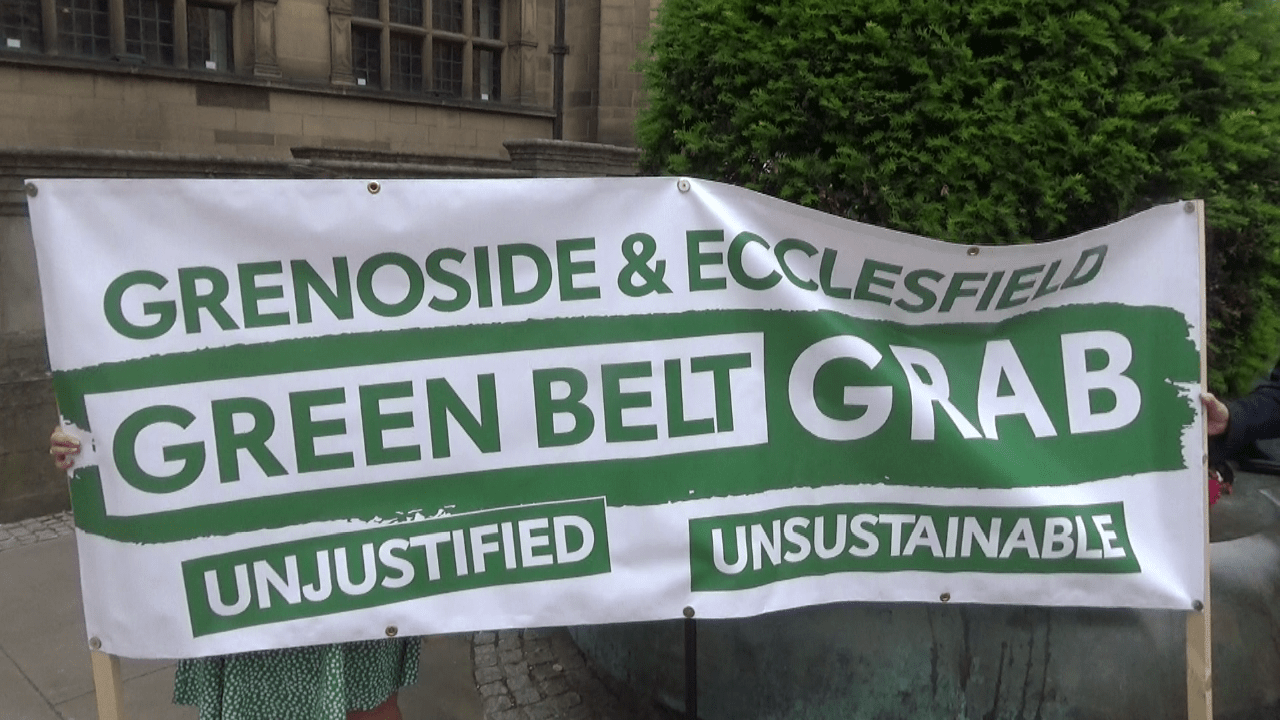
I spoke to Greenbelt Campaigners outside the Town Hall today, who are very unhappy about the plans to eat into the Greenbelt by allocating land for building new housing. This is what they had to say.
Becky from Grenoside said “I’m here as part of the campaign to save the Greenbelt in Grenoside, Chapeltown and Ecclesfield People won’t be able to get appointments with their GP. Our traffic’s already congested. It’s throwing out farmers in our area, and it will have a long-lasting impact, and we need to stop it now and stop the Sheffield City Council from this current plan.”
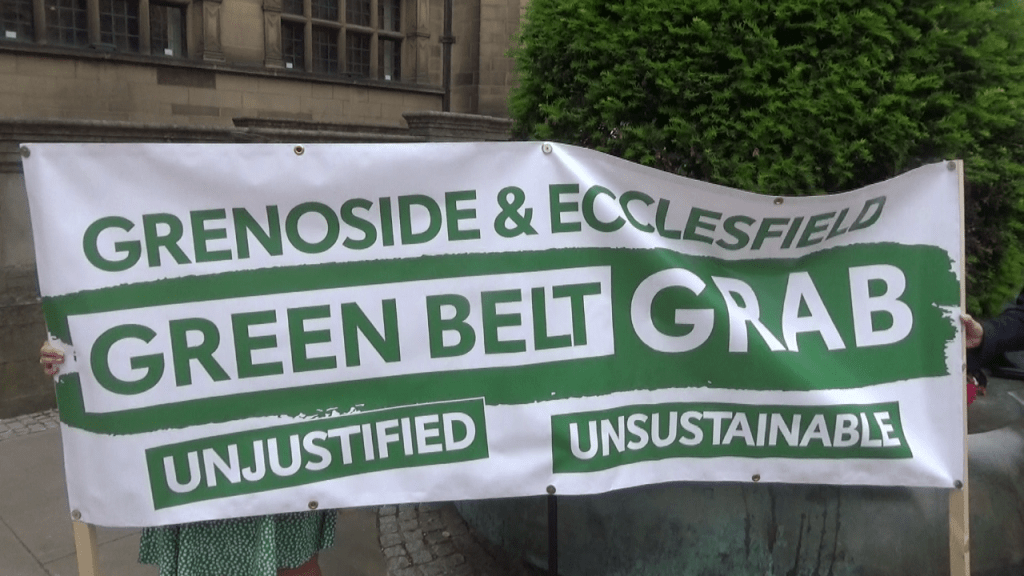
Jo Tunstall said “I’m here to protest today on behalf of the Save Our Green Belt Chapeltown, Ecclesfield and Grenoside campaign. So within S35 there are 14 parcels of Greenbelt land that have been allocated for housing and employment land. Of those 14 parcels there’s nine of them that have been allocated within S35. The land there certainly the the areas that have been chosen are some of the highest scoring green belt. So they stop urban sprawl out to the countryside and they also stop localities merging. So, localities like Foxhill, Parson Cross, Chapeltown, Ecclesfield, and Grenoside, but also because we live on the north side of Sheffield, those green belts also help separate us from Barnsley and Rotherham. So from a scoring perspective they are some of the highest scoring green belts. Two of the sites contain ancient woodland and those sites have been proposed for massive logistics buildings which obviously are going to have a significant detrimental effect. If you’re putting up a massive great logistics building to ancient woodland, then obviously there will be irreparable damage to that woodland. One housing site for 609 houses is actually a working farm at the moment. It’s a Sheffield City Council-owned piece of land that has a tenant farmer that’s been there for 44 years. They’re a first generation and they have a lease for three generations. They’re effectively going to lose their business and their home to provide 609 houses on that Green Belt land. We don’t want any building on Greenbelt. There’s absolutely no need for it. We have more than enough brownfield sites across Sheffield. We basically believe that the council have just done a lazy job in planning. They’ve tried to hit the numbers by going in areas that developers want to hit big numbers by way of housing and it’s not sustainable development.
Greenbelt Campaigners are urging the public to support their campaign at www.saveourgreenbelt.net and send objections to sheffieldplan@sheffield.gov.uk by Friday.
Sheffield and Rotherham Wildlife Trust have published their response to the proposed Local Plan. A very detailed 34 page document sets out their objection to the plan.
The introduction states “Inadequate consideration of the natural environment
Concerning the plan as a whole, we feel there is little to no consideration of what benefits there are to the natural landscape, biodiversity, and access to nature; or, the adverse impacts of proposed development upon these. These sites have been selected as they score low against green belt priorities, however in most cases they are great for nature and offer people nearby access to nature. Yet, there is no Local Nature Recovery Strategy in place for the plan to assess this.
“The National Planning Policy Framework (NPPF) states: “strategic policies should, as a
minimum, provide for objectively assessed needs for housing and other uses, as well as any needs that cannot be met within neighbouring areas, unless: any adverse impacts of doing so would significantly and demonstrably outweigh the benefits, when assessed against the policies in this Framework taken as a whole.” We feel that the adverse impacts of the proposed development would outweigh the benefits:
Regarding conserving and enhancing the natural environment, “Planning policies and
decisions should contribute to and enhance the natural and local environment by: protecting and enhancing valued landscapes, sites of biodiversity or geological value and soils (in a manner commensurate with their statutory status or identified quality in the development plan); recognising the intrinsic character and beauty of the countryside, and the wider benefits from natural capital and ecosystem services – including the economic and other benefits of the best and most versatile agricultural land, and of trees and woodland;
minimising impacts on and providing net gains for biodiversity, including by establishing
coherent ecological networks that are more resilient to current and future pressures and
incorporating features which support priority or threatened species such as swifts, bats and hedgehogs; preventing new and existing development from contributing to, being put at unacceptable risk from, or being adversely affected by, unacceptable levels of soil, air, water or noise pollution or land instability. Development should, wherever possible, help to improve local environmental conditions such as air and water quality, taking into account relevant information such as river basin management plans; and remediating and mitigating despoiled, degraded, derelict, contaminated and unstable land, where appropriate.
We do not feel that the plan meets any of these requirements as outlined in the NPPF.”
They conclude
“We urge Sheffield City Council to:
- Remove sites NES37, NES38, SES29 and CH04
- Implement evidence-based buffer zones (50m – 100m) around sensitive sites to
account for noise, light, and air pollution, and to ensure wildlife corridors remain
intact. If these sites are to remain after considering the issues with the whole plan,
as we have highlighted, conduct full ecological surveys on each area before and is
released from the Green Belt. - Conduct full ecological impact assessments for all proposed sites that are within
100m of wildlife sites, wildlife corridors or ancient woodland. - Invest in green infrastructure and wildlife-friendly planning across all development
zones, ensuring a net gain for biodiversity rather than net loss.
We remain open to working with the Council to find more sustainable solutions that align
development goals with ecological responsibility and nature recovery.”
At today’s Full Council meeting the Green Party was criticised by Greenbelt Campaigners for voting for the Local Plan.
Sheffield Green Party have explained why they voted for the Local Plan (along with Labour) here. They say rejecting the Local Plan would not have protected the Green Belt from development. It would have made unplanned development on any part of the Green Belt more likely.
Cllr Angela Argenzio said “Councillors who opposed the Local Plan while failing to come up with an alternative proposal put all Green Belt sites in Sheffield at risk of development by private companies. If there is no Local Plan, the land will still be up for grabs, as will all the Green Belt land in Sheffield. The Government’s new Planning and Infrastructure Bill is going to make it easier for developers to build on nature-rich land. With protections for nature and habitats decreasing, we need to set more standards for developments in Sheffield, not less.”
“People deserve more from their local politicians than cynical opportunism in pursuit of votes. It is simply misleading to promise that voting against the local plan will protect land from private development.”
Councillor Douglas Johnson said “The real argument will take place if and when a developer comes up with a planning application for building on any particular site. This is when local people and Councillors will have an opportunity to express their views and provide evidence on any development proposals. When any proposals are brought forward – wherever they are located in the city – they need to be assessed against a new, stronger Local Plan, so that the right balance between development and the needs of people and planet are maintained.”
Julia Armstrong reported on the debate here.
Sheffield urgently needs a Local Plan so that development around the city can be controlled. We need more affordable homes to meet the massive demand. But we also need to protect nature and provide breathing space for all the people of the city.
Discover more from Tell the Truth Sheffield
Subscribe to get the latest posts sent to your email.
