

On World Bee Day, Monday 20th May, people dressed as bees swarmed to the police box next to Sheffield Town Hall.
Bees and other pollinators, such as butterflies, bats and hummingbirds, are increasingly threatened by human activities. Pollination is a fundamental process for the survival of our ecosystems. Nearly 90% of the world’s wild flowering plant species depend, entirely, or at least in part, on animal pollination, along with more than 75% of the world’s food crops and 35% of global agricultural land. Not only do pollinators contribute directly to food security, but they are key to conserving biodiversity.

On Monday XR Bees swarmed to the Police Box next to the Town Hall to call on all in authority to make better policies, and to stop the sale and use of chemicals that poison them. They hoped they might also find Dr Who there, who once said “Lives change Worlds. People can save planets or wreck them. That’s the choice. Be the best of humanity”. Pesticides are currently causing far more damage to the planet than the Daleks! A message left on the door of the police box said “ Dr Who and everyone with power and influence. Please help bees. Promote pesticide-free gardening and agriculture. #RestoreNatureNow. Gardeners can help by not using chemicals, growing bee-friendly wildflowers, reversing the trend of paving over gardens, and using artificial grass.
Queen Bee Izzy said “Your way of life is killing us. But if we go, we’re taking you with us! Due to human impacts, species extinction rates are 100 to 1,000 times higher than normal. Close to 35 per cent of invertebrate pollinators, particularly bees and butterflies, and about 17 per cent of vertebrate pollinators, such as bats, face extinction globally. The Council could help by stopping the use of Glyphosate on our streets, cemeteries and playgrounds.

Unless things change quickly, nutritious crops like fruits, nuts and many vegetables will become rare because they lack pollinators. Intensive farming practices, land-use change, mono-cropping, pesticides and higher temperatures associated with climate change all pose problems for bee populations and, by extension, the quality of food we grow.
Professor Dave Goulson wrote in the Guardian “In 1963 Rachel Carson warned us in her book Silent Spring that we were doing terrible damage to our planet. She would weep to see how much worse it has become. Insect-rich wildlife habitats, such as hay meadows, marshes, heathlands and tropical rainforests, have been bulldozed, burned or ploughed to destruction on a vast scale. The problems with pesticides and fertilisers, she highlighted, have become far more acute, with an estimated 3m tonnes of pesticides now going into the global environment every year. Some of these new pesticides are thousands of times more toxic to insects than any that existed in Carson’s day. Soils have been degraded, rivers choked with silt and polluted with chemicals. Climate change, a phenomenon unrecognised in her time, is now threatening to further ravage our planet. These changes have all happened in our lifetime, on our watch, and they continue to accelerate.
Few people realise how devastating this is, not only for human wellbeing – we need insects to pollinate our crops, recycle dung, leaves and corpses, keep the soil healthy, control pests, and much more – but for larger animals, such as birds, fish and frogs, which rely on insects for food. Wildflowers rely on them for pollination. As insects become more scarce, our world will slowly grind to a halt, for it cannot function without them.”
David Blunkett recently wrote to the Star concerning the decline of our songbirds. According to the RSPB there has been a serious decline in the numbers of many birds, including the Song Thrush, Skylark, Lapwing and House Sparrow. Most of the declining species are farmland birds. Woodland species like Blue Tit, Nuthatch and Great Spotted Woodpecker are still on the Green list of least conservation concern. Declines may have started in woodland habitat also, with Lesser Spotted Woodpecker and Willow Tit now red-listed because of their severe declines. Since 1980, one out of every six birds has been lost. That adds up to the loss of 600 million breeding birds over 40 years.
The latest research suggests that intensive farming practices, particularly an increase in pesticides and fertiliser use are the main drivers of most bird population declines.

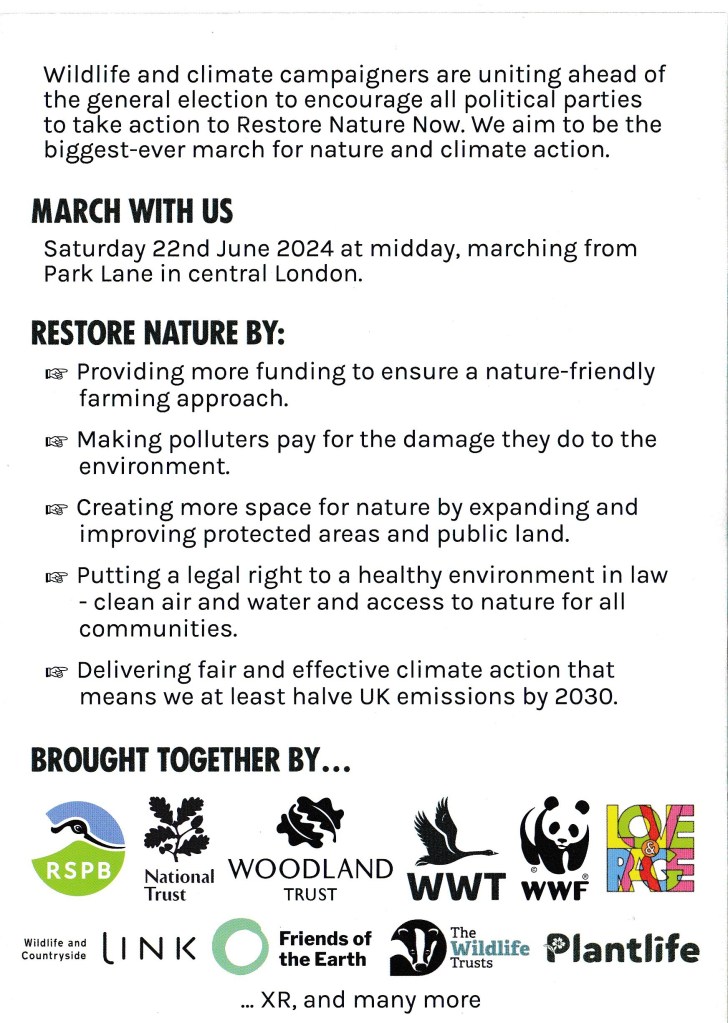
XR Bees are encouraging members of the public to join them at the Restore Nature March in London on Saturday 22nd June. The Restore Nature Now march is supported by a diverse group of dozens of wildlife and environment organisations including the RSPB, The Wildlife Trusts, The Climate Coalition, WWF-UK, National Trust, WWT, Woodland Trust, Wildlife and Countryside Link, Rewilding Britain, Extinction Rebellion and Chris Packham, who are united in the demand to #RestoreNatureNow. It is expected to be the biggest march for nature in the UK.
The next generation deserves a world free from the threat of climate catastrophe and one where nature is thriving. The General Election must be a turning point for our natural world. We’re calling on politicians of all parties to act now for people, nature and climate. Make sure your candidate supports the Climate and Nature Bill before you vote for them.
Make sure you don’t miss a post from TellthetruthSheffield.org. Subscribe today for free.
Discover more from Tell the Truth Sheffield
Subscribe to get the latest posts sent to your email.
