
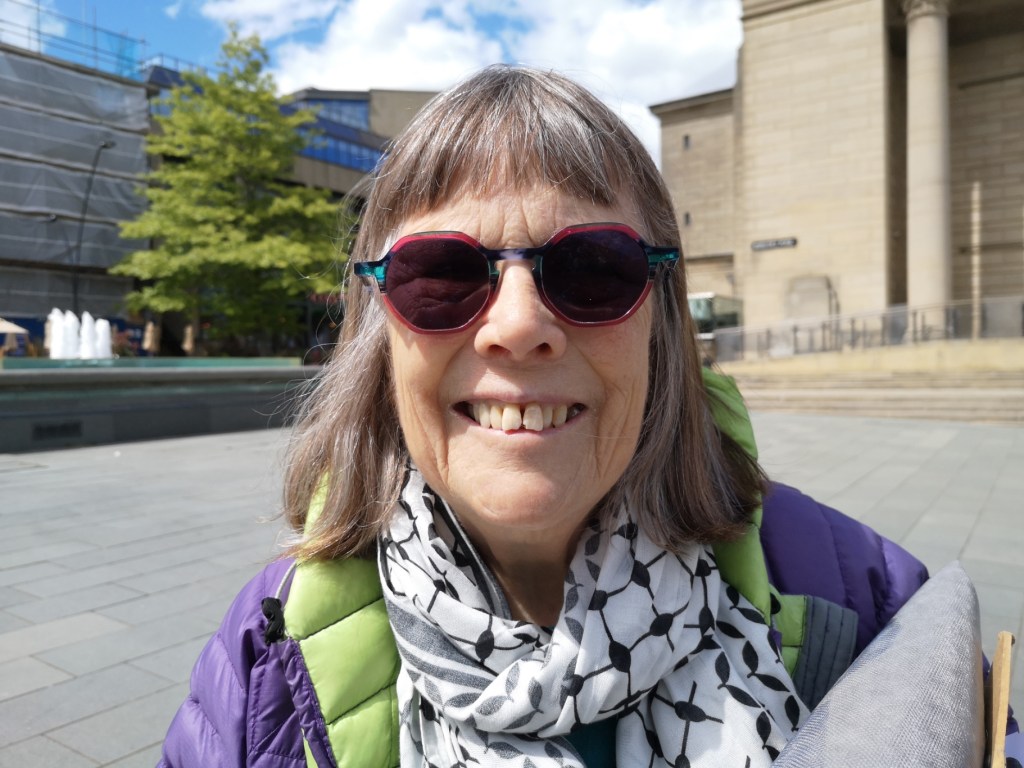
By June Cattell
Conscientious objection is the refusal to perform military service based on moral, ethical, or religious beliefs. Campaigned for by the Quakers, conscientious objection was recognised in British law in 2016 and is now increasingly widely recognised as a human right.
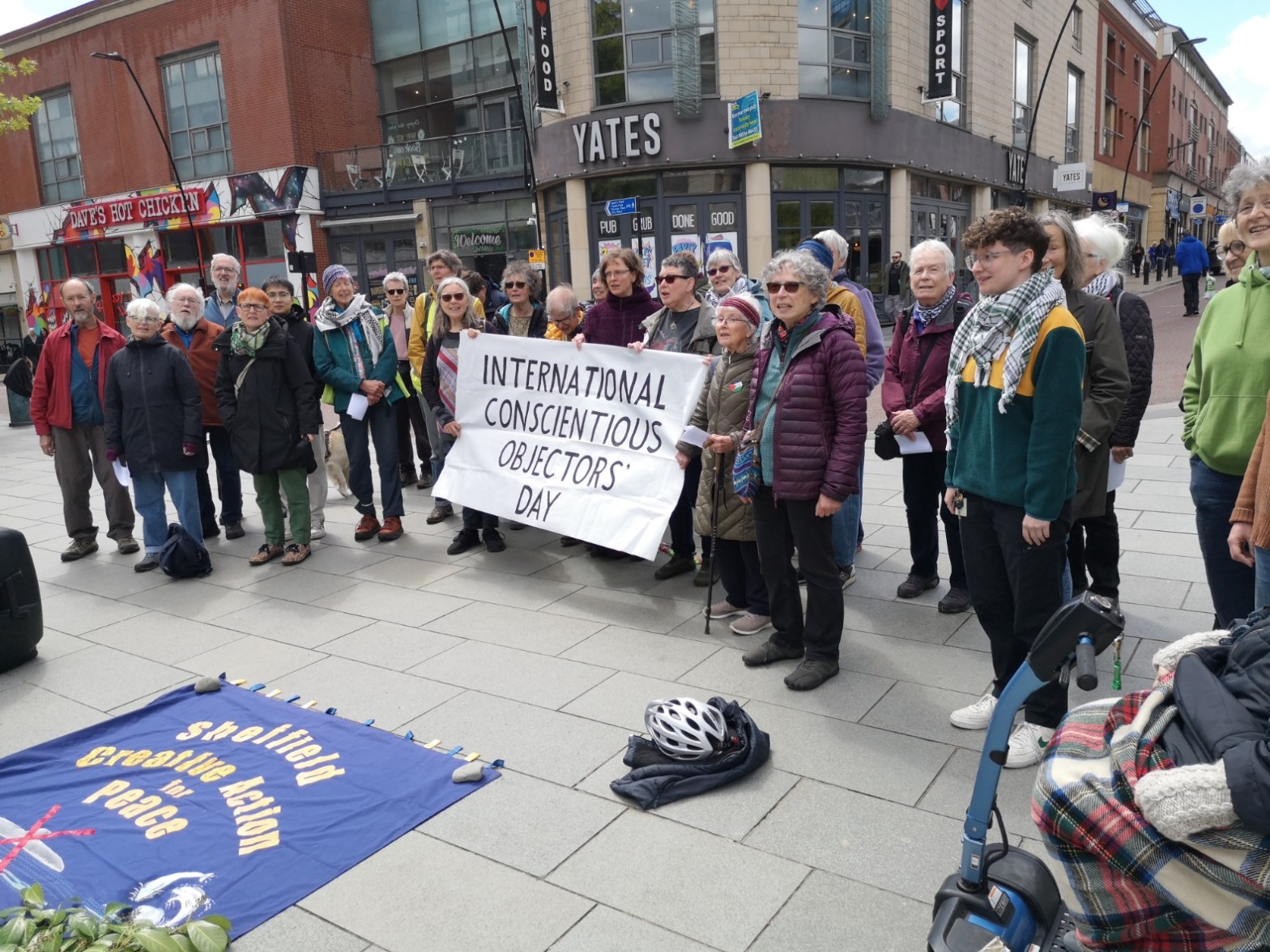
While many people are not aware of Conscientious \Objectors Day, it is an important occasion for peace campaigners. Last Friday, about 30 people gathered in the sunshine to remember conscientious objectors past and present, sharing their words and songs with the voices of peace campaigners in towns and cities throughout the world. Sheffield Choir for Peace led the singing to commemorate the day in Sheffield.
The path of conscientious objectors has never been an easy one. Conscientious objectors now and in the past have faced public condemnation, execution, prison, refusal of medical aid, torture and taunting for standing up for their beliefs.
Some countries still do not recognise Conscientious Objection. While the right to refuse to kill is enshrined in the United Nations Covenant on Civil and Political Rights, it is not universally upheld. Member states are expected to offer alternative civilian-based service, refrain from imprisonment, and set up independent bodies to assess conscientious objector claims. The right remains highly contested in regions with active conflicts, with recent suspensions of the right reported in countries like Russia and Ukraine during the ongoing war.
The commemoration in Barkers Pool began with June Cattell, a member of Sheffield Creative Action for Peace, talking about conscription and conscientious objection today. How the increasing militarism across the world is leading to more conscription being introduced, and as a consequence, the number of conscientious objectors is also increasing, particularly where there is armed conflict or where countries feel under threat, such as the USA, Eastern Europe and Germany.
June emphasised the link between conscientious objection and the campaign for peace “In times of global armed conflict, it is more important than ever to promote public debate on conscription, conscientious objection and the impact of militarism on welfare, health, poverty and the climate emergency.
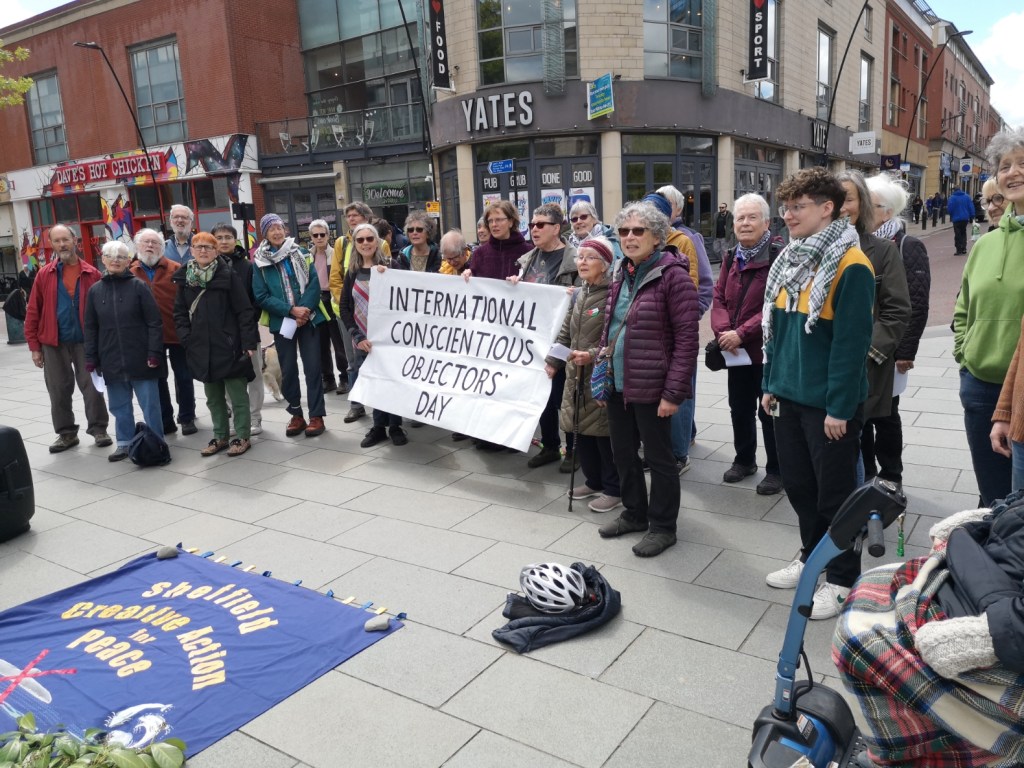
The names of some current conscientious objectors, from Russia, America, Thailand, Germany. Ukraine, USA and Israel, were read out while the choir sang the beautiful song “Tell me the names of the unsung heroes” by Jane Lewis.
To illustrate the sort of views expressed as well as the treatment that conscientious objectors are subject to today, Catherine and Jayne read out testimonies which reflect the conviction and resilience of those who choose peace over violence.
Yurii Sheliazhenko from Ukraine, a Quaker and holder of the Sean McBride peace prize, has been fighting against his conscription for over two years, but has recently been arrested and physically beaten. He is still determined to resist, however and says, “I refuse to be threatened, and I will continue my peace work with all possible means – even behind bars”
Andrii Konovalov, also from Ukraine, speaks out, “After two years of war, after hundreds of thousands of deaths on both sides, it is clear to see that armaments, weapons and war itself cannot achieve the goals of the military-minded politicians. Dialogue is the only alternative.“
Netiwit Chotiphatphaisal from Thailand, where conscription is still enforced and conscientious objection is not recognised, tells us, “I refused conscription not out of fear, but out of conviction. I reject the idea that peace must come through violence”
Kim Minhyung, a conscientious objector from South Korea, writes in his testimony, “Conscientious objection is not simply an individual’s choice, but a powerful cry and action for peace and human rights. We firmly hold onto the belief that we can resolve problems through dialogue and peaceful means, not by force.“
The moving event finished with two minutes’ silence recognising the courage of conscientious objectors past and present, and the laying of a white poppy wreath made by Sheffield Creative Action for Peace on the cenotaph. The wreath was inscribed with the words “We remember all the courageous men and women from many different countries who throughout the years have made a stand for peace by refusing to fight in the armed forces or take part in any activities which promote or enable violence or killing as a solution to conflict. We remember them all and honour them for their courage.”
And to end, the choir led the singing of a song with words by the late Margaret Meade. “Never doubt that a small group of thoughtful committed people can change the world – indeed, it is the only thing that ever has ”
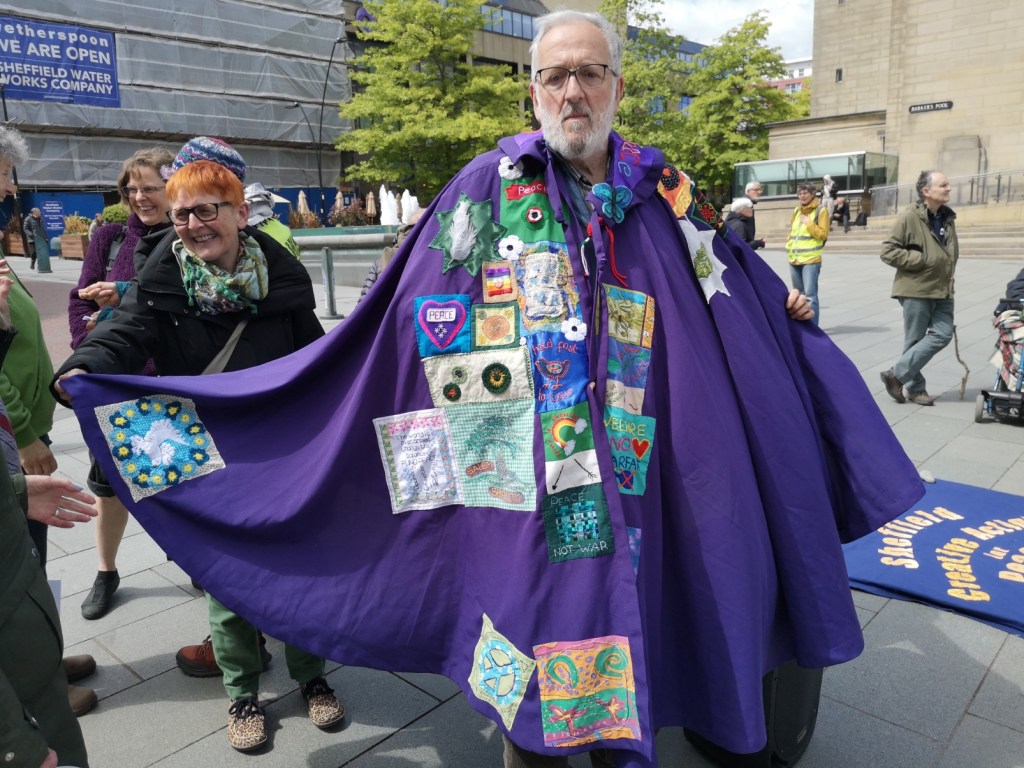
The small group Sheffield Creative Action for Peace is committed to continuing its ongoing campaign for a peaceful, safe and secure world. It has been active in Sheffield for over 10 years, using art, craft, drama and music to bring attention to actions that threaten Peace and supporting resistance to armed conflict. At present, it is creating a cloak of peace and is inviting people to make a simple patch to sew onto the cloak, which expresses their wishes for peace. To join our regular meetings or to find out how to make a patch, contact us on our Facebook page.
Discover more from Tell the Truth Sheffield
Subscribe to get the latest posts sent to your email.
