
by Dr Karine Nohr

It was not so long ago that England was fully self-sufficient for its apples. We had loads of glorious orchards all over the country with the most fantastic tasting apples.
Even in ‘the smoke’, as London was previously known by outsiders, there was an abundance of apples. As a London kid, I knew ‘apples and pears’ was Cockney rhyming slang for “going upstairs”, an expression thought to originate from the time when fruit sellers in the market would tier that abundant produce on their stall for presentation.
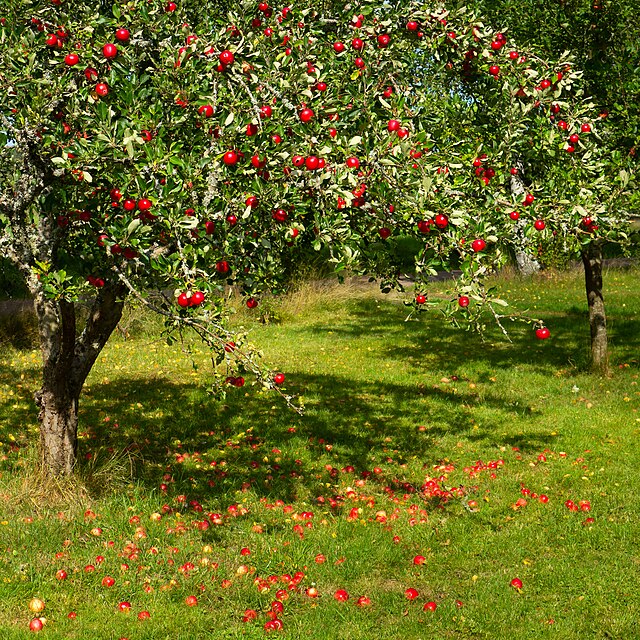
But now we import 60% of our apples, many from as far away as it might be possible to come (such as New Zealand and South Africa), which just seems gob-smackingly daft. When we consider that we used to grow all of our own apples, wasting all of those shipping containers and petrol miles to transport them to England doesn’t make sense, and they aren’t even necessarily nice when they do get here.
With other orchard fruit, the stats are even worse. Of our plums and pears, over 90% are imported. Since the early 1900s, we have lost 56% of orchards in England and Wales. In the North of England, the figure cited is closer to 80%.
In this country, we have the ideal maritime climate to grow this fruit. But orchards right across the country have been neglected or destroyed. There are a number of reasons for this, that include the climate crisis (causing extreme weather events and also the arrival of new pests and infections, in all countries), an overall reliance of importing food into the UK, (primarily and originally for commercial reasons and the fact that labour became comparatively and increasingly cheaper abroad), that agricultural land was cleared to make way for new buildings and roads, and the fact that the ‘perfect apples’, as dictated by supermarket marketing, were ‘shiny green and perfectly regular’, overtaking taste as the main criteria. Other reasons include neglect of the orchards and failure of replacement tree planting.
The loss of fruit trees on this scale is important; not only were they giving us fresh fruit, supporting wildlife and a lively biodiversity, but they were also acting as carbon sinks that we so need in this time of rising greenhouse gases.
Clearly, in striving to become more climate-resilient, self-sufficient and sustainable in the provision of food in our country, returning to growing our own orchard fruit is a no-brainer.
A Report by Forum for the Future on English Orchards ‘The Future of UK Orchard Fruit’ was published in October 2025. By speaking with stakeholders in the Orchard sector, five visions were identified for what a thriving and climate-resilient orchard sector in the UK could look like and what was needed to achieve that vision; full details are available on their website.
The first vision was that the UK needs to grow more of its top fruit to feed its people. Secondly, orchards, especially the traditional ones, should be protected and funded for their environmental and biodiversity benefits.
A third vision was that Community orchards should be more accessible and available to everyone living in the UK, offering opportunities to connect to food growing, nature, and neighbours. A further vision was that there are ample jobs and people with the skills needed to care for fruit trees and orchards of all sizes.
In Sheffield, initiatives have been started that address these visions. One of these is the Eat Trees Project, co-produced by Regather and Sheffield City Council’s Community Forestry team, and funded by The Co-Operative Foundation. In addition to this initiative being about planting trees, it’s about sowing the seeds of a more sustainable, regenerative landscape for our city and beyond.
The Project has already got quite a few achievements under its belt. It has helped hundreds of Sheffield people plant fruit trees. It has begun to plant a community orchard in Meersbrook, which will expand over the next couple of years and provide opportunities for the local community. An ‘edible tree map’, locating fruit trees in Sheffield communities, has also been produced by the Project, which will be publicly available.
The project has transformed hundreds of tonnes of apples into apple juice for the community and has been a great way to ensure that there is no waste.
Additionally, on Regather’s Farm, an ‘agroforestry demonstrator’ has been commissioned. This traditional style of land management grows crops in alleyways between the rows of trees.
Many of us, lucky enough to have gardens, may have an apple tree or other fruit tree within it. For me, my apple trees and my plum tree bring me nothing but joy. I planted both of them as baby trees (sourced from ‘Sheffield Fruit Trees’, which specialises in fruit trees unique to our city), and they have fruited the most delicious apples and plums every year.
For those interested in getting their hand in and learning about how to prune orchard trees, the Edible Tree Network (ETN) and Sheffield City Council Community Forestry Group are providing single Sunday courses in six of its community orchards (there are 2 scheduled for March in Gleadless and Beighton), and you can sign up on Eventbrite via this link.
https://www.eventbrite.co.uk/o/scc-community-forestry-20138037357
Discover more from Tell the Truth Sheffield
Subscribe to get the latest posts sent to your email.

