
by Rosalind Dean

We need to change the ways we transport ourselves, if we are to have a liveable future. Some actions can only be taken by society as a whole, so that low-carbon methods of moving people and goods become the natural choice: feet, bicycles, tricycle rickshaws, buses, freight trains. Research and development into new materials and energy sources have a valuable part to play. But as the example below makes clear, technical fixes need to be supported by our individual choices.
Steel in cars
The development of steels for the automotive industry has been a major success story. Did you know that 75% of the steel grades used today in vehicle construction did not exist 15 years ago? Engineers at the University of Sheffield have helped to develop high-strength, low-weight steels. As a result, substantial reductions in the weight of the structural body of the car have been achieved. But ….
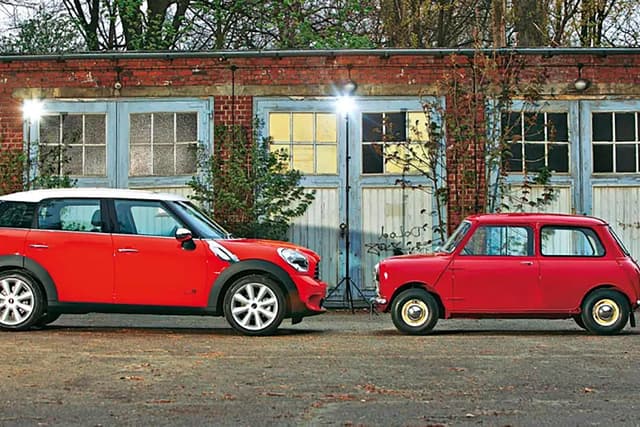
The curb weight of equivalent models of cars in Europe nearly doubled in the 40 years between 1970 and 2010. Of course, part of that is the introduction of batteries and new safety features, but mostly it is because we choose to buy bigger types of cars. The global fall in car emissions averaged around 4% between 2010 and 2022. If vehicles had stayed the same size, those emissions could have fallen by more than 30%. Apparently, car companies really push SUVs because they provide the most profit. It sounds as if we have been listening too hard to their marketing.
How we use our cars
So what does this mean for us as individuals? The first question is, of course, whether I need a car at all. Or can I car share? Try out an electric bike? Use the train for long journeys?
A second question might be, can I make do with my old car? I know that for many people their car and their driving is an expression of their personality – though hopefully not in quite the macho way the old car adverts used to show! I have been trying to enjoy my car in a different way, taking pride in the fact that I am nursing along an older car, prolonging its life with recovered body parts when the insurance declared it a write-off.
Does my sense of self-worth lie in the size and speed of my car? I can still take pride in my driving, with the skill in anticipation, smooth braking, gentle acceleration, and lower miles per gallon.
And the third question might be, if I really do need to buy another car, how small can it be? Fuel, electricity and carbon emissions are reduced; fewer tyre and brake particles pollute the air; potholes take longer to appear; it is easier to travel along Sheffield’s narrow old roads; and in the unhappy case of an accident, the risk of a fatal injury to a pedestrian or cyclist is cut.
It also means less energy and materials are embedded in making the vehicle in the first place.
Metals in our lives
Metals are a big part of everyday life. Look around your home, workplace, or streetscape. In the UK, the biggest user by far is the construction industry, followed by transport (cars, trains and planes). Steel, of course, also makes a huge contribution to renewable energy generation, as well as less desirable products like weapons. So we need to work on (at least) two levels, with individual choices and attitudes, and global strategies.
Metals production consumes about 5% of global energy and is responsible for 40% of industrial greenhouse emissions. The sustainability challenge for steel is that world consumption is projected to double by 2050, and our ambition is to achieve net-zero carbon emissions by the same date. There is research into green hydrogen, for example, but work on the design of new steels is being done in the Strategic University Steel Technology and Innovation Network (SUSTAIN). It is an academic and industrial research hub that builds on Sheffield’s centuries-old pre-eminence in steel.
It starts at the microscopic level. Amazingly, changes at the atomic scale determine properties at the macroscopic scale – what the different steels can actually do. Adding tiny amounts of niobium, vanadium, or other elements can transform the steel. This can lead to crucial improvements in tensile strength, bendability, fatigue strength and weldability, with new combinations of desirable properties. Magnesium alloys may be the “metals of the future”, improving fuel economy and reducing carbon emissions. Happily, it is also abundant, environmentally friendly and recyclable.
Future directions for metals research
To avoid a complete breakdown of our climate, we will need to be much more careful in our use of steel. Steel will be vital as we expand the renewable energy sector and create much better public transport. There are directions for research that can help with this: methods of primary production that are less energy intensive; more secondary production using scrap; better collection and sorting of scrap, especially challenging mixed scrap; better alloy design for recycling; invention of materials and technologies for sustainable alloys; increasing the life of metallic materials.
We can’t afford to waste our very limited carbon budget on producing bigger and bigger cars.
If you want to know more about the research being done at the University of Sheffield, you should be able to find the publications on this link https://sheffield.ac.uk/cmbe/people/visiting-and-honorary-staff/w-mark-rainforth
Discover more from Tell the Truth Sheffield
Subscribe to get the latest posts sent to your email.
