
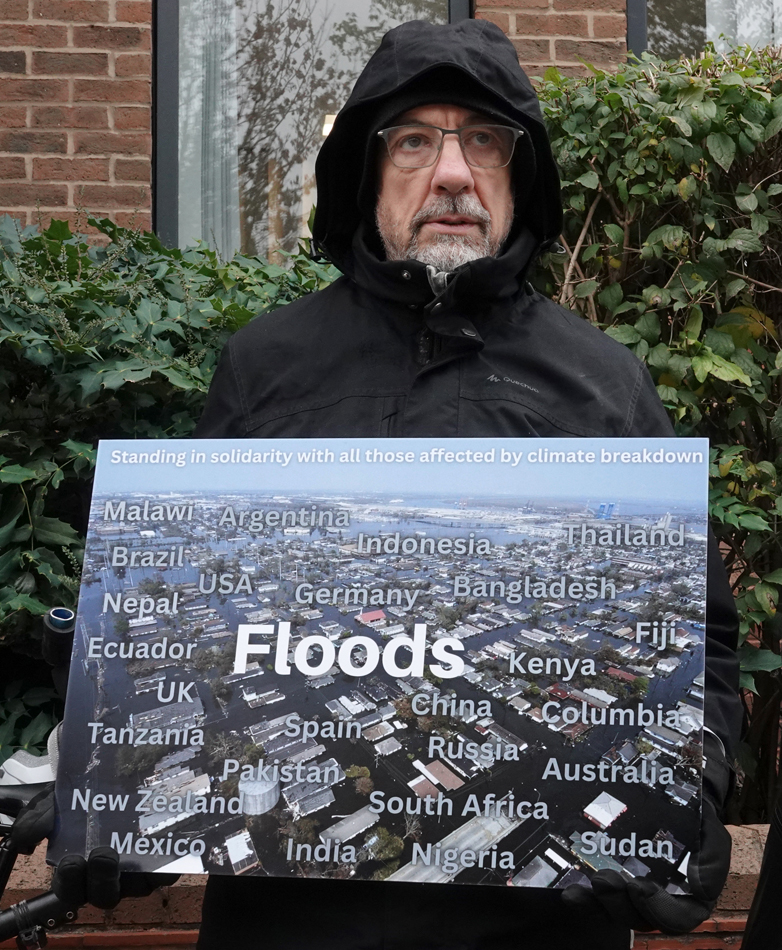
The insurance company Aviva has sometimes been in trouble with climate activists for insuring companies involved in fossil fuel exploitation. But their recent report is very helpful to the climate movement as it details the increasing risk of flooding to householders.
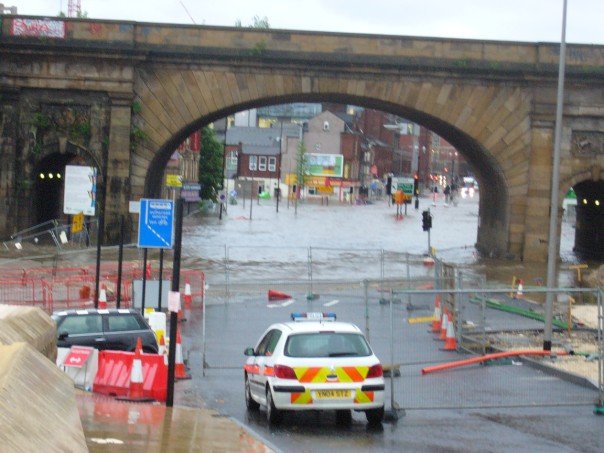
The statistics go down to the constituency level, so some quick analysis shows that
*In South Yorkshire, 1 in 6 properties are currently at risk of flooding, either from River, Coastal or Surface water. By 2050, this is expected to rise to 1 in 5 properties.
*This may sound bad, but as a landlocked county, the figures for South Yorkshire are better than most of the country. On average, 1 in 3 properties around the country will be in danger of flooding by 2050.
* One of the most threatened places in the country is Boston and Skegness, with 91.8% of properties in danger of flooding by 2050. Not far behind was Kingston upon Hull with 87.3%
*The best constituencies to avoid floods locally are Sheffield South East and Sheffield Heeley. Doncaster East, Doncaster North and Sheffield Central have the most threatened properties in South Yorkshire.
Overall, London and Yorkshire and the Humber collectively represent more than half of the top 20 constituencies affected by river and coastal flooding, highlighting that the east of England is most negatively affected.
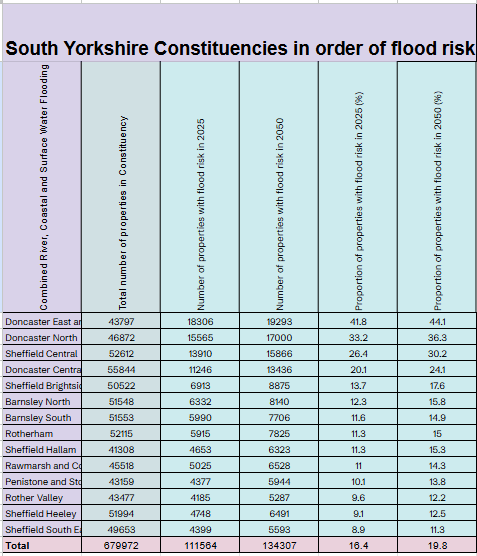
There are three different types of flood risk. Coastal flooding, which is made worse by sea level rise and winter storms, and storm surges. River flooding is getting worse because winter rainfall is increasing, and we get more rainfall in a small number of heavy events rather than dispersed rain. Surface water flooding happens when the water can’t percolate into the ground, and there isn’t good drainage, so it backs up, leading to floods.
These three sources are all getting worse. The number of households at risk is astonishing. Aviva estimates a 27% increase in the number of houses at risk of flooding in the UK, reaching 8 million properties by 2050. On top of that, another 1.8 million are at risk of subsidence from changing hydrology. Overall, that’s nearly 10 million properties at risk. Given there are roughly 30 million properties in this country, we are coming towards one in three households across the entire country being threatened by floods.
Aviva’s first recommendation is that houses shouldn’t be built on floodplains. The Guardian reported, “Over the past decade, 110,000 new homes were built in the highest risk flood zones, equivalent to one in 13 of the new homes built. Aviva calculates that if this trend were to continue, 115,000 of the government’s planned 1.5m new homes would also be in the highest-risk flood zones.” This policy is extremely short-sighted and foolish and should be the first thing the Government changes.
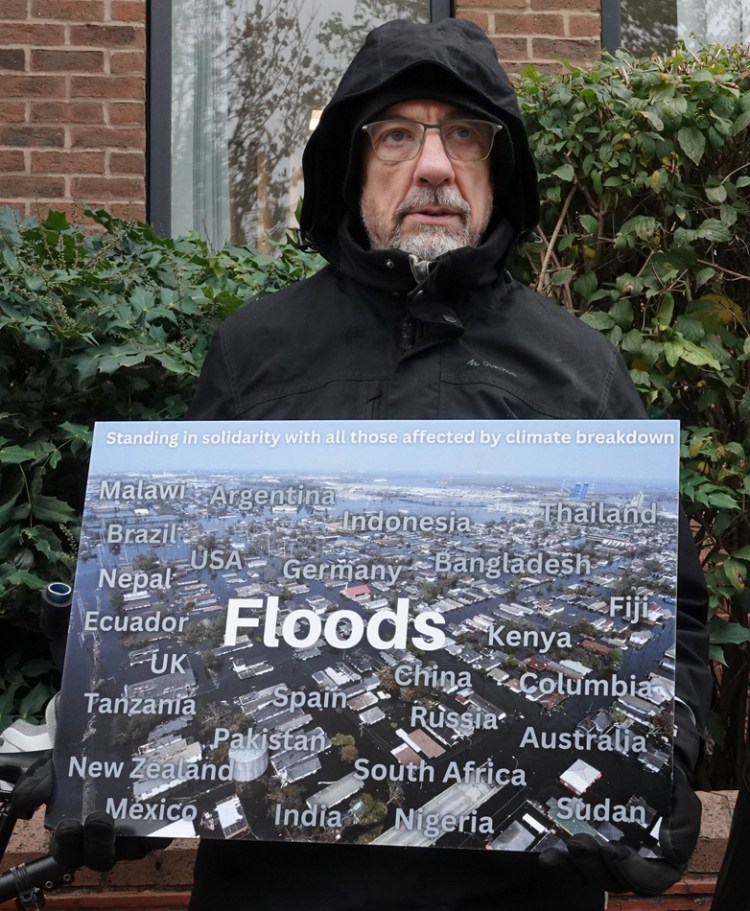
Charlie Gardener said in a podcast (see below) “There was a new housing development in King’s Lynn that my local XR group campaigned against. In the end, it was given planning permission on the basis that there is no sleeping accommodation on the bottom floor. What kind of mental process allows you to acknowledge the flood risk is so high that no one should sleep on the ground floor, yet you give permission anyway?”
The second recommendation was government support for homeowners to prepare—simple things like moving electric sockets higher up. The third was more natural engineering solutions. For hundreds of years, our approach has been hard engineering: canalising rivers to get water off the land as quickly as possible. It’s been obvious for a long time that this isn’t the best way. Instead, you need to let the land store the water. They’re calling for increased woodland creation on hillsides to absorb water and “re-wiggling” rivers. Personally, I can’t wait to see beavers reintroduced locally. They are remarkable water engineers and are great at holding the water back in the hills.
Dr Jess Neumann, associate professor of hydrology at the University of Reading, said in the Guardian, the government was not doing enough to protect people and businesses from flooding. “The future will demand more investment, more support, and more communication from the government to help prepare people for flooding, and to manage the impacts when the worst happens.”
She said traditional “hard engineering” approaches, such as seawalls, river defences and flood barriers that were still favoured in many places, needed to be supplemented by more nature-based solutions.
“We can’t keep building defences taller and higher to deal with larger and more frequent floods. Working with natural processes, such as reconnecting rivers to their floodplains, restoring wetlands, and planting woodlands to intercept rainfall, has the benefits of improving our natural environment alongside reducing flood risk.”
Some places just won’t be possible to protect, and people will notice this either as they find it impossible to get insurance for their house or are forced to leave after multiple flood incidents.
Politicians like Trump, Farage and Badenoch may tell you climate change is not a threat, but whether we believe it or not, flooding is becoming more likely. It may not bother them because if their house gets flooded they have many others to choose from. But most of us just have the one house and don’t have the finances to easily move. We have to urgently lobby our politicians to combat climate change by reducing greenhouse gas emissions as quickly as possible, as well as urging them to prepare for the increase in flooding that is already inevitable.
Further reading
Guardian article https://www.theguardian.com/environment/2025/oct/14/millions-more-homes-in-great-britain-at-risk-of-flooding-investigation-finds
Greenpeace-thousands of homes to be built in flood risk areas https://unearthed.greenpeace.org/2019/11/15/flooding-uk-boris-johnson-sheffield-yorkshire/
Star article 2019 https://www.thestar.co.uk/news/hundreds-of-homes-planned-within-flood-risk-zones-in-sheffield-1039253
Aviva’s advice on making your home “climate ready”
Tips for making your home climate-ready
As well as collective action from governments, industry and investors, residents can also take some steps to help make their homes more climate-resilient, including:
If your property is in a high flood risk zone, consider:
- Raising electrical sockets in higher-risk areas of the building.
- Fitting non-return valves on toilets.
- Installing flood gates and self-closing airbricks to avoid water getting in.
- Ensure your garden has suitable drainage to help absorb surface water and choose more permeable materials for hard surfaces, such as gravel or block paving. Avoid using fake grass, which can make it more difficult for water to be absorbed.
If your property is in a high subsidence risk zone, check that:
- Trees and large shrubs are planted at a safe distance from the property, are pruned regularly, and ideally planted with lower water demand species.
- There is no water pooling near your home’s foundations and keep drains clear and operational.
- If you are considering renovations or extensions, consider a structural survey to evaluate soil types and groundwater conditions and design your works accordingly.
If your property overheats during hot weather:
- Install internal and external sources of shade that keep the heat out without the need for electric-powered cooling. These include blackout blinds, external window shades, use of planting and installation of solar-reflective films, many of which are suitable for both homeowners and renters.
Discover more from Tell the Truth Sheffield
Subscribe to get the latest posts sent to your email.
