
by Dr Karine Knor

In 2019, supported by all Parties, the Government declared ‘a climate and ecological ’emergency’. But any ‘emergency’ response has been woefully inadequate. When we compare this to the time of the Covid pandemic, also declared as a public health emergency, a year later, and we remember the Prime Minister’s recurrent ‘address to the Nation’ alongside ‘experts’, the difference in response to the two ‘emergencies’ appears even more stark.

And yet the consequences of the worsening climate emergency will be not only will be far greater than the pandemic but also are increasing year on year: the deaths, the ill-health, the crop failures, the severe weather events, the impact on the seas, the extinction of species, are all increasing, and we have now exceeded 6 out of 9 of our planetary boundaries.
So an integrated, unfiltered account of the risks and solutions, by leading experts in the field, to form the baseline for a national conversation on the Climate and Nature Emergency, is well overdue. On November 27th, a National Emergency Briefing was held in Central Westminster Hall. Expert briefing topics included food security, national security, climate and energy, energy transition, nature, health, economics and tipping points. The intention was to cover ALL the issues that need to be on the table. An independent audience represented science, politicians, business, faith and nature. Problems in all the different fields were shown to intersect, so, for example, extreme weather events impact both land, agricultural workers ability to work, crops, which then affect food security, supply chains and people’s incomes. Similarly, links are evident across the board, affecting multiple systems in cascading and catastrophic ways. The economists pointed to the enormous financial cost of not doing enough to deal with the climate crisis: for example $10,000/second is lost to extreme weather events attributable to climate change. We are already committed to a 20% loss of the global economy in the next 20 years or so. If we don’t make some radical transformational changes, we may lose 50% of the global economy. Acting now is far more cost-effective than delaying action. Specific studies have estimated benefit-cost ratios for adaptation investments ranging from 2:1 to 10:1 or higher.
Hugh Montgomery, NHS Professor of Intensive Care Medicine in London (so a specialist on dealing with medical emergencies), presented on the impact of the climate crisis on health and healthcare.
He commenced with outlining his response to a critically ill patient in hospital, how he might respond with candour, advice and information on what can realistically be done in an emergency situation, but also with immediate and genuine action, not just words.
He then referred to the Lancet Countdown on Health and Climate Change, which maps 20 indicators of health hazards of the climate crisis every year.
The Lancet is a prestigious, long-standing, independent, peer-reviewed, international medical journal publishing high-impact medical research to influence healthcare policy and practice globally.
The 2025 report of the Lancet Countdown exposes a world in turmoil. Climate change threats to human health and survival continue breaking concerning records, while delayed—and oftentimes reversed—actions exacerbate the threats on health and survival.
People worldwide are facing extraordinary climate change health risks. Of the 20 indicators monitoring climate change-related health risks, 12 (60%) reached unprecedented levels in the latest year of data. Reference to unhealthy food systems contributing to the growing harms to both land and people was also made.
In addition to the financial cost of inaction, the Report warned that delayed climate action is costing millions of lives. Causes include Heatwave exposure, air pollution, water security, food security and infections. The direct health impacts of climate change are compounded by socioeconomic impacts. For example, weather-related extreme events caused over $304 billion in global losses.
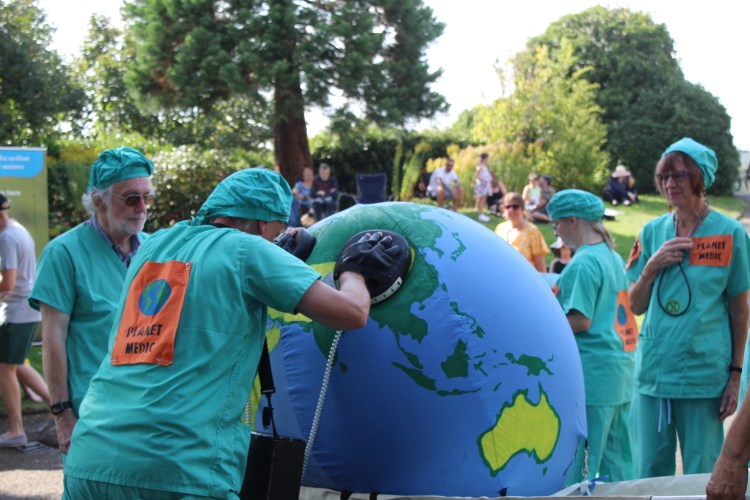
However, the Report also highlighted opportunities: countries that are taking action see health and economic benefits, showing that accelerated health-focused climate policies, rapid fossil fuel phase out and adaptation investment offer a “lifeline” to prevent worse impacts and improve wellbeing. Food systems need major transformation, shifting towards plant-based diets that reduce emissions and combat food insecurity, transport needs a transformation into good, affordable, clean, reliable public transport and support of active transport, away from individual car ownership, and lastly, we need to integrate Health in climate decision-making and empower local action to create a healthier and more resilient future.
In essence, the Report serves as a stark warning about inaction but also a blueprint for how urgent, health-led climate action can save lives and build a healthier world.
Professor Montgomery finished his presentation with the following words: “Is this an emergency? IT IS AN EMERGENCY! Now, it is an emergency, and it requires treating as such. This is no longer a risk. Without action, these impacts are certainties. And the hazards are catastrophic. If we take action, we might survive ….. If we do not, the outcome is absolutely certain. So, I leave you with this thought. The climate emergency IS a health emergency and it’s about time we started treating it as one”.
Please sign the open letter asking for a televised national emergency briefing for the public so that the public is properly informed, at https://www.nebriefing.org/open-letter-keir
Discover more from Tell the Truth Sheffield
Subscribe to get the latest posts sent to your email.
