
A guest blog by Darcy White
Last month Sheffield-based scholar/activist, Ci Davis, went to Oslo for the ISEE-Degrowth Conference 2025. I spoke to him about this experience and what he thinks it could offer Sheffield. Degrowth has emerged to explore much needed system change at a time of environmental emergency and deepening inequality. I began by asking Ci to outline what degrowth is.

“There are several different descriptions of degrowth, but the one we’re using is the downscaling of production and consumption, to reduce ecological footprints, planned democratically, in a way that is equitable, while securing wellbeing for everyone.”
“Degrowth can deal with the present crises because it understands that the planet is able to provide for people; the resources are there, they’re just not distributed in a way which allows many people to have a good life. This can be changed, but if we don’t change it, then the trajectory is for severe climate catastrophe, conflict, war, and ruined lives.”
Why did you go to the conference?
“I’ve been studying degrowth, as an online degree, and I thought it would be useful to find out what happens at these conferences because I think it’s very important that we develop something in Sheffield.”
“The conference was quite diverse. A lot of people are looking at degrowth in an academic way; they’re trying to understand society, and what it is that growth offers and what the problems are. However, degrowth started as a grassroots movement, and it’s not always called degrowth; it has many manifestations. I learned so much from people who are engaged in degrowth practices.”
Why is degrowth important at this time?
“Every time there’s a report on economic growth, on the radio, tv or in a newspaper, there’s a buzz of excitement if it’s gone up by 0.1%, or there’ll be doom and depression if it’s fallen by 0.1%. Politicians of all parties seem convinced that the only way to solve the problems we face is through economic growth.”
“But anyone looking at how Western society has functioned for the past 15 or 20 years, will notice that there has been very little growth. So, if that isn’t working, then we really need to explore alternative ways by which we can improve the lives of ordinary people.”
“But politicians continue to push the growth button harder and harder whilst abandoning important objectives, such as keeping Net Zero alive, investing in renewable energy systems, looking after people with the winter fuel allowance or by putting money into the health system. Under the current economic system all these things are sacrificed if economic growth isn’t high.”
“Yet the system continues to protect the wealth and assets of a very, very small number of people. So, degrowth is about looking at how you reallocate resources, wealth and opportunity, in ways which fundamentally create much better community well-being and happiness, which is rarely produced through relentlessly pursuing consumption.”
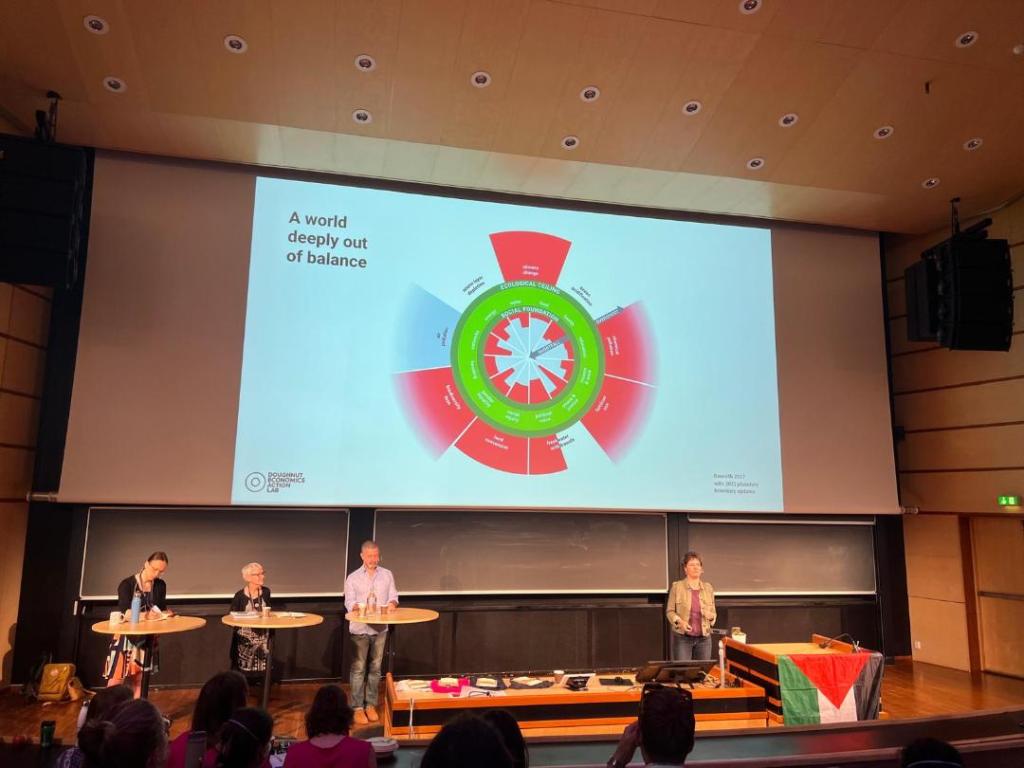
What do you think the conference achieved?
“A conference is designed to bring people together to discuss ideas, and to develop new initiatives. One of the aims of this conference was to discuss the question of whether we have lost our focus on building with grassroots movements and trying to put degrowth ideas into practice. The degrowth movement has probably overemphasised its academic work and neglected some of the early work that was done on building alternatives to the existing society. So, people are coming together and thinking about ways in which we can build back in community.”
What solutions are being considered?
“The basic premise of degrowth, is different from mainstream environmentalism which talks about efficiency and transitioning from carbon intensive fuel to renewable energy. Degrowth recognises that even renewable energy is highly dependent upon resources and supply chains for critical minerals, which are based upon extraction and exploitation of people in other countries.”
“Degrowth offers something called ‘sufficiency’, which doesn’t mean you degrow everything. You grow some things quite a lot and you get rid of many other things. It asks: what is it that we really need? We need affordable good housing, insulation and renewable energy, nutritious food, healthcare, public transport, access to digital technologies, and so on. But we need all these in a way that is compatible with the environment.”
“In this scenario our iPhones are not replaced every year or two, they’re built to last, they’re built to be repaired. We do not need private jets. We don’t need SUVs. We don’t need advertising. And fundamentally, we don’t need to spend all our lives working just to consume more.”
“So degrowth is about sufficiency for everyone, which can only work if you rethink the way in which society operates.”
What needs to happen now?
“We need to reassure people that they don’t need to fear what degrowth offers. Politicians don’t want to engage and that is so frustrating because there is a necessity to respond to the predicaments we face. There is so much at stake and degrowth offers real solutions. It is often considered niche and idealistic but that is a misconception. This must change. We need more people advocating for degrowth so that our leaders start to open their minds to its potential.”
Local group contact: degrowthslowdown@gmail.com
Discover more from Tell the Truth Sheffield
Subscribe to get the latest posts sent to your email.
