
A guest blog by Ci Davis

Councillors have adopted ‘Sheffield’s Growth Plan 2025-2035’, endorsing Cllr Tom Hunt’s Foreword to the report that states, “strong and sustained economic growth is the route to Sheffield being a more prosperous City”. This is not surprising, there is an assumption that economic growth means progress or well-being, and all recent governments have linked growth with prosperity, as Rachel Reeves stated, “by growing our economy we can rebuild Britain and make every part of the country better off”.
Presenting growth as ‘commonsense’, implying something that must be normal, natural and good, like an acorn that grows into a mighty oak, to provide a shady spot to shelter on a summer’s day. Applying this idyllic image to something as dull as the economy creates an illusion of something equally desirable, but which then constrains policy. Economic growth is prioritised over funding winter-fuel payments or raising the two-child benefit cap. If the cost-of-living crisis forces people to choose between eating or heating, growth is sold as the solution. Building affordable homes, achieving Net-Zero, and funding public-services, are presented as growth dependent. This need not be true.

Growth is defined as an increase in the total value of production of all goods and services in a geographical area. Everything produced is considered of equal value, because value is measured as money, so it does not matter if it is destructive, such as weapons, or socially useful, such as public-transport, so long at the total amount, expressed as Gross Domestic Product (GDP), increases. This is why the Council, by emphasising the most profitable forms of production, want to attract Boeing, Rolls-Royce and McClaren over more socially beneficial companies.
GDP does not measure things that are not traded, so it does not recognise the scarcity of land, energy or resources, nor the cost to the environment of waste and pollution; so, exceeding the earth’s limits, and causing damage, such as climate change, is acceptable. As value increases when input costs are low, growth will always seek to reduce wages, and the social costs of reproduction, activities like childcare and housework, are not valued so families do that work, for free, after long working days. Growth therefore produces inequality, organises how we live and work, and is destroying the planet.
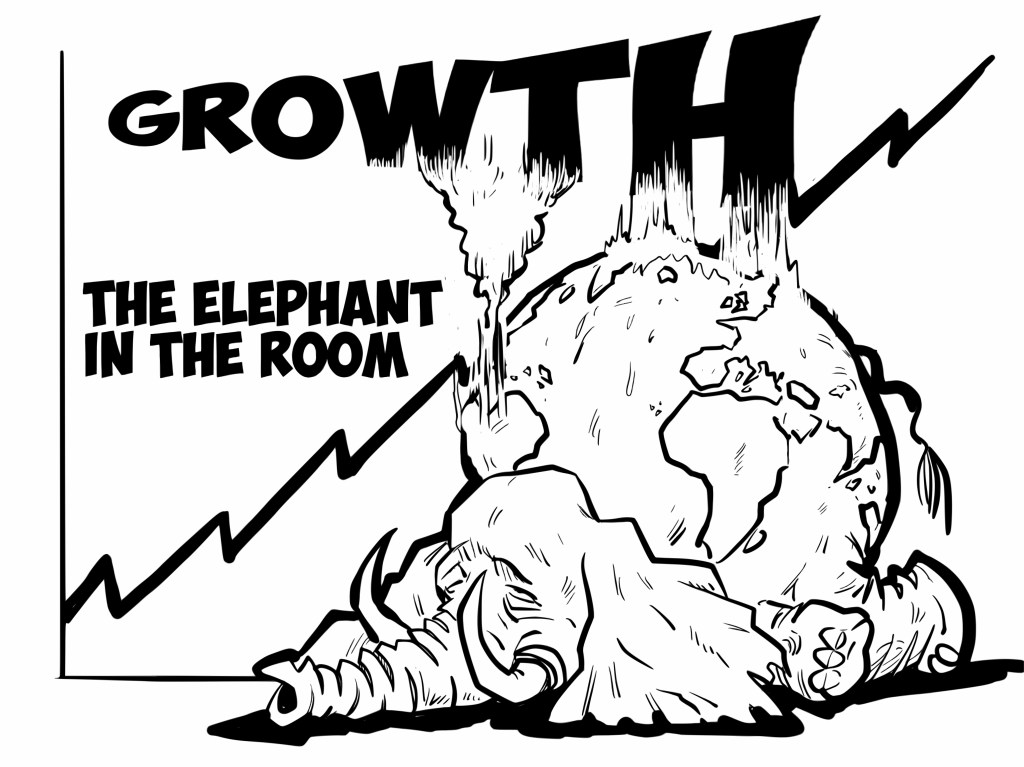
It was not always the case that growth has been the economic priority, in fact it only became measurable in the 1930s, and did not become an objective until the 1950s; before then full-employment or social stability were more important. However, after WWII the ‘never had it so good’ era of high economic growth, saw the development of the welfare state and real material gains in living-standards for working-class people; this cemented the ‘construct’ of growth as this natural and good objective to be pursued.
Furthermore, Keynesian policies of state intervention over profit-maximising private capital, saw the rich taxed at up to 90%, to redistribute wealth for public good and greater equality. This suggests that a growth-fuelled golden age, to be ‘rediscovered’, may not be necessary, and decades of austerity and low-growth figures demonstrate it is probably not possible.
For the past 50 years neoliberal economic policies have been followed, and inequality has increased ever since, which makes the suggestion that growth produces ‘prosperity for all’ clearly nonsense. Oxfam exposed the myth, calculating that the richest 1% have captured almost two thirds of the value of increased GDP since 2020, twice as much as the remaining 99%! Very few people gain from economic growth, and then only to a limited extent; it does not resolve inequality, and beyond a certain income level contributes little to well-being.
That makes sense, as GDP is a measure of the monetary value of stuff, but prosperity is not the same as the stuff we own. If GDP increases with rising childcare costs, which forces parents to work longer hours, that is not something that makes parents more prosperous. Things that are not measured are clearly important to people, like how many children are in a classroom, how easy it is to get a doctor’s appointment, or the loss of greenspace. By connecting growth with money, and linking money to prosperity, limits other ways of thinking about what is important, such as time with family, community, or access to nature.
Continued growth is not good for the planet either. Since 1950 the economy has become 8 times bigger, and if allowed, will become 8 times bigger again by 2100. Energy and material use is tied almost 100% to GDP, and advanced countries already consume more than four planets worth of resources. Human produced stuff weighs more than every living thing on the planet. Commonsense suggests this cannot continue.
There must be massive reduction of emissions and social inequality in the next 10 years, but growth as the means to achieve prosperity may be neither desirable nor possible. GDP was never intended to measure prosperity, and actual measures of well-being are now used by cities like Amsterdam, which suggests Sheffield Council’s reluctance to think creatively is narrowminded. Having exposed the ‘elephant in the room’, a longer discussion should be held about what sort of growth is needed, to offer a life worth living and to protect the planet.
Find out more
Sheffield Growth Plan: Growing a vibrant, cultural and creative Sheffield
Sheffield City Council Plan 2024-28
Sheffield Star: Council approves 10-year ‘Sheffield Growth Plan’ to unlock city’s economic potential
Don’t miss a post from Tell the Truth Sheffield! Subscribe for free today.
Sean Ashton responded with this letter to the Telegraph.
Dear Editor
Many thanks to Ci Davis (Telegraph 19th Dec) for pointing out how ludicrous our Government and Council’s obsession with economic growth is. Economics should learn from nature. Most things in nature grow, but then reach maturity, reproduce and eventually die. Things that don’t stop growing, like cancer, are always bad news.
The aim for our economic system should not be trying to grow for growth’s sake, as this will inevitably mean increased exploitation of our planet, destruction of nature and use of our atmosphere and oceans as a dustbin for our waste gases, plastics and other pollutants. Our rapidly changing climate is a red flashing warning sign that this must urgently stop.
What we should be aiming for is a steady state economy, where we no longer have to exploit nature or our fellow humans, where inequality is minimised, and where public goods like libraries and transport are valued more highly than private possessions and waste is re-used or recycled to provide the raw materials needed for manufacturing. A measure of happiness would be much better than the blunt instrument of Gross Domestic Product which just measures how much we spend.
Sean Ashton
Discover more from Tell the Truth Sheffield
Subscribe to get the latest posts sent to your email.

2 thoughts on “Sheffield City Council Gambles on Economic Growth to Produce Prosperity”