
We must talk to the kids about the birds and the bees say a couple in a cartoon. The next panel shows a desolate landscape and the parents saying “Birds and bees used to fly in the sky…”.
It’s not easy talking to young people about the many crises our planet is facing and that is true for both parents and teachers. That is why books that tackle this subject are so important. Read on for a great offer for your school or library!
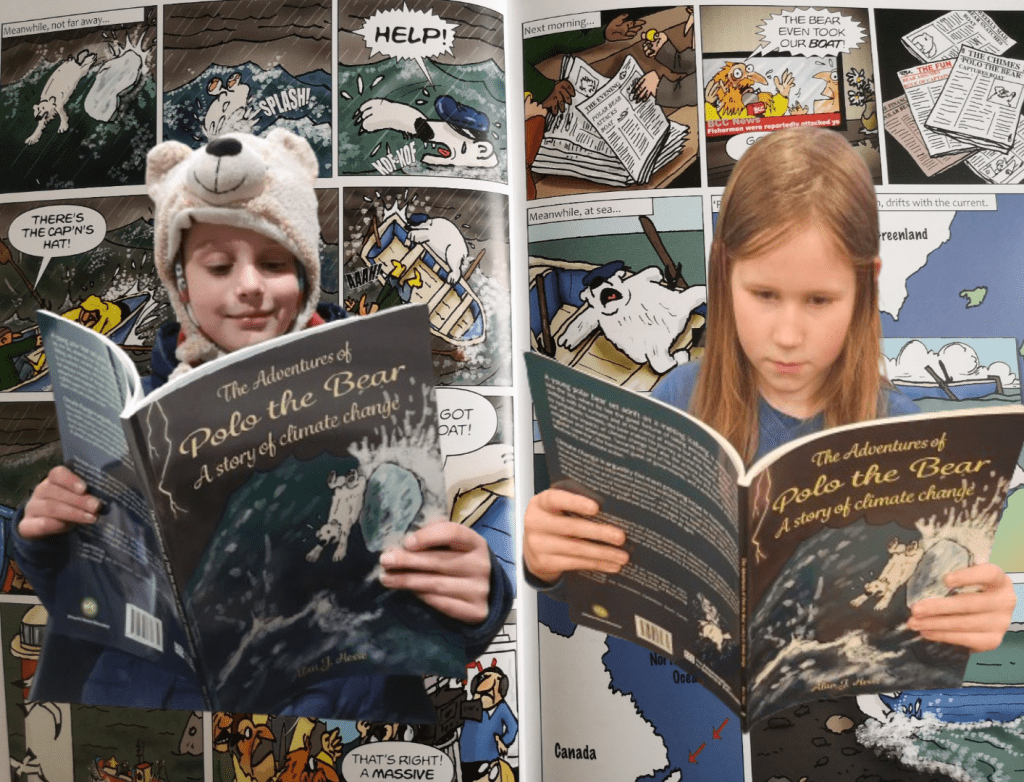
Alan J Hesse has written a graphic novel called Polo the Bear about a polar bear that finds himself floating south from the Arctic on a tiny iceberg. The book is aimed at older Primary and younger Secondary pupils. The author is a conservation biologist based in Ecuador who believes in the value of reuniting art with science, to render technical information more engaging accessible and fun.
I asked some of the 9-year-olds in my life what they thought of the book. Neighbour Orlaith, who goes to Manor Lodge School says “I liked that book because it shows how humans are impacted by climate change. Not just humans- it shows how animals are impacted too. Her favourite bit was when Polo went to see the children and talked to them about Climate Change which she thought was clever. It shows what you can do for nature and how we can avoid pollution. She liked the fact that many humans are working hard to prevent climate change.
My Granddaughter Maya said her favourite part was when Polo took the Captain’s hat and rowing boat from the fishermen at the story’s beginning. She already knew quite a lot about climate change but was surprised to find out that coral reefs are dying. Polo meets a research scientist near the Marshall Islands who is monitoring how bad the bleaching is. The flooding of the small island states made her sad. As sea levels rise it is the smallest islands that will be submerged first.
Polo’s journey takes him to the Panama Canal and Columbia, from Peru to the Galapagos Islands and the Marshall Islands, through China to Bangladesh and India, then across the Indian Ocean to Kenya and Uganda, up the River Nile through Sudan and Egypt, then across the Mediterranean to Sicily and France before finally ending up in London. Everywhere he goes, he learns more about climate change, its effect on the local people and what we need to change to avoid the worst. The maps help us understand where in the world we are in this adventurous travelogue.
Captain Polo’s adventure blends fun and education and delivers key concepts about climate change in an accessible and engaging manner. Through Captain Polo’s journey, young people gain a deeper understanding of what climate change means. Technical terms are explained clearly, and the graphic novel format makes complex topics easy to grasp.
Through Captain Polo’s thrilling journey, readers are entertained and encouraged to think critically about environmental responsibility and how their actions can make a difference.
In the book, Polo meets some famous people, including the Dalai Lama, Barack Obama and Leonardo di Caprio as well as not-so-famous people that our media usually portray as statistics, like the refugees trying to cross the channel and the Indigenous Peruvians whose potato crop has failed. Sometimes Polo’s conflict resolution techniques leave something to be desired, but, after all, he is a Polar Bear! I hope, if there are future adventures, Polo will get to meet the bosses of the Oil and Gas Corporations and Banks that finance them. There is always a danger that young people will put too much emphasis on personal changes to their lifestyle, when what is needed most are systemic changes, starting with the oil and gas corporations who must stop producing fossil fuels.
Alan Hesse says “You can’t sugarcoat what’s happening. Children need to understand the basic science of climate change and how it affects the earth’s weather patterns, globally and locally. Secondly, children need to understand that there are solutions and that people are already working on them. Part of these solutions are also adaptation, so children must realise that everybody is not in the same situation as they are, whatever that might be. There are many people around the world working actively to mitigate climate change and adapt to it. Thirdly children do want to know about the solutions and how they specifically can become a part of that solution.
School’s Climate Education South Yorkshire (SCESY) has collaborated with the author Alan J. Hesse and has acquired over 500 copies of his book. They are now in storage at Learn Sheffield. If your school or library would like a copy please get in touch with Learn Sheffield or SCESY and arrange to collect one for free! Email enquiries@learnsheffield.co.uk or phone 0114 250 7417 or admin@scesy.org.uk.
SCESY’s next schools conference will take place at the AESSEAL Stadium, Rotherham, on March 20th 2025. Please do urge your school to sign up to express their interest in attending. If you are a teacher, your school can express interest directly by emailing SCESY.
Here Alan explains more about his graphic novels.
Would you like to make your own comic about climate change? Here Alan the author explains how.
Discover more from Tell the Truth Sheffield
Subscribe to get the latest posts sent to your email.
