
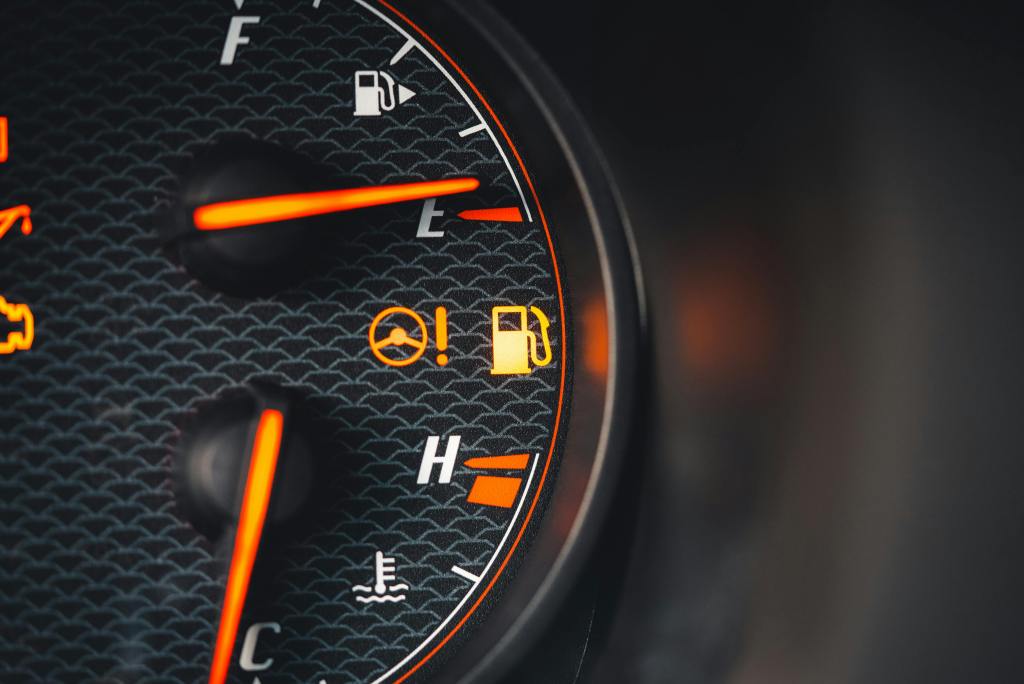
“I’ve passed my driving test!” shouts Charlie as he jumps into his second-hand Porsche and heads for the M1. He wants to put his foot down and see how fast it can go. Soon Charlie notices a red light on the dashboard, but he has no idea what it means not having read the manual. It’ll probably go away soon he thinks to himself. But then another light flashes up and another. But Charlie isn’t in the mood to stop, he’s got to the motorway and can now put his foot down…
How do you think this scenario is going to end? You probably think Charlie is an idiot but this is exactly what our economic system is doing with our planet! Let me explain.
Scientists such as Johan Rockstrom have identified nine Planetary Boundaries. These are conditions on Earth that we must not exceed if we are to continue living on a habitable planet. They are a bit like the warning lights on a car. When they are exceeded it is vital that action is taken-they can’t be ignored. Transgressing any one of these planetary boundaries could destroy our civilisation as we know it.
There are nine planetary boundaries.
- Climate change which is heating our planet at an increasing rate, faster than scientists expected.
- Biosphere integrity is about how the atmosphere, oceans, ecology, rainforests, and weather interact with each other. For instance, scientists are very worried about changes to the Gulf Stream and the Atlantic Meridional Overturning Circulation which keep the climate in the UK mild.
- Biogeochemical flows are the cycles of nitrogen and phosphorus essential for plant growth. Heavy use of fertilisers and nitrogen emissions by factories mean they leak into water bodies and disrupt the nitrogen cycle. Pesticides move through the environment in a variety of ways, including through the air, water, and soil, and can be transported by particles. These movements can cause environmental damage and expose non-target plants and animals to pesticides.
- Land-system change such as converting forests to agricultural land impacts the planet’s cycles and biodiversity.
- Freshwater use-we have a limited supply of freshwater, from rivers, lakes and groundwater. We must not consume too much.
- Introduction of novel entities. These are substances that humans create or introduce into the environment that can have disruptive effects on the Earth’s system. They include Synthetic Organic Pollutants, Radioactive materials, Genetically Modified Organisms, Nanomaterials, Microplastics, Forever Chemicals and Modified life forms.
- Ocean acidification which endangers coral reefs and ocean life.
- Atmospheric aerosol loading which is pollution by dust, smoke and haze.
- Stratospheric ozone depletion is the loss of the Ozone Layer which protects us from the sun’s radiation. Many thought this had been fixed when the Ozone layer recovered following bans on CFCs in sprays and fridges. However, there are now concerns that other chemicals are depleting the ozone layer.

(Credit: Azote for Stockholm Resilience Centre, based on analysis in Richardson et al 2023.) Attribution: CC BY-NC-ND 3.0
So if the planet had a dashboard, these would be the 9 warning lights. How many of them are already flashing red? Six! (And possibly seven according to the most recent report.)The first six items in this list are boundaries that have already been crossed, with the warning light flashing and beeping to get our attention and make us turn off at the next service station. But Governments and Corporations are ignoring these warnings, and as UN Secretary General Guterres said “We are playing Russian Roulette with our planet and we need an exit ramp off the highway to climate hell. And the truth is we have control of the wheel.”
Since the ice age, Earth has enjoyed relatively stable conditions for 4 million years. This period of time is known as the Holocene. Humans have now changed conditions on Earth so much that we are moving into a new unstable era, a new geological epoch, called the Anthropocene. Our job is to alter human behaviour so we can get back to the safe conditions of the Holocene before this becomes irreversible making our planet uninhabitable.
Currently, the problems that are causing this are usually addressed as if they were separate issues, e.g. climate change, biodiversity loss, or pollution. This approach ignores how they affect each other and how they may cause sudden dramatic changes to our planet’s systems. Planetary boundaries create a framework that considers the state of the Earth system as a whole.
Earth System Scientist Will Steffen said, “We are now hitting the ceiling of hard-wired processes that regulate the state of the functioning of the entire Earth system.”
This weekend is your chance to speak up for nature, which is being decimated as we transgress the planetary boundaries. The Sheffield Restore Nature Now March will be meeting at the arch in Norfolk Heritage Park at 10.30am on Saturday 28th September. We will be highlighting that 70% of the populations of invertebrates have been lost in the last 70 years. One million of 8 million known species are at risk of extinction in the next decade.
We must not give up. We can turn this round. But we all need to work together if we are going to manage it. We urgently need to change the media, who ignore, dismiss or belittle these threats. (The Sheffield Telegraph is very unusual in printing articles like this). We need to educate our politicians and business leaders to make them realise all these threats are connected and must be acted on together. And we need to take those responsible for pushing our planet outside its safe operating space to court because they have endangered all our lives. More of this in future articles.
Find out more about Planetary Boundaries
Planetary Health Check
https://www.planetaryhealthcheck.org/planetary-science?
Guardian
Earth may have breached seven of nine Planetary Boundaries
A 90 minute discussion on the latest Planetary Boundaries science.
Science Advances Research Article
Earth beyond six of nine planetary boundaries
Stockholm Resilience Centre
This letter appeared in both the Sheffield Star and the Telegraph
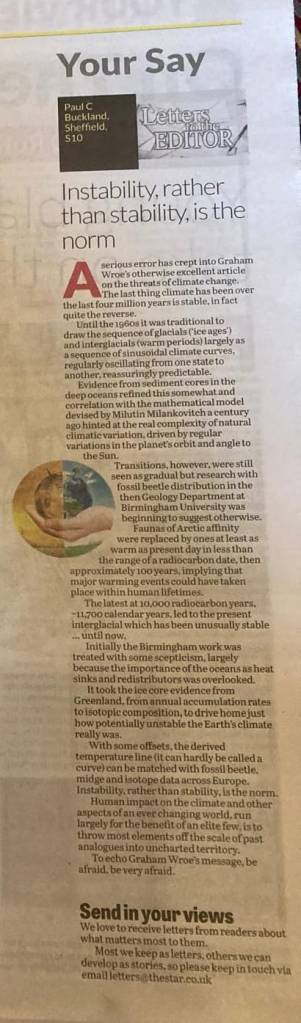
Here is my reply
Dear Editor
Many thanks to Paul Buckland for pointing out that the climate has always changed. My article in the Telegraph does not dispute that. It says that since the last ice age conditions on Earth have been relatively stable. As Paul rightly points out, these conditions are now coming to an end due to the human impact of burning fossil fuels.
Where I disagree with Paul is that I don’t want people to be very afraid. Fear causes paralysis and lack of action. Or worse it causes people to blame others, such as refugees who are also victims, not the cause of this problem.
Instead, I want people to become extremely active by joining protest groups, lobbying MPs, influencing the companies and organisations they work for and getting political, supporting candidates that take the climate emergency seriously. We need to build up our local communities so we are more resilient before extreme weather hits us. We need to grow more of our food, be better prepared for emergencies by learning first aid and basic healthcare, harvesting our water and generating our renewable electricity. We should be on a war footing, doing everything we can to get ready. But we are not because the media and many politicians still fail to accept what science is telling us.
Many years ago as a Boy Scout, my motto was “Be Prepared”. Now is the time to prepare for the difficult times ahead.
Discover more from Tell the Truth Sheffield
Subscribe to get the latest posts sent to your email.

3 thoughts on “Earth’s dashboard is full of red flashing lights.”