
Now all the ballot boxes have been safely stored away, what do the election results mean for our Environment and Climate? Is it good news or bad news?
Let’s start with the good news. The Green Party succeeded in winning all 4 of their target seats, so there will now be 4 MPs who will always put the Climate and Nature Emergencies at the top of the agenda. I can’t wait to see what they will achieve.
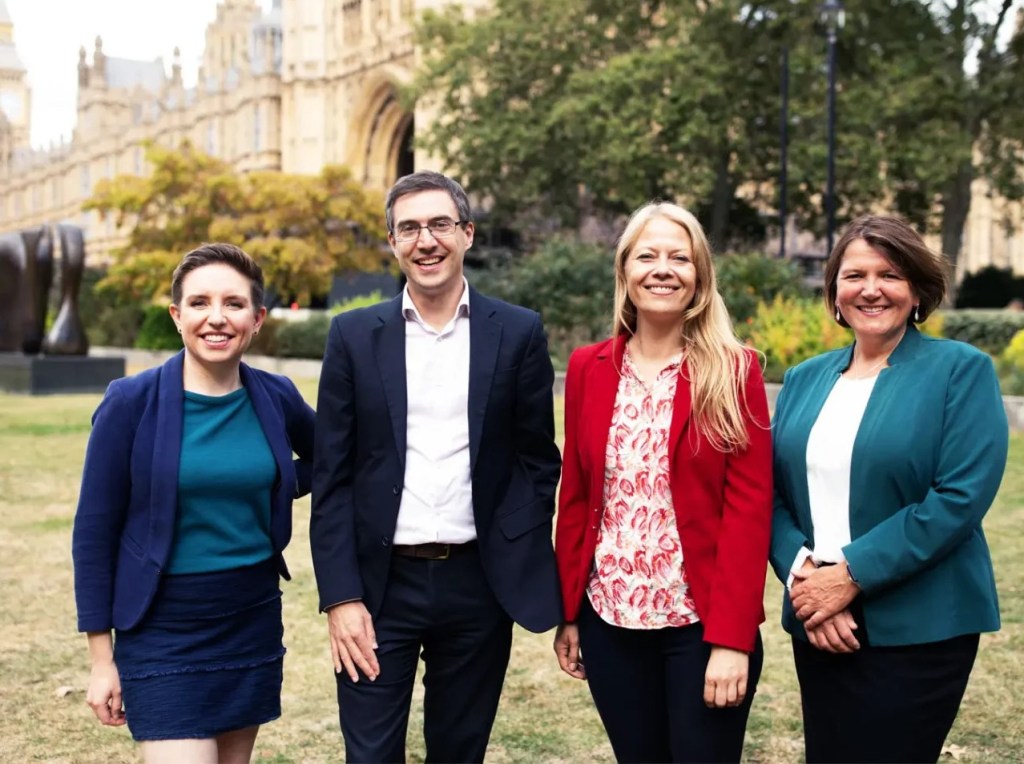
Sadly Caroline Lucas has retired from Parliament after 14 years as the sole Green MP. She is moving on to concentrate on her new role as an end of life doula. Her extraordinary service to Parliament, people and planet will be sorely missed but she leaves a fantastic example for the new MPs to emulate.
It’s also good news that some MPs who were more concerned about oil companies’ profits than protecting people and planet have lost their seats. Conservative Steve Baker lost. He is a Trustee of the Global Warming Policy Foundation, the secretive lobby group that defends the oil industry and tries to discredit climate science. He set up the Net Zero Scrutiny group to push back on Net Zero policies. Also evicted from the commons is Conservative Jacob Rees Mogg. Best known for lying down on the green benches, he was referred to Parliamentary Watchdog for not declaring his Directorship at Somerset Capital which invests £5.4million in Fossil Fuels. It’s also good that Liz Truss was defeated. £100,000 of her leadership bid was funded by former BP Executive Fitriani Hay. Locally it is good news that Miriam Cates lost her seat because she always voted against measures to avert climate change. The Commons will be much better without the awful influence of these fossil fuel backers.
Three local MPs could be important in advancing the battle against climate change.
Re-elected MP for Hallam Olivia Blake re-introduced Caroline Lucas’s Climate and Nature Bill in the last parliament. This has overwhelming support from everyone concerned about climate change and the alarming decline in nature. The Campaign “Zero Hour” explains the bill as follows.
● the crises in climate and nature are deeply intertwined, requiring a plan that considers both together.
● ensures UK emissions are reduced rapidly, for the last chance of limiting warming to 1.5°C.
● reverses the decline in nature—setting nature measurably on the path to recovery by 2030.
● Takes responsibility for our overseas footprint—both emissions and ecological.
● Prioritises nature in decision-making, and ends fossil fuel production and imports as rapidly as possible.
● Ensures no one is left behind—through fairness provisions.
● Giving people a say in finding a fair way forward through a Climate & Nature Assembly, to bring the public along with the unprecedented pace of change required.
The bill will need re-writing including greater urgency as as we have already reached 1.61°C of heating above the 1850-1900 pre-industrial average. I hope Olivia Blake will be tabling this bill again and persuading her colleagues to make it law soon.

Louise Haigh, re-elected MP for Heeley, is the new Transport Minister. She is enthusiastic about buses and wants to bring them back into public control. We have to improve our bus services if we are going to start to persuade people to leave their cars at home and use public transport. The environment movement will be backing her all the way on this one. Not so good is Louise is also a strong backer of Airports and HS2. New airports will be strongly opposed by environmentalists because we urgently need to reduce flying to reduce emissions. The abandoned HS2 scheme was a disaster for nature and people living on the route. Louise should prioritise electrifying existing routes, and improving connections between the northern cities as well as championing Active Travel.

Doncaster North MP Ed Milliband is the new Secretary of State for Energy Security and Net Zero of the United Kingdom. He has a massive task implementing Labour’s Energy Policy. At last, we have a Government with strong ambition to invest in renewables and I am just hearing on the news that they have lifted the ban on-shore wind turbines. But the best way to save energy is not to have to need it in the first place. That is why investment in insulating homes should have the greatest priority. This takes people out of poverty by reducing bills, creating jobs, reducing emissions and also keeping homes cooler in heatwaves. Ensuring all new homes have better energy efficiency and solar panels should be next.
Unfortunately, there is still lots of support for fossil fuels in Parliament. We now have 5 Reform MPs. Reform portrays itself as a party of the people, but it is 92% funded by fossil fuel interests, climate science deniers and highly polluting industries. People need to understand that this party will always put the interests of fossil fuel companies first. This also explains why Reform gets so much more media attention than the Green Party.
Some Labour MPs are problematic. Graham Stringer was re-elected and is a Director of Climate Denying lobbying group Global Warming Policy Foundation. Re-elected Tory MPs such as Claire Countinho and Rishi Sunak have clear links with the oil industry. Sunak’s family firm Infosys signed a $1.5 billion deal with BP days before announcing new oil and gas licences. Re-elected Priti Patel was responsible for clamping down on peaceful protests.
Economist Richard Murphy is not confident about the prospects of the new Government. Why? Kier Starmer’s priorities are increasing growth and wealth creation. We live on a finite planet that’s already suffering from a fever. Richard says “We know that it has been the pursuit of economic growth that has burned resources and produced vast amounts of carbon that has created this outcome. And yet Keir Starmer and Rachel Reeves are pinning their hopes on growth. In a world where we know that this is not going to work, I am baffled as to why they want to do that.”
The second Labour priority is wealth creation. But as Richard Murphy explains this always leads to increased inequality. It is time to narrow the gap between rich and poor, not widen it, so we need more progressive taxation and wealth taxes to fund the improvements so desperately needed for our public services and to tackle the climate and nature emergencies. Labour needs to learn this very quickly!
Discover more from Tell the Truth Sheffield
Subscribe to get the latest posts sent to your email.
