
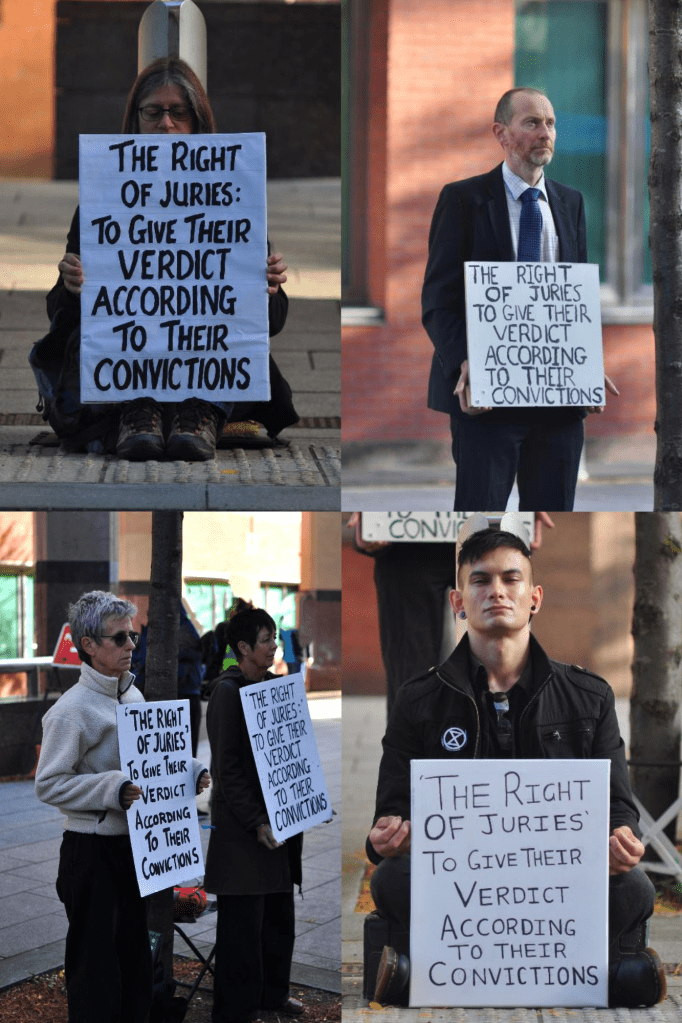
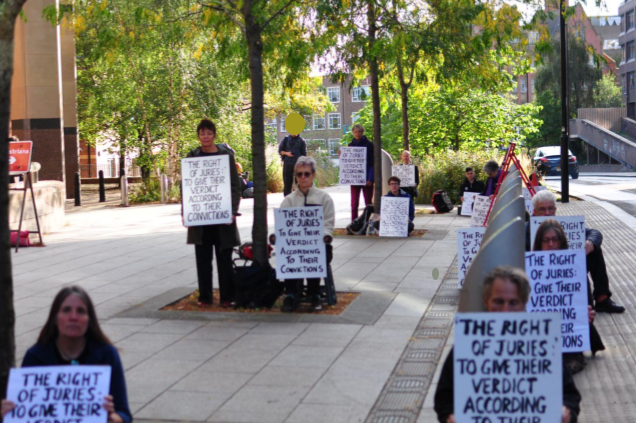
Fourteen very brave protestors risked arrest outside Sheffield Crown Court on Monday, September 25th. It was part of a national campaign to defend our juries. (see defendourjuries.org for more information). They all held signs reading ‘The right of juries: to give their verdict according to their convictions’.

What’s it all about? In the past, some juries have found protestors not guilty, not because they didn’t do what they were accused of, but because the jury agreed the actions were justifiable in order to prevent a greater crime or injustice. The context and motivation for the crime are always vital in such cases. They include those who
- toppled the statue of the slave trader, Edward Colston into Bristol harbour.
- defaced Shell’s Headquarters to protest at the company’s sustained cover-up of the effects of fossil fuel emissions;
- blocked the M4 to demand action on fuel poverty and climate breakdown;
- intervened to prevent violent deportations to Jamaica
- protested at Elbit who manufacture drones that kill Palestinians.
But more recently judges have prevented protesters from explaining the motivations for their actions in court. Changes have been introduced into some court proceedings and are being used to limit the amount of information provided to a jury. These include:
- banning those engaged in campaigns of political resistance from explaining their motivations and beliefs to the jury;
- disallowing or ignoring relevant evidence and witnesses (including expert testimony as to the Government’s failure to act on the scientific advice);
- telling the jury that motives, even if articulated, are irrelevant and must be ignored;
- sending people to prison just for using the terms “climate change” and “fuel poverty” in court, banning references to a jury’s right to acquit a defendant as a matter of conscience;
- arresting and referring for prosecution those who remind jurors of their right to make decisions on their conscience;
- directing the jury that defences such as necessity, proportionality or reasonable excuse are not available and limiting the time to present a defence to 15 minutes.
Often motivation makes all the difference to a verdict. Think about crime dramas you’ve watched where the jury has to decide if it is murder or manslaughter. This is particularly true for court cases where protesters have deliberately committed a crime, made no attempt to hide what they have done and waited for the police to arrest them in a desperate attempt to bring attention to a much bigger crime such as ecocide or genocide.
How can a jury apply their conscience to the evidence if they’re prevented from hearing why a defendant did what they did? And how can they exercise a right if they don’t know they’ve got it?
Trudi Warner, 68, stood outside a trial of climate activists in March, allegedly holding a sign reading “Jurors: you have an absolute right to acquit a defendant according to your conscience.” She was arrested and has been referred to the high court for contempt of court, which could lead to a 2-year prison sentence.
In light of these developments, Michael Mansfield KC, one of the country’s leading barristers, has said: “Jury trial is the jewel in the crown of the criminal justice system in the United Kingdom and has to be preserved and protected. The right of a jury to return verdicts according to their ‘convictions’ and ‘consciences’ has been enshrined since the trial of two Quakers in 1670 – William Penn and William Mead. It has been memorialised with a plaque in the Old Bailey. No defendant and no defence counsel should be prohibited from referencing this paramount feature of our system.”
In Sheffield, as well as holding signs which stated the law, a letter was passed to judges at the Crown Court, which set out the history and right of juries to act on their conscience. People at the protest were from a variety of backgrounds including health, IT, arts, social work and education.
Jenni Crisp from High Storrs said, “It’s really important that juries understand the full context for people’s actions, and are then empowered to act on their conscience.”
Heather Hunt said “ Juries are being guided by the judges that a defendant’s motivation is irrelevant when considering whether a defendant is guilty or not guilty. In no way am I perverting the course of justice. The right for juries to base their judgement based on their convictions is carved in stone outside the Old Bailey. So I am holding this placard today so that jurors are reminded of their rights, whatever the cases being heard today. I am proud to be part of this action alongside more than 300 other people, up and down the county, outside Courts of Law.

Janice Brown said, “When our freedom to protest is threatened in these ways, I feel it is my duty to take action to protect our rights.”
Izzy Price said, “I am here today because the right to protest is being deliberately eroded by the current government. Some judges are directing defendants not to speak about their motivation for their actions. How can a jury make a just decision if they are prevented from hearing the truth, the whole truth and nothing but the truth?”
Discover more from Tell the Truth Sheffield
Subscribe to get the latest posts sent to your email.

One thought on “Fourteen brave protesters risk arrest at Sheffield Court to defend juries.”